

12 questions for the center-left
The center-left offers an alternative to both the left and the Democratic “establishment.” But it’s losing influence — and struggling to define itself.


Here at Silver Bulletin, we’ve frequently critiqued President Trump, the Democratic “establishment”, “Resistance Libs”, the left, the “tech right,” and the Republican Party. What’s missing from that list? We’ve had less to say about the political tribe that I at least vaguely belong to myself: the center-left.
How does one define the center-left? Well, that isn’t entirely straightforward. As Matt Glassman writes, “moderation” is associated with a cluster of attributes, including but not limited to: centrism, pragmatism, independence, willingness to compromise, obsession with “electability”, comparative optimism about the status quo, liberalism, and a preference for more complex, technocratic approaches toward governance. These aren’t entirely synonymous with one another and some elements can be in tension.
But put a pin in that for now; we’ll come back to it later. Because there’s a more pressing question: is the center-left at risk of losing its influence — even dying out, becoming the Blockbuster Video of politics1? For a cautionary tale, you need to look no further than the center-right, which has been almost completely hollowed out, with most of the public intellectuals who once occupied that space either having become Resistance Libs or joining the Trump Train.
The death of the center-right didn’t come all at once. In fact, Republicans reacted to the failures of George W. Bush by nominating John McCain in 2008, probably the closest thing to a truly independent-minded presidential nominee in the modern era.2 But having the misfortune of inheriting Bush’s mess amid the worst financial crisis in 75 years, McCain lost to Barack Obama by more than 7 points. Mitt Romney then fended off the Tea Party in 2012, but also lost to Obama.
The repeated failures undoubtedly contributed to Trump’s rise to power. Trump zagged toward the populist, anti-immigrant right when the RNC “autopsy” after 2012 had recommended zigging toward the center — although he also pledged to protect Social Security and other entitlement programs, avoiding some of the most unpopular parts of the Bush-Romney agenda.3 Trump openly criticized all three of Bush, Romney and, of course, McCain. (“He’s not a war hero. He’s a war hero because he was captured. I like people that weren’t captured.”)
The center-left could find itself in a similar predicament. According to statistical measures of their Senate voting records, Joe Biden wasn’t really a centrist in the same way that McCain was. (Biden has always been much more of a loyal partisan, for one thing.) But Biden did win the 2020 nomination, helped by a cluster of endorsements and perhaps a “flight to safety” among voters as COVID hit American shores. Biden’s nomination came against literally more than two dozen alternatives, many of whom mistakenly assumed that Bernie Sanders’s strong performance in 2016 against Hillary Clinton heralded the rise of the left wing.
But maybe those candidates were just premature, not wrong. Although Graham Platner’s implosion was a setback for the left, they’ve been flexing their muscles in races from New York City to Colorado. And according to Gallup polling, the share of voters who describe themselves as “moderate” has fallen from 43 percent in 1992 to 33 percent today. Within the Democratic Party, meanwhile, self-described liberals now outnumber moderates almost 2:1.
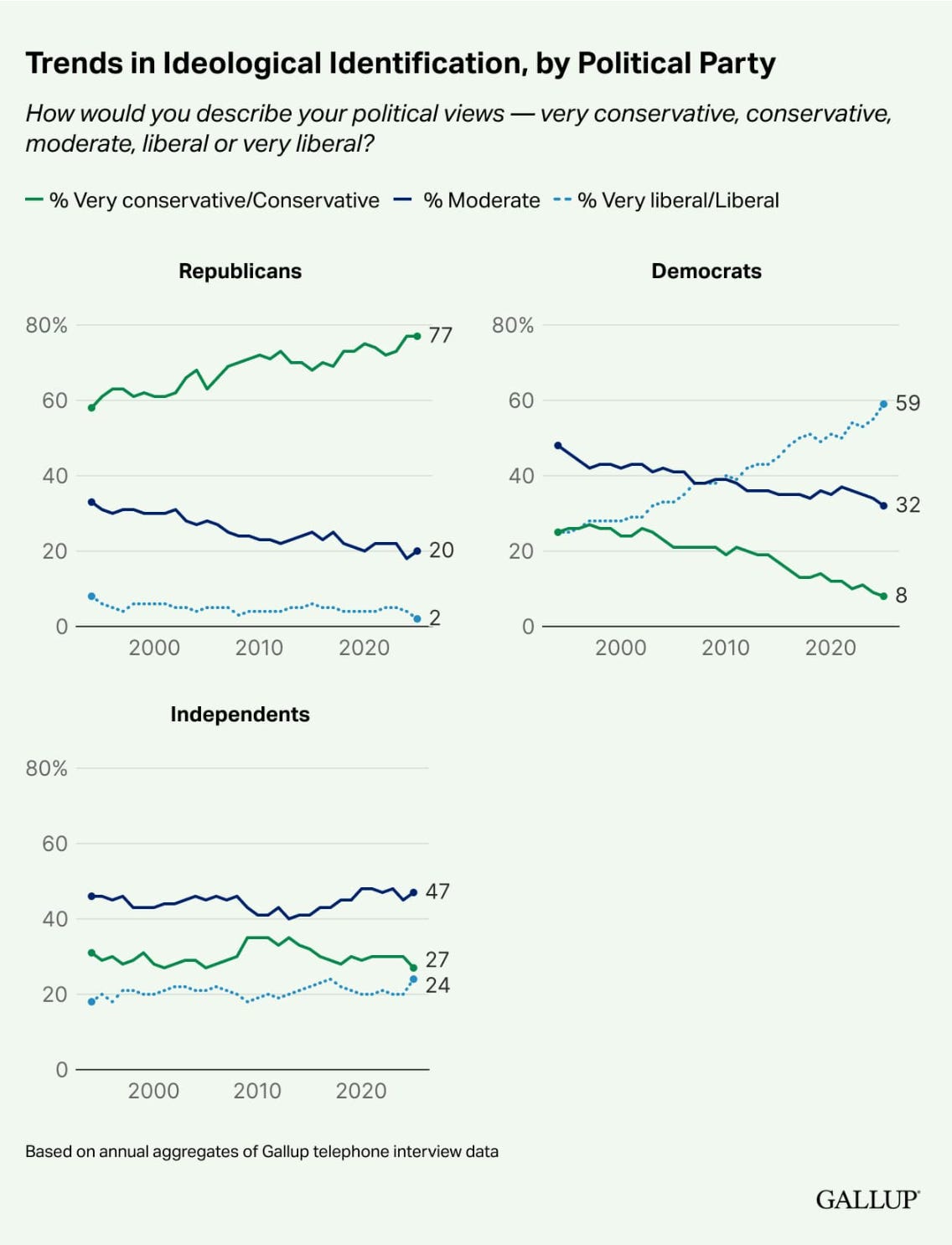
These trends come despite the fact that, in the same Gallup polling, far more voters describe themselves as “independent” than ever before, with both major parties being deeply unpopular.
This puts the center-left in an awkward predicament. Voters might want independence from the major parties. But they don’t necessarily want more moderation; in fact, they are more willing to experiment with more radical approaches. However, the parties themselves are as partisan as ever, and social media tends to reinforce those orthodoxies. (So does Substack: Silver Bulletin is the only newsletter in the U.S. politics Top 10 classified as non-partisan by independent researchers.) Excessive partisanship may drive away moderates — but if they exit the primary voter pool, that only makes the remaining voters in the Democratic primary electorate even more progressive and partisan. Outnumbered in the Democratic Party, but having little in common with the MAGA-fied version of the GOP, the center-left is at risk of becoming politically homeless.
The center-left is losing the argument about why Democrats lost in 2024
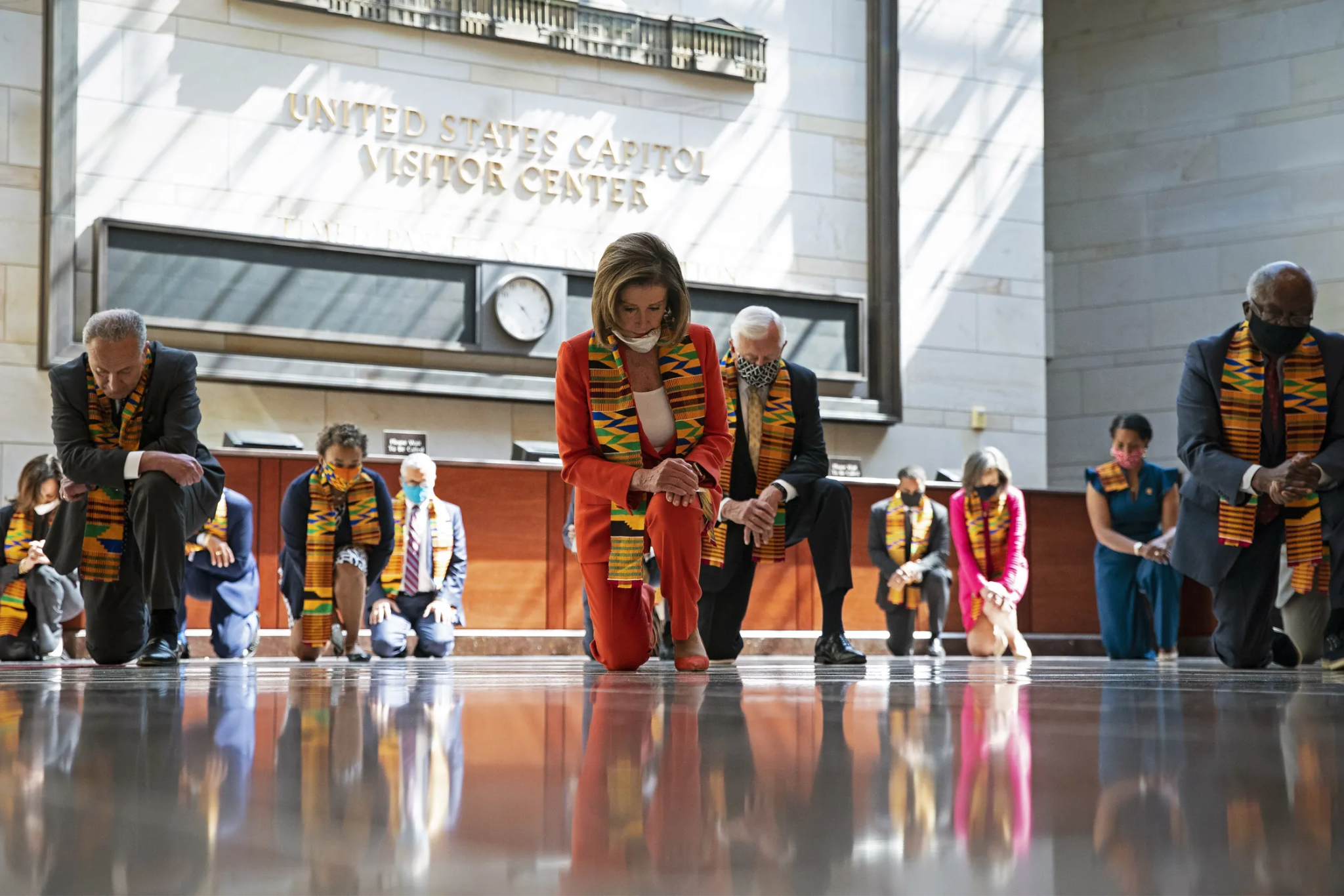
What’s more, the center-left risks being associated with the failures of the Democratic Party establishment — when, from a center-left standpoint, the problem was really the opposite: that the establishment moved too far to the left. More specifically, that Biden, despite his moderate reputation, was far too deferential to the progressive staffer class and “the groups”, particularly on immigration and on stimulus spending. Meanwhile, Kamala Harris and the rest of the Democratic Party couldn’t escape the shadow of Peak Woke. Remember this?
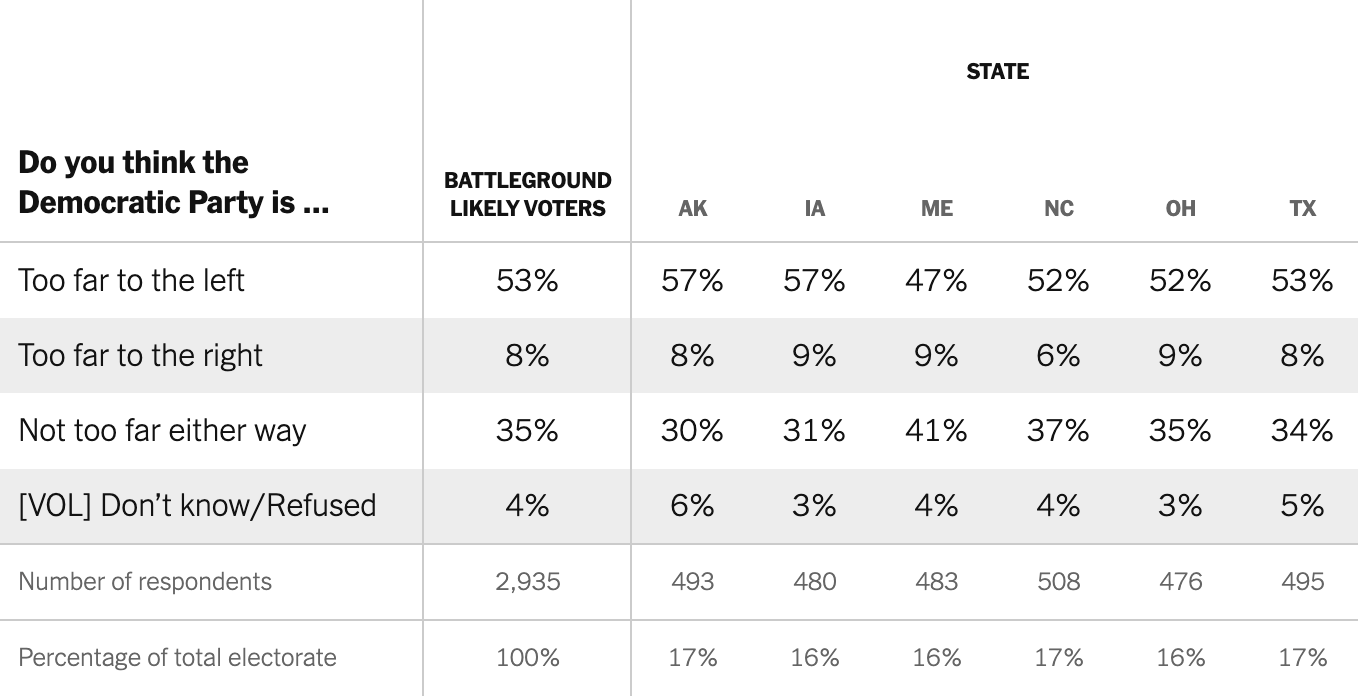
“Hopium” and motivated reasoning about public opinion don’t help either, as Democrats and the cosmopolitan, coastal news media are prone to mistaking the views of their most vocal opinion leaders and the most enthusiastic primary voters for those of the rest of the electorate. In a series of New York Times polls of key Senate races earlier this month, one that projected Democrats to come up slightly short of the four seats they need to flip the Senate in November, 53 percent of voters said that the Democratic Party was too far to the left, as compared to just 8 percent who said they were too far to the right.4
But Democratic primary voters, like Republican ones, increasingly occupy a separate universe. The Yale Youth Poll recently asked voters to select the more important issue for their vote from a randomly selected pair of 30 issues. Among all voters5, Israel/Palestine only tied for 25th out of 30 issues, winning just 28 percent of head-to-head “matchups”.
But among self-described “extremely liberal” voters, Israel/Palestine won 45 percent of the time. Gay and trans rights also got huge boosts. These differences are likely to be even more profound among the most politically active voters, to the point where views toward Israel have increasingly been a litmus test in certain Democratic primaries.6
Even if the media is overstating the importance of flashpoints like Israel and trans rights, enthusiasm matters a lot, and the center-left’s pet issues — affordable housing, I guess? — don’t tend to appeal to people’s passions in quite the same way. Turnout is overrated in general elections, but very important in primaries. In the primary in New York’s 10th Congressional District, where Brad Lander ousted incumbent Dan Goldman in a race with a heavy emphasis on Israel, just under 84,000 people voted out of a population of 750,000. That’s reasonably high by New York standards, but still only 11 percent of the population.
5 ways to define the center-left
Maybe the center-left can attribute some of this to bad luck. Still, making excuses is never a winning strategy in politics. And part of the problem is that the center-left may face an identity crisis. There are several different frameworks that you might use to categorize it.
First, you can describe the American political landscape in terms of partisanship. This chart of the voting record of Diana DeGette — a mainline progressive Democrat who was recently defeated by a DSA-backed challenger in her Colorado primary — categorizes all members of Congress from liberal to conservative based on their roll-call votes. In this conception, there isn’t really a center-left or anything in the center at all. Instead, the center-left is absorbed within the Democratic Party mainstream.
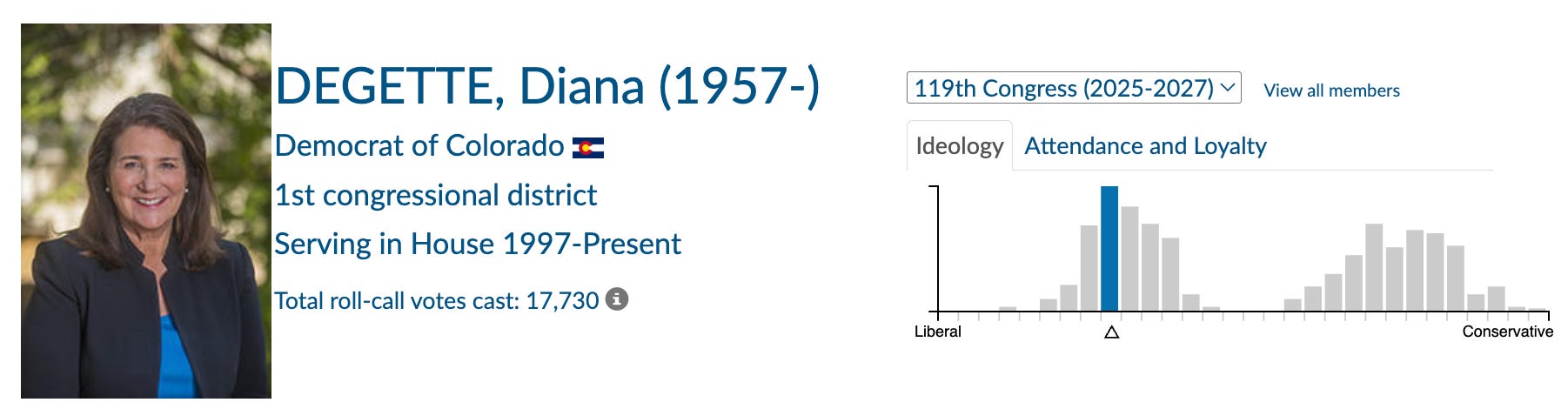
Actually, I lied. You can find one truly centrist Democrat: Jared Golden of Maine’s 2nd Congressional District:
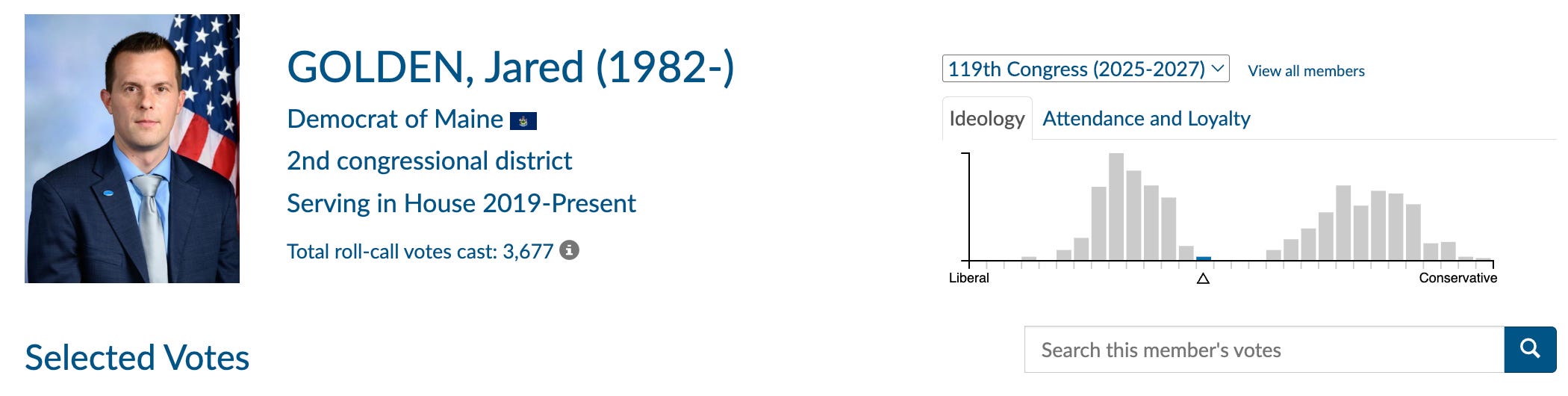
But guess what? Golden, who has massively overperformed partisan baselines in his district, announced his retirement in November when faced with a primary challenge from Matt Dunlap, the Maine state auditor who is significantly to his left.7 That the Democratic Party is moving to the left doesn’t mean that the overall electorate is. In fact, that’s what you’d expect if centrists exit the coalition and so the coalition shrinks.
If you survey voters rather than looking at voting records in Congress, there is more of a middle — people who are “cross-pressured” between different views. Swing voters aren’t a myth. But their numbers are in steady decline amid ever-increasing partisanship. There’s no particular reason for a voter’s views on say, abortion, Gaza and taxation to be correlated with one another, but in a system with two extremely entrenched parties, they increasingly are.
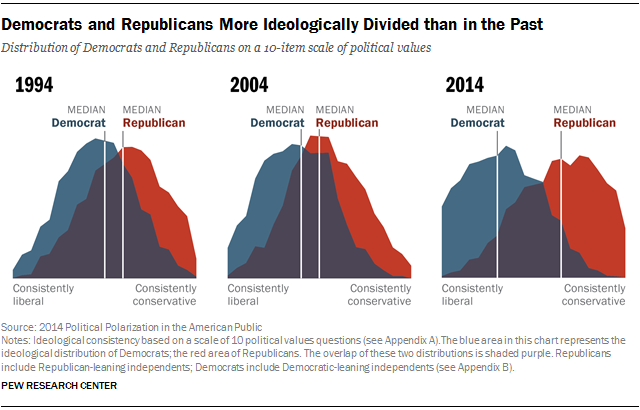
A third alternative is to view the center-left as one of three major factions within the broader Democratic Party coalition, as I did in my story on Heather Cox Richardson that distinguished three groups:
The Left
Resistance Libs
Abundance Libs
In this conception, the Democratic establishment is largely associated with the Resistance Libs and not the more centrist-leaning, pro-growth Abundance Libs. Even as polls show the Resistance Libs becoming increasingly discontented with their party, they tend to be highly defensive of Harris and Biden and convinced that they didn’t beat Trump because Democrats don’t “fight” hard enough.
But this framing isn’t common in mainstream media coverage of the Democratic Party. Instead, most news outlets treat “liberal” and “left” as synonymous, and many Democrats dubiously characterize candidates like Harris and Gavin Newsom as “centrist”.
A fourth approach is to set the parties aside and look for underlying ideological clusters, as I tried to do in my 2023 story on liberalism. That post defined “liberal” in a more European sense in opposition to the progressive left — not the way the term is usually applied in the United States. In other countries, liberalism is defined by its advocacy for individual rights, the rule of law, and a market-based approach to economics. (Though many liberals prefer a mixed economy and varying degrees of redistribution later on.) In this conception, liberalism is a separate third thing and a distinct ideological tradition that doesn’t fit neatly into the left-right spectrum.
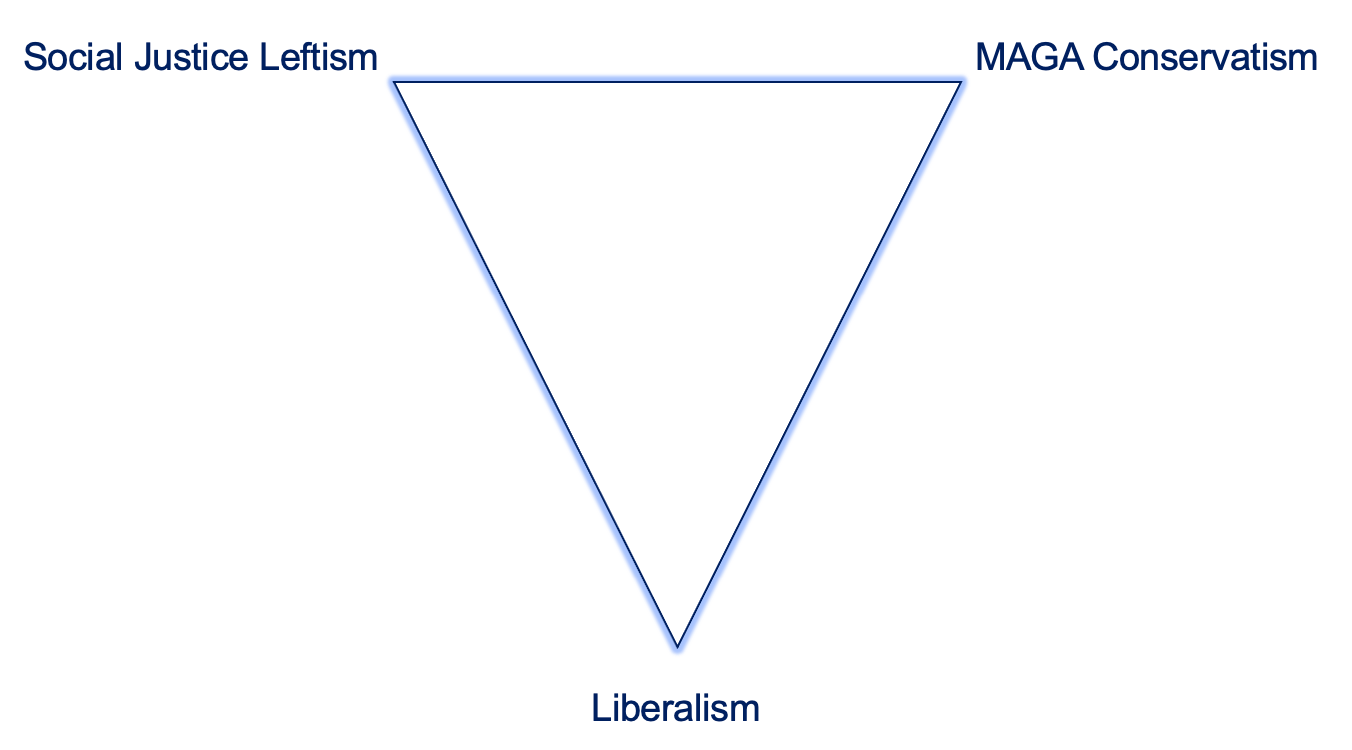
My 2023 post now reads as slightly dated. The term “Social Justice Leftism” was my clumsy euphemism for the woke left — which I argued had some decidedly illiberal characteristics such as only lukewarm support for free speech. Still, there are things I like about this ideological triangle. I like that it recognizes liberalism as a separate and, in fact, philosophically well-grounded view rather than an ad hoc set of compromises and edge cases.
The triangle also helps to explain why both the Democratic establishment and what remains of the non-Trump Republican establishment find themselves in awkward positions. The Democratic establishment is trying to straddle the left and liberal traditions, but is increasingly struggling to hold the coalition together. The center-right, as we’ve said, is in even worse shape.
Finally, you could conceive of the U.S. as a parliamentary system. In Europe and other Western democracies, you can basically identify five major ideological clusters:
🔴 Labor/Social Democrats
🔵 Conservative/Tory/Christian Democrats
🟡 Liberal/Center-Left
🟣 Populist/Right-Wing/Nationalist
🟢 Green/Socialist/Hard Left
Yes, in the European tradition, the party colors are typically reversed from the convention in the United States, with left-leaning parties being red and right-leaning parties blue. And you can debate the semantics of exactly how this would map onto the United States.8
The important thing is that in this conception, liberals have their own party, rather than being part of Labo(u)r. However, this comes at a cost: they usually aren’t all that many voters’ first choice, especially in countries with strong polarization. In the United Kingdom, for instance, the Liberal Democrats have about 11 percent of the seats in Parliament, and that’s actually a recent high-water mark that resulted in part from the profound unpopularity of Tories and Labour. The real energy these days is often more in the extremes, like Marine Le Pen’s National Rally or Britain’s Reform UK. The liberal parties, however, do tend to play nice with others and often play an important role in helping one of the major parties form a coalition government.
Questions for the center-left
However it’s defined, we’re overdue to ask some questions of the center-left. I have a lot of questions, in fact, because I’m not sure how well things are going. The headline teases it as 12 questions, but it’s actually 52 (!) questions organized into 12 clusters.
In an earlier draft of this article, I paused after each cluster to give my “answers.” But that feels too didactic. You’re welcome to infer my opinions from the way the questions are posed and from what I’ve written previously in the newsletter. (I’ve also included a few editorial comments in footnotes.) But the questions are not intended to be rhetorical: I think these are generally hard issues that the center-left perhaps does not reflect upon enough.9
The questions are roughly sorted by importance, with the first four clusters being the ones I consider to be more existential.
The “Core 4” questions
Should the center-left explicitly avow liberalism as opposed to centrism, moderation or compromise? Is it a separate third thing with distinctive characteristics, or a sort of a 70/30 blend of progressivism and conservatism? If the latter, how does the center-left address the critique that it doesn’t really stand for anything?10
What is the center-left’s relationship with the Democratic Party “establishment”? Is it part of the establishment — even synonymous with the establishment? Or does it want to keep the Democratic Party at arm’s length? If the center-left seeks to channel its power through the Democratic Party, what risks does that pose as the establishment becomes increasingly unpopular? Either way, how does the center-left convey to voters that it should not be held responsible for the failures of said establishment, particularly its recent choice of presidential candidates?
What is the center-left’s strategy for dealing with an increasingly angry electorate? How does the center-left win Democratic primaries when Democrats want candidates who “fight”? Would an “angry center” attract more converts in an era where controversy and grievance often motivate voters? Or should the center-left bet that appealing to people’s more rational, dispassionate sensibilities will come back into fashion?11 How much should it emphasize non-ideological attributes like civility12 and candidate integrity or character? If the center-left is generally more optimistic than other political factions, should it lean into this or de-emphasize this? How does the center-left persuade voters that America has made significant progress when this view is increasingly unpopular and Americans have become less patriotic?
What is the center-left’s view on how capitalism is going as we pass the quarter-pole of the 21st Century? How much does the center-left prioritize economic growth versus distributional issues? Does it think government spending should be smaller or larger as a share of GDP? Is an “abundance” agenda neo-liberalism in sheep’s clothing? (And if so, is that a bad thing?) What is the center-left’s approach toward the tech sector and particularly toward AI?
Other important tactical and strategic questions
How organized should the center-left be — in terms of raising money, endorsing candidates, and seeking to increase voter turnout for its preferred candidates? Put another way, how much does the center-left want to engage in the “dirty work” of politics? Should there be more or fewer formal structures such as PACs, think tanks and congressional caucuses? Would building such infrastructure necessarily require the center-left to be part of the institutional Democratic Party?
What is the center-left’s approach toward poll-driven selection of policies and candidates? Does it too often default toward making arguments on “electability” grounds when it really prefers a given policy on the merits?13 How should the center-left feel about left-wing (or even right-wing) positions that are comparatively popular, or center-left/liberal positions that are unpopular? Even if it’s true that more moderate candidates overperform, how does the center-left win the intraparty argument over electability when many influential Democrats are disinclined to believe this?
Should the center-left join the Resistance Libs in regarding Trump as a 5-alarm, existential threat to American liberal democracy — or as something that will pass? Should it advocate for “vote blue no matter who”, because of Trump, as part of some broader “pro-democracy” coalition?14 If the center-left is part of the coalition, is it holding up its side of the bargain when leftist Democrats win primaries?
Should the center-left regard the “DSA left” as a threat to liberal values? If it does view the DSA as illiberal, how does it persuade “normie Democrats” about this at a time when the left appears to have a lot of momentum and much of the party is risk-averse and trend-following? Alternatively, are there issues where the center-left can find common ground with the capital-L Left against the mainline Democratic establishment?15
What is the center-left’s attitude toward the center-right and other non-MAGA parts of the Republican Party? Would the center-left have more leverage if it more often aligned with or even voted for Republicans? Would it be better off if the center-right were rehabilitated, potentially enabling a broader center coalition? In the abstract, would the center-left be satisfied with a parliamentary-type system in which it’s almost never the largest party but often plays kingmaker?
What is the center-left’s strategy for avoiding both the perception and the reality of elitism, especially given that it tends to attract high-earning, successful people? How much should it care about diversity of various kinds? How does it avoid Davos-type groupthink? Does it think the “expert class” is performing well or poorly? Does it think there’s too much or too little democracy? Does it share a Progressive Era vision for technocratic paternalism, or does it tend to defer to popular sentiment and self-determination?16
Can the center-left credibly regard itself as more pragmatic and evidence-driven than other political factions? Are they the “reasonable voices in the room”, or is this too self-flattering? Aside from effective governance, how does it demonstrate this to voters in a politics dominated by motivated reasoning and “vibes”? Should the center-left be low-key — or explicitly17 —utilitarian?
How does the center-left navigate Israel/Gaza? Can it accommodate people with widely divergent views on Israel and carve out a middle ground at a time when an increasing number of highly politically active Democrats view Israel as a litmus test? How can it avoid the “smalltentism” that defines other Democratic factions, especially when the center-left’s numbers are not all that large?
I suppose I’m hoping to get a debate started about these questions. And yes, that potentially includes here in the comments section. But keep in mind that Silver Bulletin has an extremely politically heterodox readership as compared to most Substacks. So please be kind and give other subscribers the benefit of the doubt.
I.e., another brand that peaked in the 1990s; Bill Clinton had unmistakable centrist tendencies.
You could argue about whether Bill Clinton counts as “modern”.
In 2016, voters saw Trump as more moderate than Hillary Clinton, in fact, though this wasn’t true by the time Trump got a few years into his term.
By comparison, 47 percent of voters said Republicans were too far to the right.
The Yale Youth Poll surveyed all voters with an oversample of young voters. The results described in this section are among all voters, not just young ones.
This is also an issue on which trends are accelerated because former pro-Israel Democrats may simply be exiting the party entirely.
Dunlap eventually won the nomination, which will make for an interesting A/B test for those of us who believe moderate candidates overpefrorm.
One might imagine that there used to be separate parties for Northern Democrats and Southern Democrats, which fused together, perhaps under Bill Clinton. I’d also note that while the Green Party tends to be associated with the left wing in the U.S., in Europe it’s often more associated with the center-left.
Plus, my personal preferences — I tend to be much more skeptical of political parties than your average bear, and would therefore be perfectly happy with a center-left that keeps its distance from the Democratic Party — aren’t necessarily what's best for the center-left tactically or electorally.
I think the critique that centrists don’t stand for anything — see a version from Hamilton Nolan here — is quite sophomoric. First, it ignores that liberalism is a separate thing from leftism. And second, it ignores that being willing to balance different virtues or goals (say, you want liberty, and you tend to think markets enhance economic growth, but you also want a generous welfare state) is how human beings navigate most of our problems and often a sign of maturity. If you eat french fries only once or twice a month because you really like them but are also watching cholesterol, you’re not some sort of sellout because you’re insufficiently french-fry-maxxing; you’re rationally balancing different goals.
If it ever was in fashion.
One could argue that this is part of the liberal tradition. If you look at the etymology of “liberal”, it has connotations associated with freedom but also others associated with graciousness, nobility, etc.
Do I think it’s true that more centrist policies are usually more popular? Yes. Do I think it’s true that people on the center-left sometimes make poll-driven arguments when really they’re expressing policy preferences? Also yes! But every political group does this.
Bonus question: Is Trump the only thing holding the broader center and left together?
There might be some short-term tactical alliances. Both the left (with important exceptions like AOC and Bernie) and the center-left tended to want Joe Biden out of the 2024 race, albeit for different reasons, whereas the mainline/establishment part of the party was much more willing to come to his defense. They also both might be part of an Anybody-But-Gavin alliance in 2028. In the long run, more effective opportunities for partnership might come through things like advocating for good municipal governance and fighting against corruption, the theory being that the establishment tends to reward patronage as opposed to effective leadership.
This is another dimension on which I tend to differ from other people on the center-left. I’m more skeptical of central planning and more willing to defer to democratically-selected choices so long as they don’t violate basic Constitutional rights or other core principles of liberalism. I am a fan of the Churchill line that “democracy is the worst form of Government except for all those other forms”.
It just increasingly feels like the Democrats learned absolutely zero lessons from the 2020 Presidential primary. The new “should we have open borders” will be “do you want Israel to exist?” And then 70% of the country will be sitting there wondering what this has to do with them.
My roots are center right, and while I have more right than left in me, I'm politically homeless. One of my kids--more progressive than I am—demanded to know who I voted for in the last election. I said neither of these two fuckers. Please, please, please. Let's just have a center [anything] without corruption and with silent leadership so that I don't have to wake up every day and wonder WTF just happened while I was asleep. Trump is not the end of the world. It might be the end of the R party, but life will go on. I think one of our biggest challenges as a country is that we have too much time and money to do stupid shit instead of focusing on what matters. I don't WANT a war or an economic catastrophe, but those kinds of things clear your thinking and sort out the wheat from the chaff. I grew up in Guatemala w/o running water or electricity or plumbing. I'm a US citizen and grateful for it. This is still an amazing country, with serious issues. And those issues are led by both parties. Let's start being reasonable people, okay?