

The Democratic base isn’t in the mood to compromise
Jasmine Crockett probably isn’t an optimal Senate candidate. But Democratic voters are angry, and “when we fight, we win” will be a compelling message in the primaries.


Texas has been a tease for Democrats. Despite being a diverse, urban, multicultural state, the last time it elected a Democrat as governor was Ann Richards in 1990. And the last Democratic U.S. Senator elected in Texas was in 1988, when Lloyd Bentsen won another term while simultaneously losing as Michael Dukakis’s running mate.
Beto O’Rourke came close to victory in 2018, finishing within 3 points of Ted Cruz. But since then, Texas has slid backward for Democrats. Joe Biden lost the state by just under 6 points in 2020, a year when pre-election polling had suggested a close contest. But Donald Trump blew out Kamala Harris by 14 points in the Lone Star State last year. As in Florida, Democrats have discovered that electoral improvement in the suburbs doesn’t outweigh the combination of a shift among Latino voters back toward Trump plus a solid base of Southern religious conservatives.
Still, if you had to design a Democratic candidate in a lab to break through the red wall in Texas, someone like Colin Allred might come pretty close to the ideal in a football-obsessed state. A civil rights attorney and former linebacker for the NFL’s Tennessee Titans — sure, the Cowboys or Texans would have been better — Allred has a strong electoral track record. In 2018, he upset Republican incumbent Pete Sessions in Texas’s 32nd Congressional District by an impressive 6.6-point margin in a district that Democrats hadn’t even bothered to contest two years earlier.
Indeed, in 2024, Democrats gave Allred a try as their U.S. Senate nominee. He performed considerably better than Harris, losing to Cruz by 8 points. It was a loss, but election nerds like me are inclined to point out that this was actually a pretty good performance. Last year obviously wasn’t a great electoral climate for Democrats, but outperforming Harris’s baseline by 6 points might be enough in a “blue wave” year, a distinct possibility next year considering Trump’s unpopularity and what is likely to be a substantial Democratic turnout advantage, as demonstrated by an excellent set of results for Democrats in off-year elections last month.
On Monday, however, Allred quit the Senate race to run for the House instead. Although he attributed his decision to wanting to avoid a “bruising” primary, the primary is likely to be contentious anyway between state representative James Talarico and a new entrant into the race, Rep. Jasmine Crockett, who opted into the Senate contest on Monday after a long deliberation. Although the polling is slightly messy here, and Texas's use of a runoff system adds further complications, Allred had generally trailed both Crockett and Talarico in recent surveys.1 So Allred is leaving the race for the same reason that most candidates quit: he was probably going to lose. (Plus, the few Democratic U.S. House seats that remain in Texas following Republican redistricting are creating a game of musical chairs.)
I’ve seen some centrist and/or electability-minded commentators criticize Crockett for running, accusing her of using the Senate race to build her national profile in a race she’s unlikely to win. I agree that Crockett probably won’t be a strong general election candidate, although her margins in her very blue Dallas district have been impressive enough.2 To be honest, though, I find this attitude a little undemocratic. I generally don’t think parties should be in the business of denying voters choices — and the electorate, if you trust the polls, had already shown a considerable amount of lukewarmness toward Allred.
As a sports guy, I understand why the case for Allred’s superior electability wasn’t that persuasive. Voters, like casual sports fans, pay attention to the W’s and L’s. (Try explaining to Bears fans why their team isn’t that good despite being 9-4.) That Allred lost in 2024 — and that O’Rourke did in 2018 — was the headline, rather their relative performances by some value-above-replacement-candidate metric, as much as I think WAR is a smart approach.
Talarico might be more the man of the moment anyway. As a devout Christian and former public school teacher who went on Joe Rogan, he “reads” as a moderate. In practice, Talarico’s issue positions are almost uniformly progressive. But the profile isn’t that dissimilar to a Texas version of Graham Platner in Maine, another candidate who is more progressive than you might expect based on his outward appearance. (Though unlike Platner, Talarico doesn’t have a history of “problematic” tattoos and Reddit posts).
Meanwhile, if you go to Talarico’s campaign website, here’s what you get:
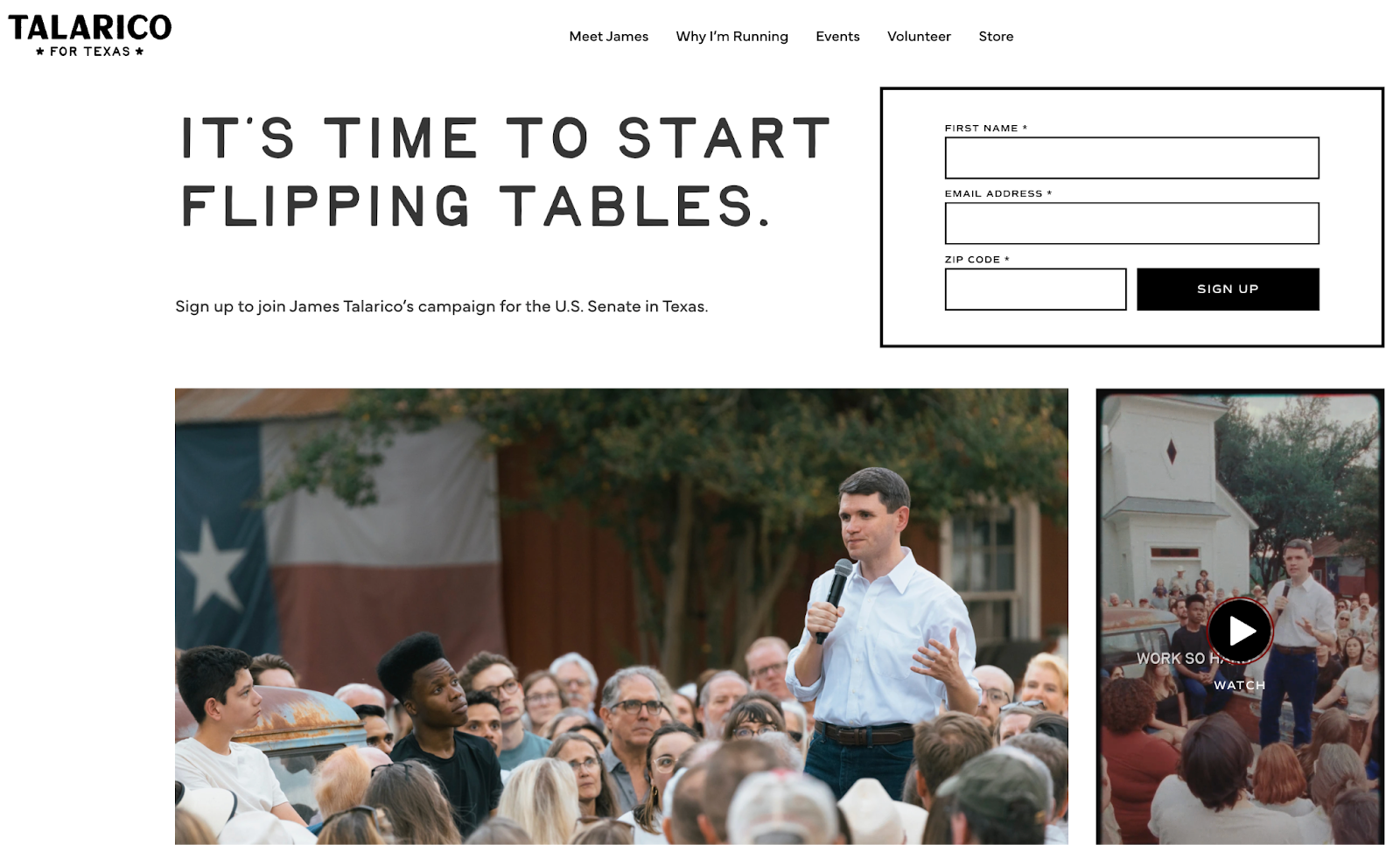
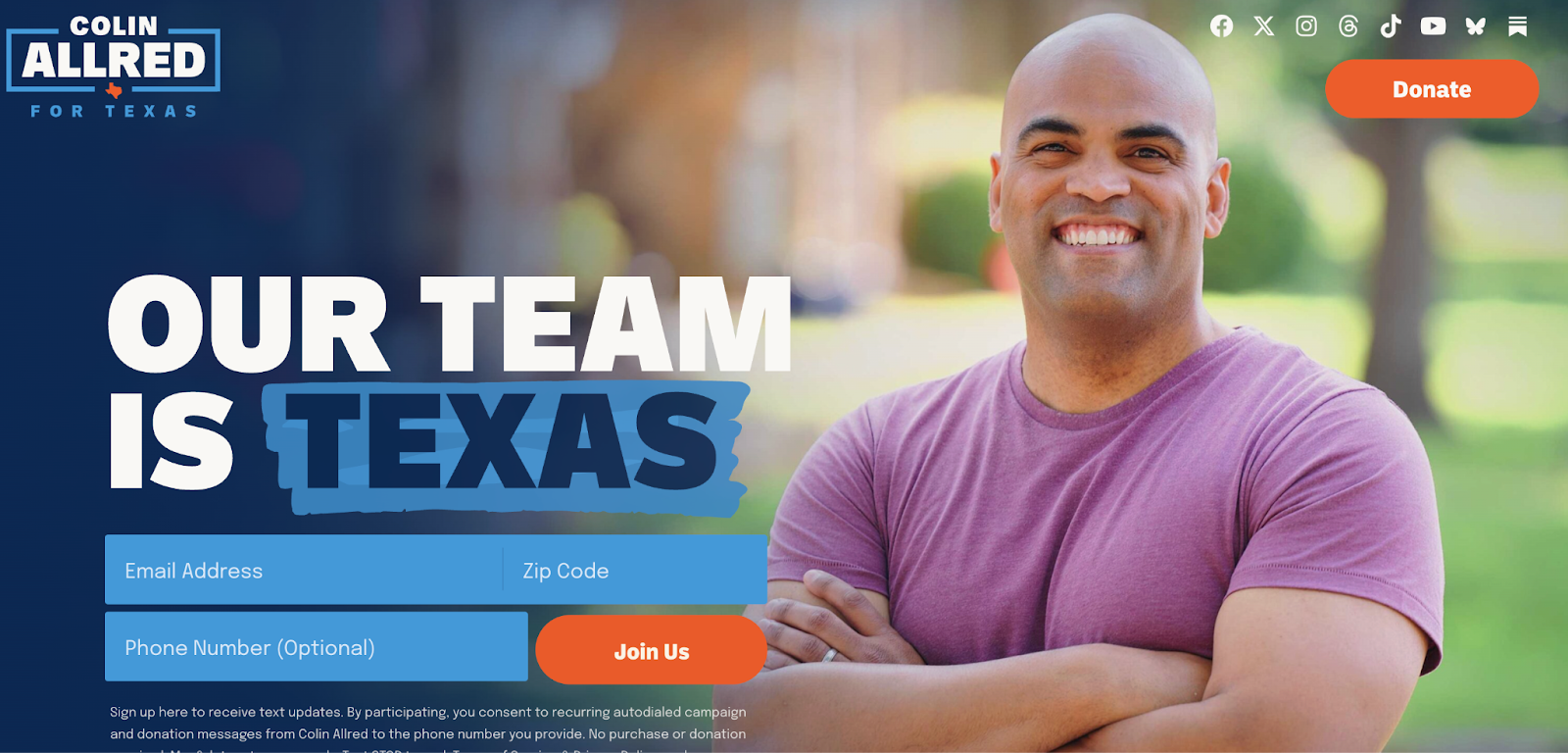
“Flipping tables” is a Biblical reference, but also a message of rightful indignation. It’s a different vibe than Allred’s website, which features him smiling and, although it refers to “corrupt politicians like Donald Trump”, is full of messages about teamwork, public service and how “Colin’s campaign isn’t about partisanship.”
Crockett also struck a defiant theme in her launch video, which consists of 45 seconds of silence — halfway through, she turns from profile to stare at the camera, then crosses her arms before she finally flashes a smile — as disparaging comments by Trump play in the background.
Crockett isn’t going to strike anyone as a moderate. That voters come in with different assumptions about Black women than white men plays a role in that. But Crockett also has a voting record that is more liberal than 92 percent of the current Congress, and she’s a social media star and frequent cable news guest who pretty much wears that on her sleeve. Her theory of the case is that she can win the election by turning out Democratic base voters even in a state where Trump won 56 percent of the vote last year.
Even if moderation wins, a moderate temperament might not sell well to Democrats
Just in case this isn’t clear, today’s newsletter is meant to be descriptive, not proscriptive. Yes, I agree with those who say Democrats ought to place a heavy emphasis on “electability,” especially in states like Texas. In fact, the greater the threat that you think Trump is to the future of American democracy, the less you can afford to nominate only candidates who pass a progressive purity test. I also agree that moderation usually helps. Not necessarily being a down-the-line centrist, but at least vibing with your local electorate rather than the MSNBC (excuse me, MS Now) audience.
Still, take a look at this recent data from Pew Research:
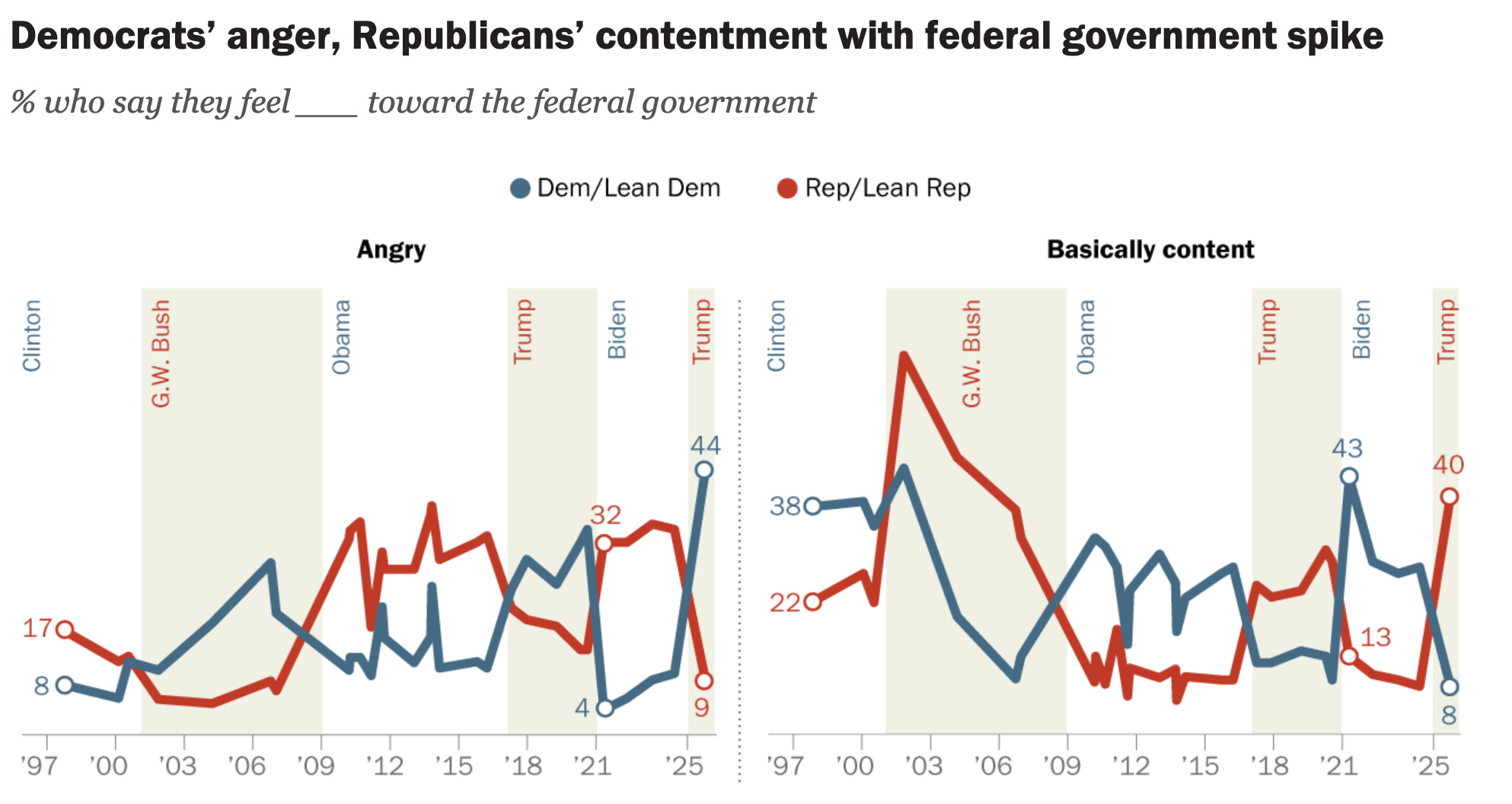
Some 44 percent of Democrats feel angry toward the federal government, a far higher percentage than even in the midst of COVID during Trump’s first term. And the sense of anger is palpable on social media (especially on Bluesky) and across other platforms. Substack newsletters like The Contrarian, aimed at what I think of as “resistance libs” — older Dems who are highly politically engaged — routinely express a lot of anger, both toward anything and everything that Trump does and toward Democrats when they’re seen as insufficiently combative. Podcasts like “I’ve Had It” also often strike an exasperated mood, often with little restraint. Cohost Jennifer Welch recently called Erika Kirk (Charlie Kirk’s widow) a “grifter” and Kirk an “unrepentant racist.”
This anger doesn’t always come attached to a logical political strategy. Personalities like Simon Rosenberg, who always spin every piece of news as good for Democrats, are celebrated at outlets like The Contrarian, no matter how much false hope they gave Democrats about Joe Biden’s condition and other things last year. Indeed, some of these outlets still fiercely defend Biden’s decision to run for re-election and blame the media for forcing him out, even though nobody did more than Biden to put Democrats in their current predicament. And the shutdown was driven by base anger rather than by any coherent game plan or broader buy-in within the Democratic caucus, producing an eventual capitulation.
Meanwhile, “I’ve Had It” recently had California Gov. Gavin Newsom on as a guest for a very friendly interview, even though the hosts purport to be furious at the Democratic establishment. It’s hard to think of a more establishment-y figure than Newsom, who was first elected mayor of San Francisco while George W. Bush was still in office, who has a mostly conventional set of progressive policy positions and some of the same California baggage that Kamala Harris had last year, and whose Twitter account recently endorsed a statement that Biden — not Barack Obama, who remains far more popular — was “THE BEST PRESIDENT IN MODERN AMERICAN HISTORY!”.
Newsom, although he has shown a few heterodox stripes lately, routinely embraces the message that “we have to fight fire with fire.” Sometimes this is smart: even as someone who’s not a big Newsom guy, I thought he handled Prop 50 extremely effectively. But at other times, the “fight” takes the form of cringy all-caps tweets meant to imitate Trump’s style.
The notion of fighting smartly is less often seen in the resistance-lib-o-sphere. People like Matt Yglesias and Ezra Klein are detested for advocating for a more measured, moderate approach or for trying to find common ground with conservatives. Nor are the resistance libs happy to hear critiques of Biden or Harris from people like me, even if they’d have been better off if they’d listened to those concerns.3
“Electability” is becoming a harder sell
That doesn’t mean the “happy warrior” modality can never work. Zohran Mamdani has been a notably affable figure, even finding common ground with Trump in a recent White House meeting. But Mamdani’s progressive bona fides are well-established, and he’s a smart politician who recognized that, even in New York City, a Muslim democratic socialist from Uganda had some work to do to soften his image. (He also created an effective contrast against the frequently angry Andrew Cuomo.)
But the resistance libs aren’t likely to be receptive to any message that some of their ideas are unpopular, or that the Democratic Party could stand to shave off some of its rougher edges. To be fair, thermostatic public opinion is making many liberal ideas more popular again instead of producing a conservative vibe shift, especially as Trump’s popularity lags.
Still, partisan Democrats have lots of coping strategies. First and foremost is what I’ve called The Big Cope, or “the belief that Democrats would win every competitive election if only it weren’t for unfair media coverage”.
Crockett has also invoked an older coping mechanism, namely the belief that Democrats would win every competitive election if only they turned out their voters. There used to be a grain of truth in this back when “marginal” voters were more likely to be Democrats: Obama won by a solid margin in 2012 despite losing independents to Mitt Romney in many swing states, for example. However, as Trump has gained ground among younger voters and racial minority groups who are less reliable voters, it’s now usually Republicans who benefit from higher turnout — whereas Democrats clean up in low-turnout special elections. Nor was turnout the main cause of Harris’s loss.
However, I think we have to acknowledge the argument that moderation = winning more elections (other things being equal) isn’t an easy sell. Some of the academic work suggesting that the benefits of moderation have evaporated is extremely dubious if you kick the tires on it. But this requires sorting through arguments about regression analysis and model specification. Because there aren’t many moderate Democrats left with people like Joe Manchin and now Jared Golden retiring, there aren’t a lot of favorable examples to cite. A moderate Democrat who outperforms the baseline by 6 points in an R+10 state or district is still usually going to lose except under the most favorable conditions for the party.
There’s also the elephant in the room: Trump. How was he elected twice if moderation matters, progressives might ask? It’s a fair question, and the answers offered by electability types like me aren’t likely to be entirely satisfying. In 2016, Trump was actually seen as more moderate than Hillary Clinton, in part because he eschewed some unpopular Bush/Romney-era conservative positions like on gay marriage and rolling back the welfare state. After Republicans tried to repeal Obamacare anyway, they paid the price in 2018 — and then in 2020, Trump lost. But in 2024, in an echo of 2016, more voters said Harris was too liberal than that Trump was too conservative.
I personally think that assessment is wrong, but Harris left a lot of very progressive-coded baggage from her primary campaign in 2019. And she was fighting an uphill battle against both broad voter dissatisfaction with the Biden-Harris administration, partly for ignoring the polling on issues like immigration, and the fact that self-identified conservatives still considerably outnumber liberals in the electorate.
Talarico might still be a favorite against Crockett
Ironically, however, there’s one electability-related trope that’s more common among resistance libs than among number-crunching types. And it could wind up hurting Crockett. Namely, it’s the belief that women underperform men. (Especially women of color.) I mostly agree with research suggesting this idea is overstated, though a fuller examination is well beyond the scope of today’s newsletter. Still, it’s inevitably going to have some intuitive currency. Democrats can point to the scoreboard and detect that Harris and Clinton lost, while Biden and Obama won. Even before Harris’s loss last year, with the possible exception of Amy Kloubuchar, nearly all women candidates, from Harris to Elizabeth Warren to Kirsten Gillibrand, notably underperformed expectations in the 2020 Democratic primaries.4
I suppose I’d bet on Talarico winning the primary if you gave me some free money to play with (prediction markets narrowly agree). The Democratic primary electorate in Texas is relatively conservative — Clinton beat Bernie Sanders by nearly 2:1 there in 2016 — and Talarico is a talented politician with a compelling biography.
But Talarico’s table-flipping rhetoric probably also helps him. Over the past 15 years, since the dawn of the Tea Party Era, Democrats have generally nominated higher-quality candidates for Senate and governor as measured by experience in office or being a better ideological fit for their local electorates. I don’t expect that advantage to evaporate entirely or for Democrats to go full Tea Party. Abigail Spanberger and Mikie Sherill were both relatively moderate and traditionally well-qualified, for instance. But they probably also won’t get a clean slate of Senate and gubernatorial candidates optimized for electability next year. There are too many angry voters, and the party establishment is too distrusted to successfully intervene in primaries as it sometimes has in the past.5
Allred also trailed O’Rourke in polls, who is unlikely to run but hasn’t made any formal decision.
Crockett actually had a positive Split Ticket WAR in 2022 and then didn’t face a Republican opponent in 2024.
Sometimes, these clashes are tonal as much as substantive. I suspect my critiques of Biden might be viewed slightly more sympathetically by resistance libs if I expressed the requisite amount of outrange about Trump instead of the more aloof, analytical approach that we typically take at Silver Bulletin.
Janet Mills in Maine might have some of this problem, too, although she’s overtaken Platner in one recent poll.
Most notably, in rallying behind Joe Biden ahead of South Carolina in 2020.
Matt Yglesias has pointed out that there is a difference between policy moderation and procedural moderation.
"We're going to work toward moderate policies" certainly may be appealing to swing voters.
"We're going to work toward moderate policies AND we aren't really going to do anything when we get filibustered or the Supreme Court lawlessly strikes even our compromise policies down" is not a winner with anyone.
I would be careful about equating the Democratic base with resistance liberals. Even in 2020 when woke was at its peak Biden won easily. They may be angry now but the two biggest winners this year, Sherrill and Spanberger, aren’t The Contrarian types.
That said, the biggest worry I have for the midterms is Democrats stepping on their own feet. 2026 is shaping up to be a great year and if there was ever a time to try to win Texas that’s it. Crockett is tailor made to drive away anyone who is not addicted to social media and MSNBC.
I preferred Allred but I like Talarico and maybe he catches fire. If Democrats must throw away a race by nominating someone toxic it’s better to do it in Texas than Ohio or Iowa where they have a better chance of winning.