

SBSQ #27: Is redistricting backfiring on Republicans?
Redistricting 201. Plus, do NFL teams understand game theory? And, should the Knicks trade for Giannis?

Happy Sunday, and welcome to the Mike Trout edition (#27) of Silver Bulletin Subscriber Questions. As always, you can leave questions for edition #28 in the comments section below.
I’m hoping that, as with Trout in his prime, this edition features a high slugging percentage with a minimum of fuss. So let’s take two redistricting questions and then two sports ones.
Are aggressive Republican redistricting efforts starting to backfire?
Would SCOTUS striking the Voting Rights Act produce a permanent GOP majority?
Should the Knicks trade for Giannis Antetokounmpo?
Are NFL teams following game theory? And should they be running more fake punts?
Are aggressive Republican redistricting efforts starting to backfire?
Scott asks:
What are the chances this redistricting push backfires on either party?
Cracking districts lowers the margin in nearby areas, since those voters have to be redistributed. If the math is off, or there’s a wave election, those leaner districts could flip easier than before. It might be more difficult to get to that tipping point, but I would think it puts more seats in danger.
How big would the wave need to be for this to end up as a net loss for either side?
In August, I outlined what was basically a Game Theory 101 take on the redistricting wars. I argued that it was a race to the bottom — or more formally, a prisoner’s dilemma. Even if Republicans “started it”, Democrats were only hurting themselves by failing to reciprocate. But now that Democrats have shown a willingness to fight back, especially with the passage of Prop 50 in California, we’re even closer to the inevitable-seeming equilibrium. Given the lack of constraints on districting likely to be enforced by the current Supreme Court, you might predict this involves a maximalist approach from both parties.
I also contended in that story, in contrast to the conventional wisdom at the time, that this equilibrium does not inherently favor Republicans. And I guess that looks smart, because even after the Supreme Court upheld Texas’s redistricting plan last week, the 2026 redistricting wars have pretty much been fought to a draw so far:
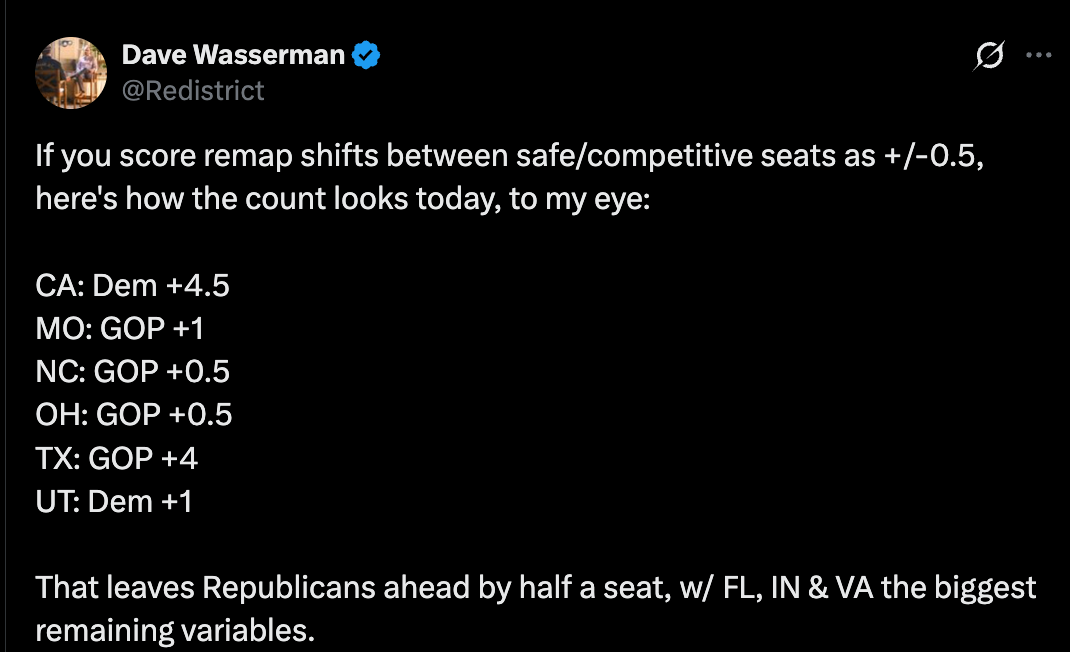
Furthermore, Republicans don’t necessarily hold an advantage in the long run either. Once Abigail Spanberger is sworn in as governor in Virginia next month, Democrats will hold state government “trifectas” (control of the governorship and all legislative chambers) in states commanding more U.S. House seats than Republicans have. While Republicans hold trifectas in more states, the Dem trifecta states tend to have higher populations. (To be fair, you could probably add North Carolina to the GOP side of the ledger because the governor doesn’t play any role in redistricting there.)
But that August article left out some of the complications you’re getting at, Scott; let’s address them here in SBSQ. One is that redistricting is not actually a zero-sum game. For one thing, excessively partisan gerrymandering is bad for democracy. But more self-interestedly, redistricting can threaten an incumbent’s job or force him to defend a district that spiders out to places beyond his home base where voters are less familiar with him, reducing his incumbency advantage.
Partly for these reasons, the state senate in Indiana has so far resisted Trump’s calls to redistrict, even as the state house has approved a 9-0 Republican map. Even in an era of exceedingly high partisanship, incumbents are generally pretty risk-averse when it comes to their own jobs. And last month’s elections, which went very well for Democrats, raise the possibility that next year’s midterms could be contested in something like a D +8 national environment in which even relatively safe Republican seats could be in play.
Indeed, the parties are not taking a truly maximalist approach. Indiana has been one example, but also consider California. Democrats are expected to gain an additional 4-5 seats as a result of their new Gavin Newsom-backed, voter-approved map. But that will still leave 4-5 Republicans in California’s congressional delegation, when in theory it would be possible to draw a legally-compliant 52-0 Democratic map.
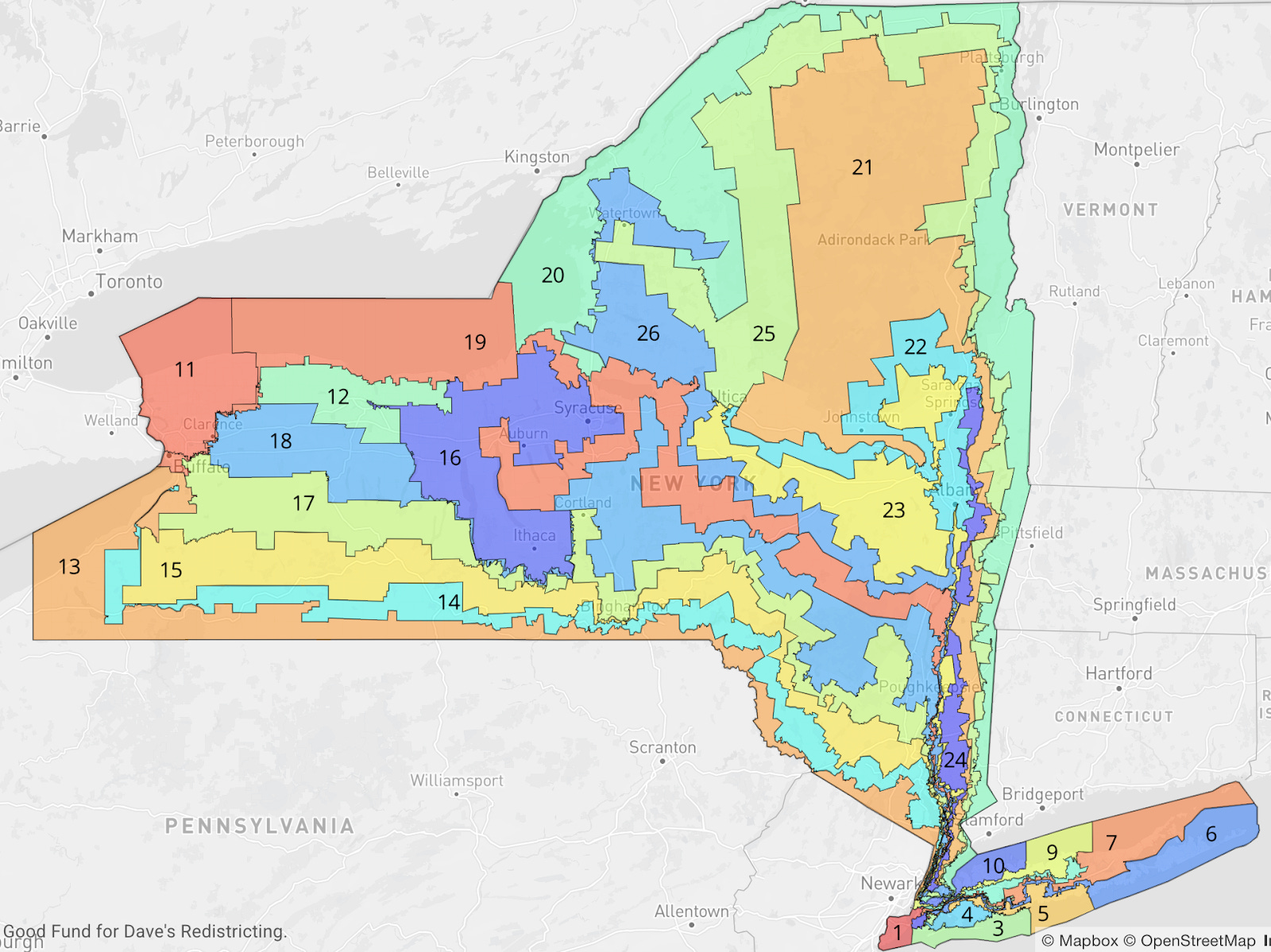
Such a map would risk coming across as ridiculous to voters, however, which might have made Prop 50 harder to pass. And the most extreme gerrymanders can also have ugly aesthetics. Look, for instance, at this map of a “Hochul-Proof NY Gerrymander” in New York from a creative Redditor. This is actually a 26-0 Democratic map. But to achieve it, you have to do things like, for instance, take the 21st district, mostly centered in the Adirondacks, and stretch a finger of it all the way to Hunts Point in the Bronx.
So another lesson of this cycle has been that public opinion matters and still produces some constraints. It’s not easy to measure how much voters care about good governance or maintaining some basic pretense of fairness. But that doesn’t mean the effects are zero. In California, Prop 50 was framed by Gavin Newsom as a response to unfair treatment — it is formally named the Election Rigging Response Act. That framing was smart; the referendum passed by almost 30 points.
Plus, courts, including the current Supreme Court, take public opinion into account. Truly outrageous gerrymanders that sparked a public backlash might be handled less sympathetically by courts when inevitable legal disputes arise.
Would SCOTUS striking the Voting Rights Act produce a permanent GOP majority?
Another complication is the Voting Rights Act, so let’s take a separate question on that. Doug Turnbull asks:
Nate Cohn of NYT has written an article claiming VRA Section 2 defanging/overturning would net GOP 8-12 seats, and create a structural advantage of R+~5 in the House. Based on oral arguments, this seems fairly likely. The ruling is due out in June.
(a) Do you agree with Nate’s assessment
(b) What can Dems do in this situation, how should they respond strategically, game-theory wise, etc if they can only win the House in major wave years?
(c) Does this force the Dems hand to be more centrist?
(d) How might coalitional shifts diminish this structural advantage?