

What is Gavin Newsom doing?
Losing support in polls, the governor is leaning into his role as the avatar of an unpopular Democratic establishment.

Following the successful passage of his redistricting referendum in California last November, California Gov. Gavin Newsom began the year as the frontrunner for the 2028 Democratic nomination. But polls suggest that he’s slumping. According to Race to the White House, Newsom’s support among prospective Democratic voters in 2028 has fallen from 25 percent in January to 15 percent today.
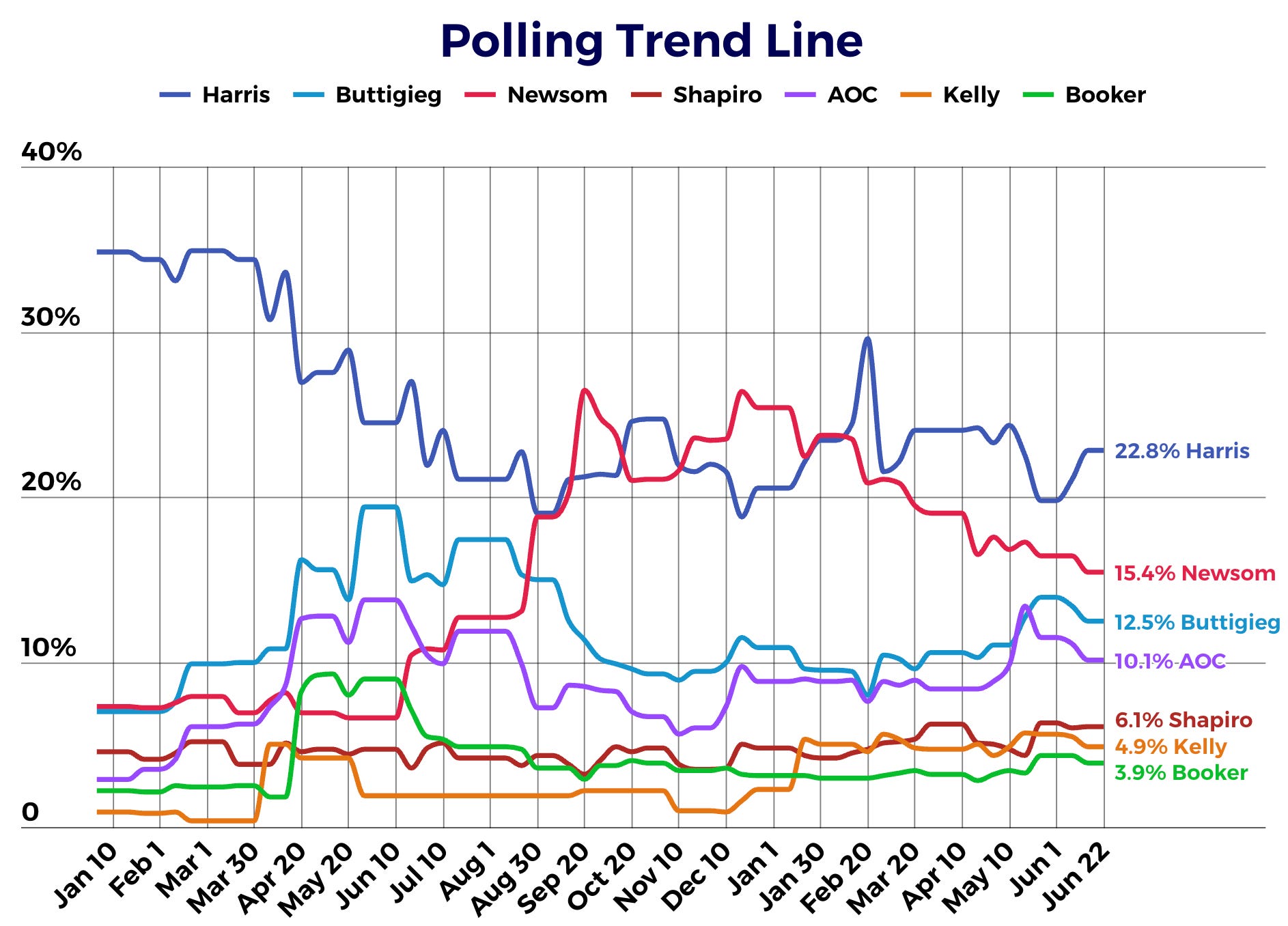
That's a fairly big shift, given that not all that much has happened. The California gubernatorial primary was kind of a mess, with Newsom not endorsing a candidate until Xavier Becerra was the lone Democrat left standing. Still, that’s local news and this is a national primary. And redistricting has remained a big story, even if it ended on a slightly bitter note for Democrats.
But these early polls do have some predictive power, believe it or not. Prediction markets have tracked with them, with Newsom’s probability of winning the nomination declining from 35.5 percent on Jan. 1 to 23.3 percent today.
No one opponent has emerged as the obvious alternative. Bettors see the field as wide open, with the top six candidates having less than a 60 percent combined probability of winning the nomination. But it’s worth noting where the biggest gains have come from: Kamala Harris and Georgia Sen. Jon Ossoff. Each presents a challenge for Newsom. Harris, who might or might not be serious about running again, is from the same state, and it’s hard to find much daylight between her and Newsom on policy. And Ossoff, you could argue, mogs Newsom in the “good-looking white guy” category, only with youth on his side and the credential of actually having won elections in a swing state.
If you ask me, though, the reason for Newsom’s decline is simple: this is reversion to the mean. He doesn’t have a particularly persuasive argument for being the nominee, and his early support may reflect name recognition as much as anything else.
Newsom is as “establishment” as it gets
As the governor of the nation’s largest state1, Newsom is the logical “next-in-line” candidate for the establishment faction of the Democratic Party. He’s perhaps also the best-known Democrat who isn’t Harris or 80+ years old (Joe Biden, Bernie Sanders). But this comes at a time when that establishment is highly unpopular, including with Democratic voters.
Last year, Newsom made a few conspicuous moves toward a more “heterodox”, centrist side by inviting people like Charlie Kirk on his podcast and shifting to the right on transgender athletes. And in January, he announced his opposition to California’s proposed wealth tax that might appear on this November’s ballot.
These moves, although not necessarily popular with Democratic primary voters, might suggest a candidate trying to break out of the establishment box. But Newsom’s strategy has been a little contradictory. Who was one of his most recent podcast guests? Hunter Biden, the pardoned son of the former president.
Indeed, as Axios notes, Newsom has made a show of embracing Biden and his legacy — somewhat ironically given that Newsom essentially ran a shadow campaign against Biden in 2022. The Biden admiration isn’t new, however. Last October, Newsom described Biden as “one of the most successful presidents in the last century.”
We’ve written a lot about Biden and his legacy at Silver Bulletin, and I’ve urged Democrats to get over it and move past him. Newsom is conspicuously doing the opposite.
Because it’s not as though voters are warming to Biden’s legacy, as they sometimes do for former presidents. In fact, CNN just released a poll of favorability ratings for living presidents. Only 30 percent of voters had a favorable impression of Biden, actually lower than the 38 percent approval rating that Biden left office with. By comparison, Donald Trump had a 34 percent favorability rating in the poll, Bill Clinton was at 38 percent, George W. Bush was at 42, and Barack Obama is the only actually popular former president with a 57 percent positive rating.
As you might imagine, voters who do hold a favorable view of Biden are nearly all partisan Democrats. Among self-identified Democrats in the poll, Biden has a 71 percent favorability rating. But it’s just 51 percent among voters who merely lean toward the Democratic Party.2 And it’s just 20 percent among independents — compared to 56 percent for Obama. (It probably hasn’t helped that the Biden family is constantly making news in the wrong way, by re-litigating the Democratic Party’s decision to push Biden aside.)
True, every Democratic candidate is going to face difficult decisions on issues like trans rights or policing where the median Democratic primary voter is well to the left of the median general election voter. Biden is a strange hill to die on, however. A 71 percent favorability rating is far from unanimous support even among Democrats. It’s not like Biden is particularly well-liked by the left, either. And if 2028 is a “change election”, like most elections are, it’s hard to see why you’d embrace an 83-year-old whose legacy voters just rejected in 2024 when his vice president went head-to-head against Trump.
As an aside, I’d note how popular Obama remains with Democrats — a 96 percent favorability rating! Now and then, I’ll see some contrarian take from a self-described liberal on Twitter or Bluesky claiming that the base wants to move beyond Obama. But that’s deeply out of touch with the polling. Obama is basically the only Democrat who still unifies the various factions of the party, including younger voters and more left-wing ones. Indeed, Obama has his fair share of imitators, including Ossoff and Pennsylvania Gov. Josh Shapiro, who can mimic his cadence.
So it’s at least a little bit weird that Newsom describes Biden as “one of the most successful presidents in the last century” when far more Democrats would describe Obama that way. In the CNN poll, 30 percent of voters listed Obama as the president they admire most; just 1 percent of respondents said that of Biden.
But let’s get back to the question posed by the headline.
Newsom is running as a factional candidate of the #Resistance Libs
In my piece on Heather Cox Richardson, I identified three main factions of the Democratic Party. First, The Left, who have candidates they prefer to Newsom like Alexandria Ocasio-Cortez. Second, the more centrist-y Abundance Libs. Newsom has been friendly with them at times, going on Abundance co-author Ezra Klein’s podcast for instance. But they tend to have a lot of critiques both of Newsom’s performance in office — Abundance is basically a book about the failures of governance in California — and his electability.
Last but by no means least — they’re possibly the largest faction — are the #Resistance Libs. They’re progressive but usually not “far left”. Demographically (like Richardson), they’re older, college-educated and female-leaning. But they tend to really root for the blue team. They’re less ideological than they are partisan, a distinction that sometimes gets lost. They’re the group that tends to feel Biden was unfairly railroaded out because of what they think of as overblown media fixation on Biden’s age.
Although Biden isn’t popular with pretty much anyone — even among Black voters, only 53 percent have a favorable view of him — you can find some echoes of the #Resistance Lib constituency in the CNN poll on Biden. He’s relatively more popular with women than men, with voters aged 45 or older, and with college-educated voters who frequently consume political news, all #Resistance Lib hallmarks. (Note that the numbers in this table are among all voters, not just Democrats.)
Meanwhile, while none of the factions were happy about 2024, they each have different theories of the case for how Democrats can get a better result in 2028. The Left thinks the party should move, well, left, especially on distributional and economic issues. The Abundance Libs think the party should tone down culture war issues that poll poorly and prove that they can govern more effectively.
And the #Resistance Libs? They basically deny that Democrats have a substantive problem at all. Instead, their leading theories of 2024 are that Democrats lost because 1) they didn’t fight hard enough, both against Trump and against unfair media coverage and 2) because Kamala Harris was a Black woman.
Newsom resolves each of these concerns, although the white guy part is left unstated. HE’S A FIGHTER WHO TWEETS IN ALL CAPS LIKE TRUMP. AND HE’S A WINNER.
To be clear, Newsom’s redistricting play was both substantive and smart, and he deserves a lot of credit for it. Also to be clear, the Republican Party is likely to have a hell of a mess on its hands in choosing its nominee in 2028 and will face massive headwinds unless Trump magically becomes more popular in the second half of his lame duck term. Newsom can win and is probably no worse than a toss-up against JD Vance or whomever.
But Newsom’s electability argument is weak. Polls find that Democratic voters see Newsom as highly “electable”, but his margins in California have been underwhelming, and the Golden State is the furthest thing from a swing state. True, I don’t expect primary voters to be making Wins Above Replacement calculations, but candidates like Ossoff (and Shapiro, depending on how his re-election goes) obviously have stronger arguments in the electability department by virtue of over-performing in swing states.
So my theory is that Newsom’s noisy support for Biden is intended as a signal to the most partisan #Resistance Libs — as an effort at reassuring them that they were right about 2024.
The most effective signals are often costly signals, however. Most voters are extremely skeptical about Biden’s performance in office. The better strategy is probably to invoke some nostalgia for the one Democratic president (Obama) that voters actually do have warm feelings for, while also promising change, generational and otherwise. But someone like Ossoff is in a stronger position to make this case than Newsom.
Maybe Newsom realizes this: that he’s never going to effectively rebrand himself as anything other than a capital-E Establishment Democrat, so he might as well embrace it. It might not be the worst choice as a matter of tactics. But it’s also a sign of weakness. Newsom is never going to be the favorite candidate of the Left (especially after opposing the wealth tax) or the Abundance Libs. But if he can hold the #Resistance Libs, he’ll have a high floor in the Democrats’ highly proportional primary system.
What happens from there? Maybe the same thing that happened for Biden in 2020 and John Kerry in 2004. The rest of the party rallies around the early frontrunner as the “least-worst” choice after an early primary win or two, fleeing to safety when presented with alternatives that seem equally problematic. Newsom has more raw political talent than Kerry or Biden, frankly. And it’s a formula that has worked before in the Democratic primaries — but also one that tends to produce highly triangulating and thoroughly mediocre general election candidates.
And, indeed as the architect of a series of policies that have caused voters to leave California.
In the CNN poll, the “lean Democrat” column in the crosstabs included both capital-D Democrats and independents who said they lean toward the Democratic Party. I was able to estimate the numbers for the “lean Democrat” group alone through extrapolation based on the sample sizes of each group.
If the “resistance libs” are the wing of the party who thing nothing is actually wrong with the democratic brand, nothing was actually wrong with Biden and it’s he who was wronged, not the democratic voters who were lied to about his cognitive decline and robbed of a chance to select our nominee in 2024, and that the only reason we got Trump 2.0 AND PUSHED OUR COUNTRY TO THE BRINK of complete distraction was because “everyone is being mean to the old guy and the black women and they need a scoldin” then left and center in the party need to have a cease fire for two years unite against them because the far left and the blue dogs have far more in common with each other than whatever the hell that wing is.
Generally, I think it's too early to look to who the Democratic party will nominate for 2028. It's like asking people now what they want for Xmas dinner. The focus is more now, more on the midterms, more on affordability. Or like asking a 20 year old if they want to have kids if and when they get married. The question AND the answer is premature.
Secondly, I think there is a failure to recognize how large the percentage is of independents (aka "unaffiliated" voters). I think independents are largely "undecided" so they are the key population in the key 10-15 states that have the potential to determine the midterms and the 2028 elections.
So the polling doesn't focus on the data that is relevant.
BTW, I don't think Kamala has a prayer nor does Buttigieg in 2028. I think the future is foggy!