

On redistricting, Democrats are playing as the away team
Democrats are fighting uphill against Republican-leaning courts. But they can’t afford either despondence or complacency.

Before we get into the meat of today’s newsletter, two quick plugs:
I’ll be doing a live show with my former FiveThirtyEight colleagues, Galen Druke and Clare Malone, this Wednesday (5/13) at 6 PM at the Village Underground in NYC! There’s still a little bit of ticket inventory left. I hope to see some of you there.
And, if you haven’t yet, I’d encourage you to check out PELE, our new international soccer model, which debuted on Friday. We’re always excited to bring you more models, and while yes, there will be a related World Cup version of PELE coming in a few weeks, we think PELE is pretty cool on its own.
Republicans won the redistricting war, after all
As recently as three weeks ago, when Virginia passed a ballot referendum to draw new, more partisan districts, it appeared Democrats had fought the Great Mid-Decade Redistricting War of 2026 to a draw or even gained a slight advantage.
Welp, that is plainly no longer the case. Some further Republican states, like Florida, have redrawn their districts; that part isn’t really a surprise. However, Democrats have also faced a pair of legal setbacks. Two weeks ago, the Supreme Court’s Callais decision weakened the Voting Rights Act. And then on Friday, the Virginia Supreme Court invalidated the ballot referendum on procedural grounds.
So any victory laps by Democrats were premature. And my thesis that there are no structural impediments to Democrats holding serve with Republicans on redistricting, so long as they were willing to be sufficiently aggressive rather than unilaterally disarm, has been weakened. That thesis gave insufficient consideration to the role of the courts.
At the same time, the impact of the recent decisions is fairly incremental as far as November’s midterms go. Here’s a helpful chart created by the New York Times’s Nate Cohn that summarizes the situation:
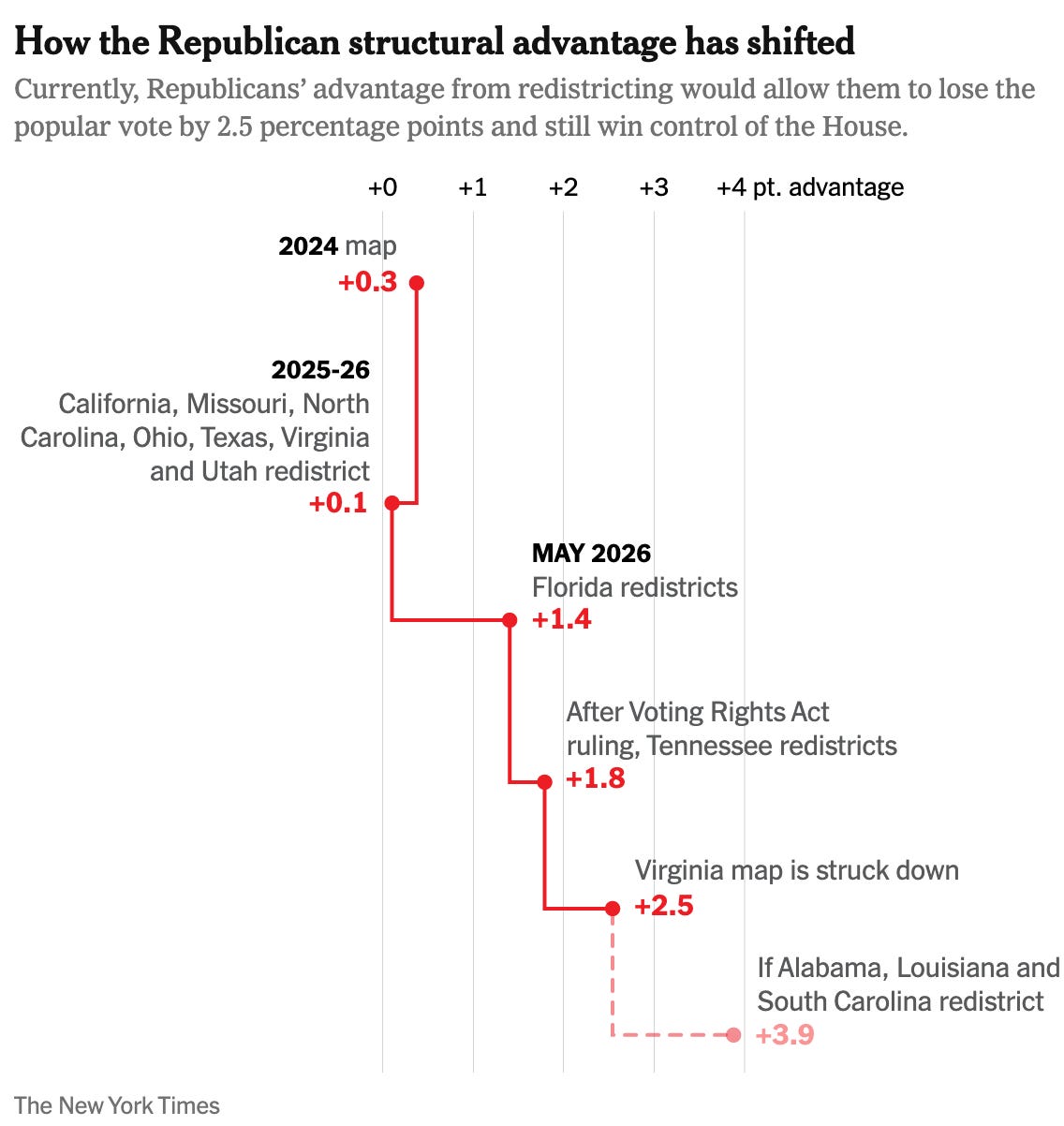
According to Cohn’s estimates, the median district had projected to be just 0.1 percentage point more Republican than the country as a whole after the Virginia referendum passed: actually, a tick better for Democrats than the 2024 map. Now, however, the Republican advantage in November looks to be somewhere between 2.5 and 3.9 points, pending further legal action and legislation. (Democrats are appealing the Virginia decision to the U.S. Supreme Court, for what it’s worth, as well as considering what I’d consider to be a fairly radical plan to force state justices into early retirement.)
Now, I do have a couple of technical complexities to add to Cohn’s analysis. One is that it treats the result in each district as deterministic rather than probabilistic. As reliable as the presidential vote tends to be as a predictor of Congressional outcomes in an era of such high partisanship, there will be some unpredictability and regional variation in November.
Ron DeSantis’s new map in Florida, for instance, creates a number of lean Republican and likely-but-not-certain Republican districts that are definitely not safe pickups in the event of a blue wave year or a reversal of the sharp shift toward Republicans in Florida. For that matter, while the Virginia referendum has been portrayed as a 4-seat Democratic pickup, it was probably more like a 2.5- or 3-seat gain on a probabilistic basis. Democrats might still have a shot at adding one or two seats in Virginia.
Also, in 2024, Democrats fared better in the House than the median presidential vote implied. In fact, they almost won the House despite losing the popular vote by 2.6 points in the House and by 1.5 points in the presidency. Several subtle factors contributed to this.1
To sort out the details of all of this, you need a proper probabilistic model, like the Silver Bulletin midterms model we’ll begin publishing soon-ish. (The ETA is roughly 6 weeks out.) It wouldn’t surprise me if it portrays a slightly more optimistic picture for Dems than Cohn’s estimates, but we’ll see.
The basic equation, though, is that Democrats have gone from a map where if they won the popular vote for the House by any margin at all, they were probably also going to win a majority of districts … to one where they’ll need a little cushion. Currently, they have one. Democrats lead by 6.1 points in our generic congressional ballot tracker.
A 6-point win would very likely be enough for Democrats to claim the House, even if the map winds up at R +3 or R +4. However, a normal-sized polling error in favor of the GOP (if Republicans were to beat their polls by about the same amount that they did in 2024, for instance) would be enough to flip the House back into pure toss-up range. Needless to say, there are also still almost six months until the election, which creates additional uncertainty. (Though that might actually work to the Democrats’ benefit: most congressional ballot polls being published now are conducted among registered voters rather than likely voters, and don’t account for a possible Democratic turnout advantage, for example.)
Overall, the reaction from prediction markets to all of this seems roughly sensible. Polymarket had Democrats’ chances of a House majority peaking at 87 percent a few weeks ago; that’s now down to 78 percent. While I’m not sure I’d call Virginia a “huge blow” to Democrats like some headlines have, the cumulative effect of Virginia + Callais + this latest round of red-state redistricting is material.
Who controls the state courts?
In 2026, Democrats are still favored to take the House, thanks to the blue wind at their backs. But they won’t necessarily have one in 2028. If Gavin Newsom or AOC carries the presidency by a narrow margin in 2028, will they even bring Congress with them? The Senate had appeared to be a bigger barrier to a Democratic trifecta, but now it’s at least theoretically possible that Democrats could control both the presidency and the Senate after 2028 but not the House, depending on the bias of the map two years from now.
The Callais decision will give Republicans some further opportunities to redistrict between 2026 and 2028. But they’re probably closer now to maxing out their maps, especially considering that Democrats may well make state legislative gains this November. In addition to taking another shot at Virginia, Colorado and New York loom large as places where Democrats could draw far more partisan maps before 2028, though New York Democrats have expressed skepticism about a more aggressive redraw.
However, if courts usually rule in the Republicans’ favor, basically letting Republicans get away with everything they want, and Democrats only half of what they want, that could produce a case of one step forward after two steps back.
The Supreme Court, obviously, features a 6-3 conservative majority that usually rules along partisan lines in redistricting decisions. In the past, Democrats probably weren’t strategic enough about pushing their older justices into retirement, but those choices can’t be undone now. (It wouldn’t surprise me to see a revival of talk about court packing.)
Virginia’s court is also Republican-leaning. Three of the seven justices were elected by the state legislature when Republicans controlled both the Virginia House of Delegates and the state senate, compared to just one under a Democratic sweep. (The other three justices were chosen when the state house and senate were split.)
As recently as 2020, state courts tended to lean quite Republican, according to an extensive analysis conducted that year by Ballotpedia. This reflected a combination of several things: a longstanding GOP tendency to place more emphasis on the judiciary, plus a pair of very poor midterms for Democrats in 2010 and 2014, which, when combined with self-perpetuating GOP gerrymanders enacted after the 2010 Census, tended to entrench the GOP advantage in state legislatures.
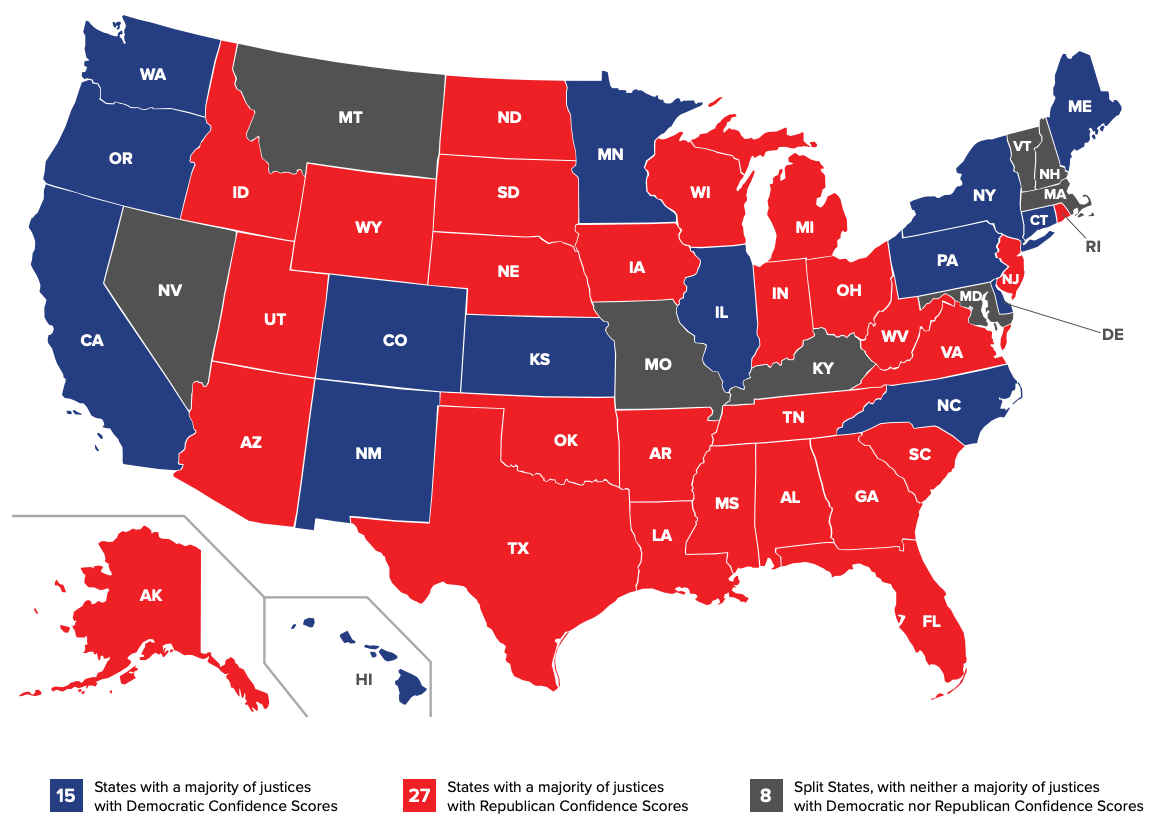
Unfortunately, the Ballotpedia map hasn’t been updated since then, and because every state uses different procedures to select its justices, properly revising it would require a lot of work.
Clearly, some things have changed since 2020. Democrats flipped Wisconsin in 2023, for example, but have lost control of the court in North Carolina.
The best I can do for today — this was supposed to be a short newsletter — was to ask Google Gemini, Claude, and ChatGPT to take deep dives, probe a couple of things that seemed wrong, and have them argue about one another’s borderline calls and edge cases until I developed some sort of consensus ratings. I told the models to focus on de facto behavior, how the courts are behaving recently as a practical matter, which usually but does not always match the pedigree of the people who appointed them. (Massachusetts has a fairly liberal court despite most members being appointed under Republican Charlie Baker, for example.) Here are those ratings:
As measured by electoral votes, the tally is Republicans 264, Democrats 252, tossup 22. So there’s a slight Republican edge there, which expands if you only consider only the Strong Republican (232) and Strong Democrat (205) courts. Among the seven canonical 2024 swing states, Democrats actually have a 4-3 advantage, including all three of the “Blue Wall” states of Michigan, Pennsylvania, and Wisconsin. But Republicans make up for that with conservative courts in the borderline swing states of Virginia and New Hampshire.
It’s not enough of an edge, in my view, to call this a structural Republican advantage in the state courts; Democrats have smartly put more emphasis on court seats in recent elections and mostly evened the score. But obviously, the 6-3 conservative advantage on the Supreme Court matters just as much and probably more.
Redistricting 201 considerations and the risk of complacency
The Republican advantage in courts — even if it’s mostly just the Supreme Court and federal courts now rather than state courts — is not a reason for Democrats to disarm. Were it not for California, for example, the 2026 House race would be one step closer to a true toss-up.
But it probably does mean the particular mechanisms Democrats use to engage in partisan redistricting will receive more scrutiny, on average. For the record, I’m not as cynical about the Supreme Court’s decisions as some people with my political orientation. But SCOTUS can certainly sometimes engage in Calvinball-type rationales where the rules are mostly made up as they go along.
Democrats’ gerrymanders tend to look a little bit uglier, for instance, because smaller, blue-leaning urban areas are typically adjoined by spaghetti strings. That arguably shouldn’t matter, since there’s no federal mandate for compactness, though it is enshrined in some state constitutions. But it might matter if SCOTUS’s decisions involve partisan motivated reasoning.
It’s probably important for Democrats to keep public opinion somewhat in mind, too. Polls have shown that partisan gerrymandering is quite unpopular in theory — even if voters have been willing to adopt it in practice. Courts, even the Supreme Court, are somewhat responsive to public opinion. Moreover, there’s the potential for voter backlash to consider. As you can see from Cohn’s chart, the marginal impact of any one state redistricting on the national picture is relatively small. Voters can get really motivated if they feel like they’re being disenfranchised or treated unfairly, however. Turnout was actually stronger in the Republican areas of Virginia for the referendum, for example. Personally, I think that the state legislature there retiring justices early would read as extremely dubious to voters in what’s still a relatively moderate state: probably not enough for Virginia to go back to being a purple state again, but who knows. I’d probably argue for Democrats to turn the dial up to 9 on redistricting, but that would be more like an 11.
However, Democrats can’t really afford to leave seats on the table in states like New York or Colorado, where more partisan maps are very likely to pass muster with state courts. As I wrote last week, the notion that there’s some intrinsic trade-off between minority representation and the number of Democrats elected to Congress is true in red states but is basically a myth in blue states: in fact, smartly-drawn maps could easily increase the number of minority members elected, in part because Democrats elected to Congress are much more likely to belong to minority groups. The real motivation behind Democrats’ reluctance in states like New York and Maryland to redistrict more aggressively is probably incumbents seeking to protect themselves.
And what should probably also worry Democrats is the risk of complacency. In 2022, Democrats had a comparatively good midterm by historical standards, considering President Biden’s unpopularity at the time. But it wasn’t great: they did lose control of the House! It was enough for Democrats to convince themselves that everything was fine with Biden, however. Gavin Newsom gave up his not-very-subtle “invisible primary” campaign to replace Biden on the 2024 ticket soon thereafter.
Look, November will probably go well for Democrats. They remain favored in the House, the Senate is shaping up to be close, and they’ll probably pick up their share of governorships and state legislative seats. But if Democrats only narrowly win the House this November with a D +6 or D +7 popular vote margin, it very much won’t be safe in 2028 when all 435 seats are contested again (some with new lines). The race for the House in presidential years tends to be relatively even.
Because Democratic maps will tend to face more scrutiny given the current courts, that means they’re basically playing as the away team. They probably need to balance considerations like public opinion more carefully than Republicans do. The close calls won’t tend to go in their favor, and they’re going to have their share of disappointments, like in Virginia last week. But their goal should be to fight as close to a draw as they can in the short run, and then put even more of an emphasis on courts and state legislatures in the long run — until and unless both parties agree that the current situation is untenable and undemocratic, and pass a bipartisan bill to fix this.
Democrats have tended to be a little smarter about allocating strategic resources and nominating strong candidates in swing races, resulting in modest overperformance in both the House and Senate. Meanwhile, Democrats left more districts uncontested than Republicans did in 2024, allowing the GOP to run up the score by a point or so in the House popular vote. More subtle still, Democratic districts tend to have slightly lower populations and turnout than Republican districts on average — population shifts since the 2020 Census have mostly been toward red territory — which means they get slightly more bang for their buck out of every vote.
The Republican party has pursued an insidious, multi-decade strategy to obtain and retain control over state and local governments well beyond what the legitimate democratic process would afford them. The Democrats are indeed late to the game, which leads to ideas that sound extreme (like the retirement age gambit), because they're trying to catch up all at once to decades of subtle moves. But in a consequentialist analysis, "suddenly" vs. "gradually" is not really a factor. The Republicans packed the courts first, and turnabout is fair play.
It's weird to see Kentucky in any kind of "toss up" category, even one as esoteric maybe as "State Supreme Court Partisan Ideology".