

Yes, Virginia, redistricting is a two-player game
Democratic voters are pretty rational. For once, their leadership has been, too.

Yesterday, Virginia voters approved a referendum that would give Democrats partisan control of the state’s redistricting process, removing it from a bipartisan commission. Barring court challenges, the new districts will take effect for this November’s midterms, with Democrats favored in 10 of Virginia’s 11 districts, creating the possibility for a 4-seat gain over the current 6-5 delegation. (Although Democrats might have picked up one seat anyway, given what’s likely to be a favorable environment.)
Some of the districts are pretty jagged, as is typically the case when parties get to draw their own maps:
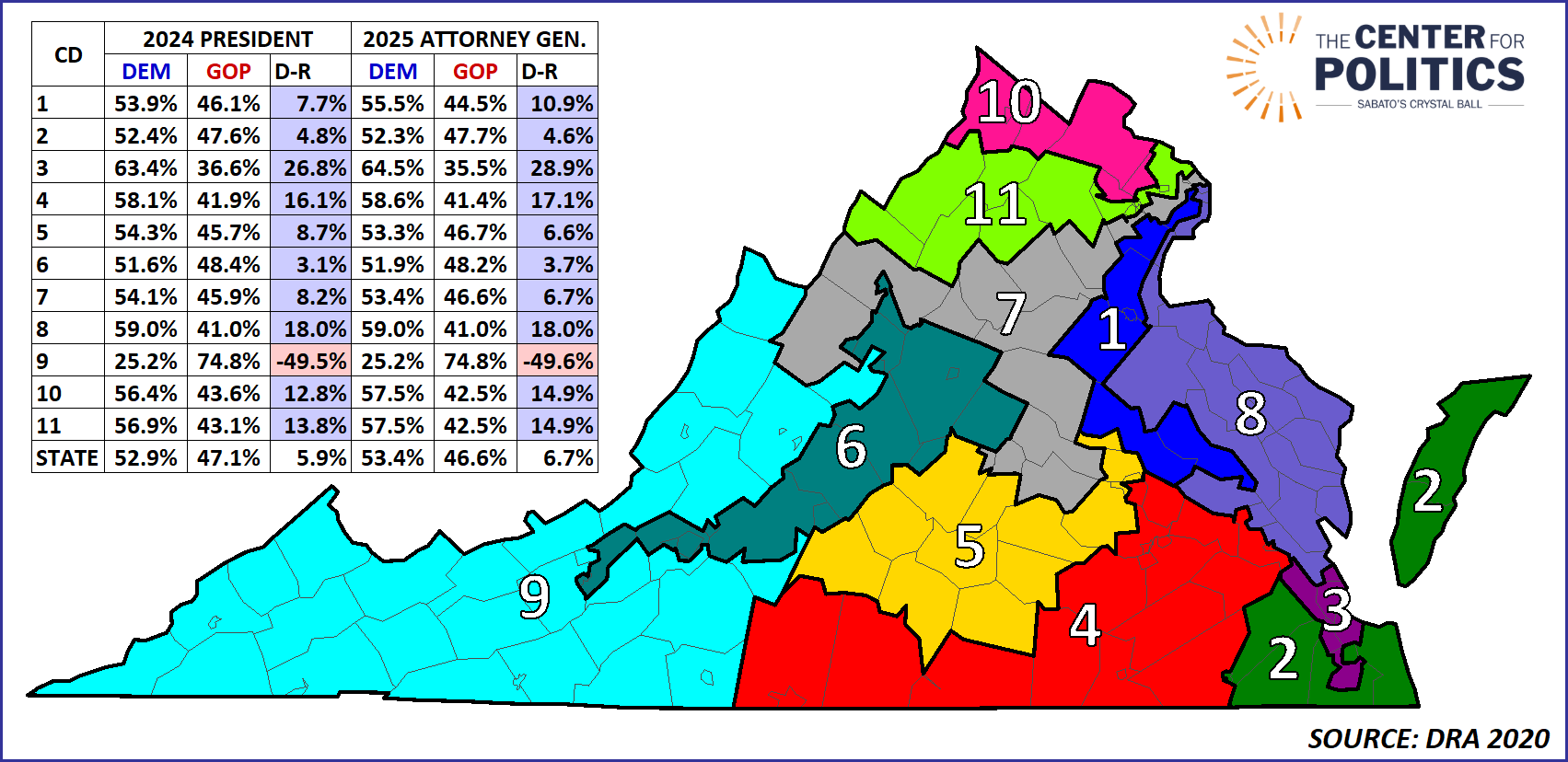
The new map is not totally without downside risk for Democrats. Five of the state’s districts were carried by Kamala Harris by single digits, leaving Dem incumbents vulnerable in a Republican wave year or should Virginia revert to being more purple.
But the reward is worth it. Axios estimates that Democrats have actually gained ground from the mid-decade redistricting war that began in Texas. And Kyle Kondik calculates that the map that will be contested in November is almost perfectly fair.
There are still court decisions left in a few states, and our model will provide a more precise version of this calculation once it launches — it wouldn’t shock me if the map winds up slightly favoring Democrats.1 Still, if Democrats win the popular vote for the House by any margin (and they probably will) they’re very likely to take control of the chamber.
Nobody likes I-told-you-so’s, but … well … here’s what I wrote in August:
Democrats can win the redistricting war

Democrats are fighting mad about Trump-led Republican efforts to conduct mid-decade redistricting in Texas and other states in advance of next year’s midterms — and,…
That column pointed out that if both parties took a truly maximalist approach to redistricting, it might actually work to Democrats’ benefit. Although Republicans have a gubernatorial/legislative trifecta in more states, Democrats’ trifectas are in more populous states. So once Abigail Spanberger flipped Virginia’s governorship in November, Democrats inherited trifecta control over a larger number of Congressional seats:
Another part of my theory was that Democrats tend to turn out in bigger numbers than Republicans for any sort of special election like the one in Virginia yesterday, which makes the party more nimble if districts are constantly being rejiggered.
The Virginia margin was underwhelming, but the result was still impressive
But here’s some grist for the Nate haters: in Virginia, part of my “I told you so” deserves a demerit. As Patrick Ruffini points out, turnout was actually higher yesterday in red-leaning counties where voters are understandably concerned about losing their representation in Congress to gerrymandered districts.
It wasn’t enough to carry the day, though: “yes” won by 3 points. (Results aren’t official yet.)
One could argue that the margin was a little underwhelming. Harris won Virginia by 6 points in 2024 in a mediocre electoral environment for Democrats; “yes” won by 3 with Trump’s approval rating at 38.8 percent and falling. There were a few voters like Virginia resident and friend-of-the-newsletter Matt Glassman who voted “no” on principle.
Indeed, yesterday’s result may come to represent the upper bound for how far Democrats are willing to push things. In a slightly more purple state or in a slightly more red-leaning political environment, the referendum might have failed. And Spanberger’s downside is protected because governors in Virginia are limited to one consecutive term. Change any of those factors, and I’m not sure you’re going to see governors pushing for this. I wouldn’t expect Michigan’s Jocelyn Benson to campaign for partisan districts in that state should she and Democrats win a trifecta there later this year, for instance.
On the other hand, this is a pretty damned impressive display of partisan coordination. Less than a decade ago, polls showed Democrats opposed to gerrymandering by 2:1 margins — note that Republicans were opposed to it by almost as wide a margin. And one of Barack Obama’s and Eric Holder’s big post-presidency projects was to fight for “fair maps”, which used to mean opposing gerrymandering and partisan control over districting.

Obama urged Virginians to vote yes, however.
Is this hypocritical? Yeah, kind of. But I’d like to play a tune from the world’s tiniest violin for Republicans who are crying foul about all of this. Gerrymandering goes back to the early days of the republic, and mid-decade redistricting is basically a Republican invention upheld by Republican-friendly courts. The recent lineage goes back to Texas — but actually Texas in 2003 under Rick Perry and Tom DeLay rather than last year.
Democrats solved for the equilibrium
Personally, I think having fewer competitive seats and less representative districts is pernicious to representative government. But I don’t think something like Virginia is a particularly close call.
It’s completely obvious that you can’t have unilateral disarmament, and some measure of credit should go to Gavin Newsom (not usually my favorite politician) who kicked things off by fighting back instead of just complaining.
Democrats in Virginia understood what was at stake. The county-by-county margins were almost perfectly aligned with the 2024 presidential vote:
The closest thing to an exception was in the Northern Virginia counties shown in dark blue. These are home to the canonical “high-information” voters, with many residents who work for the federal government or government contractors. These counties were generally above both trendlines, meaning that in some suburban DC counties like Fairfax and Loudoun, the yes margin actually beat Harris’s over Trump last year.
Yes, consuming lots of political news often correlates with being highly partisan, but this is one case where naked partisanship helped steer Democrats in a more strategically optimal direction.
Perhaps because my degree was in economics, because I play a lot of games — OK, really just poker, but I play a lot of poker — and because I’ve spent a lot of time covering highly competitive environments like sports, my brain tends to want to “solve for the equilibrium”. If one “player” in the game makes a move, I assume that the other party will reciprocate by employing roughly their most self-interested strategy according to the tenets of game theory.
That doesn’t always yield flawless predictions about political behavior. If Democrats were perfectly rational, they’d probably have nominated someone other than Harris (although she was a big improvement over Joe Biden). And it’s hard to understand what Trump has gotten politically or otherwise from starting a war with Iran.
But when the incentives are simple and straightforward, voters usually behave rationally. And a democratic system — even a competitive authoritarian system like Hungary — is often a resilient way to express those preferences.
Don’t like this? Ask Congress for help.
In game theory terms, redistricting is a classic prisoner’s dilemma. The rational move is to “defect” and screw over your “partner” unless you have some means of coordination or cooperation. What most people don’t understand about the prisoner’s dilemma, though, is that it’s not a zero-sum game: the prisoners would be better off if they could trust one another. But if they can’t, it’s every man for himself.
I think it goes without saying that even if Republicans “started it”, we’re locked into a race-to-the-bottom now given extraordinarily high levels of partisanship. In this cycle’s redistricting wars, there have been a few pockets of resistance: Indiana for Republicans and Maryland for Democrats. And there are a few voters like Glassman who will take a principled stance.
But not many. If the parties can’t trust one another, Texas and Virginia are what you’re going to get until and unless there is some enforceable means of coordination.
And that means regulation. It’s not going to come from the Supreme Court, or at least anything resembling SCOTUS’s current construction. In 2019, with Ruth Bader Ginsburg still on the court, the Supreme Court ruled 5-4 in the Rucho vs. Common Cause decision that control of districting was a “political question” — in other words, up to Congress.
I don’t think it’s completely crazy to think that bipartisan legislation on redistricting could someday pass Congress. In the abstract, gerrymandering is still quite unpopular with voters. It might grow more unpopular when voters in Texas and Virginia realize in November that their longstanding member of Congress has been displaced because districts have been changed and they’re now represented by someone in a completely different part of the state.
Furthermore, it ought to be unpopular with current elected officials, since they’re often unseated by aggressive redistricting.
But it’s tough. You need a system that 1) both parties agree is roughly fair, 2) that will withstand legal scrutiny and 3) doesn’t have too many loopholes.
It’s honestly the kind of problem that some sort of bipartisan good government group might want to get to work on, understanding that partisanship will probably have to retreat from its current levels before some sort of solution is actionable. And while I’m more optimistic than most pundits about the future of American democracy, I’m not asking to volunteer.
There are a couple of reasons for this. One is that Democratic districts tend to have fewer voters on average, so they get a little more mileage out of every vote. Another is that Democrats have shown some tendency to direct campaign contributions to swing districts and states, which can produce a point or two of overperformance in the most important races.
"It’s completely obvious that you can’t have unilateral disarmament." Yes, so Obama and Democratic leaders are not even "kind of" hypocritical here. It's perfectly consistent to (a) wish for different rules and to even push for different rules and to even push for different rules on ethical grounds on the one hand while (b) playing by the rules you have in the meantime, and playing them just as ruthlessly as the other fella. In fact, pulling back on (b) is not only political malpractice but it undermines (a) by unfairly allowing your numbers to be diminished. In other words, you have to gerrymander in order to get even a chance of gerrymandering reform.
One analogy I like: Suppose you don't like the designated hitter rule and, in a perfect world by your lights, pitchers would have to bat or be replaced in the lineup. Let's say that you're in the business and have been outspoken about that view. Let's further say that you become the manager of an American League team. It wouldn't be even "kind of" hypocritical for you to use the DH rule as the other team does. Indeed, it would be absolutely insane for you to have your pitcher bat on principle.
You might say in response that the DH rule has zero ethical aspect, whereas gerrymandering does. It's actually wrong, you might say, for politicians to pick their voters rather than the other way around. I actually agree. But unilateral disarmament *compounds* that injustice by, in essence, requiring that the baddies win. In that case, you're just a stupid chump who's made the world worse. You haven't gotten rid of gerrymandering. You've just made it so one side profits by it.
"And Kyle Kondick calculates that the map that will be contested in November is almost perfectly fair."
You should probably clarify that Kondick is referring to the national map as being fair, not Virginia. Because there's not really any way to say that Virginia's map is fair. It's a state where 52% of the population voted for Democrats but will have 92% Democrat representation in the House. 40% difference is not the biggest gap, but all the states with bigger gaps (NH, NM, ME, RI, CT, IA) are small population states with only a few seats (2, 3, 2, 2, 5, 4) compared to Virginia's 11. The next most lopsided state with more than 5 seats is MA with 9 seats and also a ~40% difference, then IL with ~30% difference and 17 seats. One might also note that VA, MA, and IL are all very blue states. The TX redistricting will cause a difference of about 25% by comparison, slightly below the difference in CA. By this measure, the Democrats are much more aggressive with their gerrymandering than the GOP.