

What is Heather Cox Richardsonism?
No longer just a Substack: it's one of the 3 emerging factions of the Democratic Party.


First, it was Blueskyism. Now, it’s “Heather Cox Richardsonism”? Given the changes to the algorithm, tweets don’t really go “viral” these days unless they fall into one of a few dubious niches. But this one from the weekend sparked a relatively big reaction, both on X and (negatively, of course) on Bluesky.
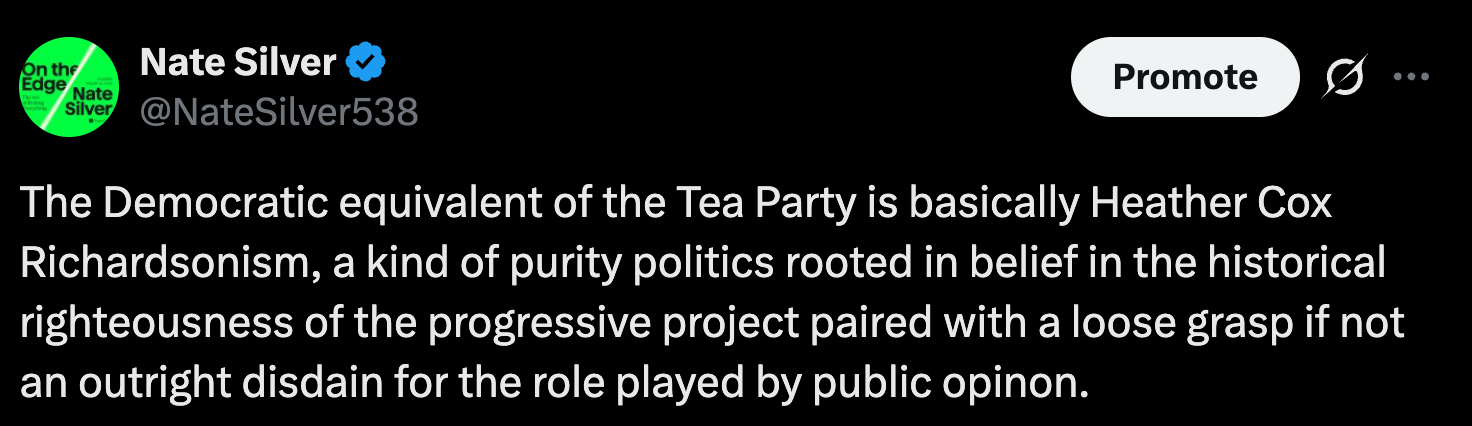
I think it was a good tweet, but there’s more behind it than can easily be expressed in 280 characters. So, as part of the occasional Silver Bulletin series “Nate’s tweets, explained”, let’s work our way through it.
Heather Cox Richardson is a historian who earned her PhD at Harvard and who now teaches at Boston College — and one of the most influential political writers in America. HCR’s Substack, “Letters from an American”, had seemed like an unlikely hit when it first spun out of a series of Facebook posts late in Trump’s first term. But it has since only grown in influence. It currently ranks #3 on the U.S. Politics bestseller list, by far Substack’s most popular category.
Although Richardson rarely paywalls posts, these leaderboards are based on paid subscription revenue (meaning that people frequently sign up for a paid sub anyway out of loyalty to her cause). The only other publications that rank higher in the category, The Free Press and The Bulwark, have dozens of contributors and use Substack as a publishing platform for what are essentially traditional mid-size newsrooms (to the extent that category still exists in 2025). HCR is much more of a solo operator. Her newsletters, like On Kawara’s paintings, are labelled by the date (e.g., “December 12, 2025”), usually arriving in my inbox around midnight from her home in coastal Maine.
While I doubt this was Richardson’s intent, this is in some ways an admirable example of American entrepreneurship. She provides allyship to a market niche — older, college-educated, normie liberals, especially women — that is poorly served by a mainstream media perpetually chasing younger, often male audiences. And furthermore, which has taken a rightward turn under Trump 2.0, increasingly reflecting the political preferences of wealthy owners and publishers. It’s safe to assume that HCR is earning millions of dollars per year from “Letters from an American”. But many people have made orders of magnitude more money by being, for instance, early investors in Bitcoin. So all credit to her success; nevertheless, it’s an interesting cultural and political phenomenon.
A thousand flowers are going to bloom in the Substack ecosystem. A fair number of you subscribe to both Silver Bulletin and other authors whom I frequently disagree with, and that’s great. (I’m not sure how you’d measure this, but I’d guess we’d rank highly in political diversity among comparably-sized Substacks.)
There is almost certainly a wider range of voices represented in the media today than a quarter-century ago, when the milquetoast, group-thinky centrism of shows like Meet the Press tended to drown out all other perspectives except Fox News and right-wing talk radio. In the older days, Richardson probably wouldn’t have been given the same opportunities. Or if she had, she would be literally somewhat boxed in by TV bookers into speaking toward particular talking points or playing a certain “TV-ready” role. But while success on Substack genuinely brings a lot of freedom, it also risks audience capture.
It also means that Richardson, however reluctantly,1 has become a political celebrity, an avatar for something bigger than herself. Having experienced a little of this myself, I know it can put you in an uncomfortable position. You’re minding your business, and suddenly you’re getting recognized at the grocery store and hundreds of thousands of people — millions in HCR’s case — are hanging on your every word.
Since they were dropped from the SAT, let’s revisit how analogies work
So, while I’m empathetic to HCR, she has a very big platform. And I don’t think her success is any accident: it reflects the evolution in how a large segment of the Democratic base has reacted to Trump. Let’s get back to that tweet which called “Heather Cox Richardsonism” the “Democratic equivalent of the Tea Party”.
I’m not saying that they’re exactly alike. Suppose I tweeted that “The European equivalent of New York pizza slices is basically donor kebabs”. This is not intended to imply that donor kebabs are a type of pizza or that pizza is a sandwich. Rather, they serve some analogous functions as greasy, tasty, cheap, late-night food, typically ordered at a counter and messily consumed somewhere on or near the premises. The contrasts are also interesting: why are pizza slices2 in Europe usually kind of shit?
So when I write about “the Democratic equivalent of the Tea Party…” this analogy implies similarities as well as differences, differences shaped by the contours of the respective demographics of Democrats and Republicans, their relationship with various institutions and their formative political experiences.
I’m hoping to do a Part II of this that goes through the comparison more explicitly. But this isn’t coming out of nowhere. The tweet was basically a spin-off from last week’s newsletter about Democrats' increasingly angry mood and how that could lead to some electorally suboptimal choices.
Nor is the comparison particularly original. In October, the Ettingermentum Newsletter (always a great read, even when I disagree, which I often do) published a post entitled “The Democratic Party’s Tea Party Moment Has Begun”. It cited some of the same factors that I covered in last week’s newsletter, such as the political rise of Jasmine Crockett and Graham Platner.
It also emphasized something else: a disconcerting reaction to Charlie Kirk’s assassination from a respectable, above-board liberal faction, including Richardson, who passed along misinformation about the political identity of the shooter to her 2.7 million-person-strong email list:
But in fact, the alleged shooter was not someone on the left. The alleged killer, Tyler Robinson, is a young white man from a Republican, gun enthusiast family, who appears to have embraced the far right, disliking Kirk for being insufficiently radical.
Rather than grappling with reality, right-wing figures are using Kirk’s murder to prop up their fictional world. Briefly, they claimed Robinson had been “radicalized” in college. Then, when it turned out he had spent only a single semester at a liberal arts college before going to trade school, MAGA pivoted to attack those who allegedly had celebrated Kirk’s death on social media.
After having speculated without evidence that Robinson was a “Groyper” who had killed Kirk for being insufficiently conservative, Richardson was proven wrong by subsequent events. But she made no effort to correct the record, and her misleading interpretation traveled widely. There is possibly even a thread between Richardson’s newsletter and Jimmy Kimmel getting suspended, for example, after he repeated a similar theory on his show.
I agree with Joshua A. Cohen (a.k.a. Ettingermentum) that this seems like a revealing moment for Democratic politics. That such an influential person, a history PhD from Harvard who claims to be highly concerned about misinformation, would commit a misinformation misdemeanor of her own — that seems significant. Democrats have had their problems with epistemic bubbles, but this one hit a little differently.
Richardsonism and the 3 factions of the Democratic Party
I’d argue that there are three main factions of the Democratic Party as the jockeying is already underway for the 2026 and 2028 primaries. First, there’s the Capital-L Left: populist, deservedly feeling recharged by the success of Zohran Mamdani and a backlash to the increasingly politically assertive billionaire class.
Next, there’s what you might think of as the Abundance Libs: technocratic, more willing to find common ground with Republicans, and more sympathetic to market-based solutions. I’m a big fan of Ezra Klein and Derek Thompson, the authors of Abundance, but I think the project is more neo-liberal than left-wing — to me, not such a bad thing! That’s a subject for a different newsletter, however.
The third faction Richardsonism or a term I’ll treat as synonymous with it: #Resistance Libs. They’re older, with extremely high educational attainment, predominantly female, and very highly politically engaged. This is the audience for a cluster of political activism encompassing things such as the No Kings protests and some highly popular anti-Trump Substacks3 along with certain prominent podcasts and much of Bluesky.
(You could argue for the existence of a fourth faction, the Social Justice Left a.k.a. the woke left, but I’d claim that it’s largely been absorbed into the others.)
If you’re a longtime reader of Silver Bulletin, you’ll know that it’s the #Resistance Libs whom I clash with the most. Partly, that’s a matter of taste: I’m not going to lie, I find them kind of cringe. But it’s also because I think they have the worst political instincts of the three groups — for instance, in their infatuation with Gavin Newsom and their steadfast defenses of Joe Biden’s decision to run for re-election.4
It’s also because I sometimes find them hypocritical. What purport to be principled defenses of democracy are often just defenses of the Democratic Party.
But whatever you call this faction — The #Resistance or No Kings or Richardsonism — I think one must identify it as a distinctive thing. Richardsonism often clashes with the Abundance Libs, especially on questions of “electability” and the strategic benefits (or lack thereof) of moderation. But it also doesn’t always vibe with the Capital-L Left. There’s not a lot of economic populism, for instance. Take a look at this field survey of No Kings protestors published by Axios. What were their top issues?
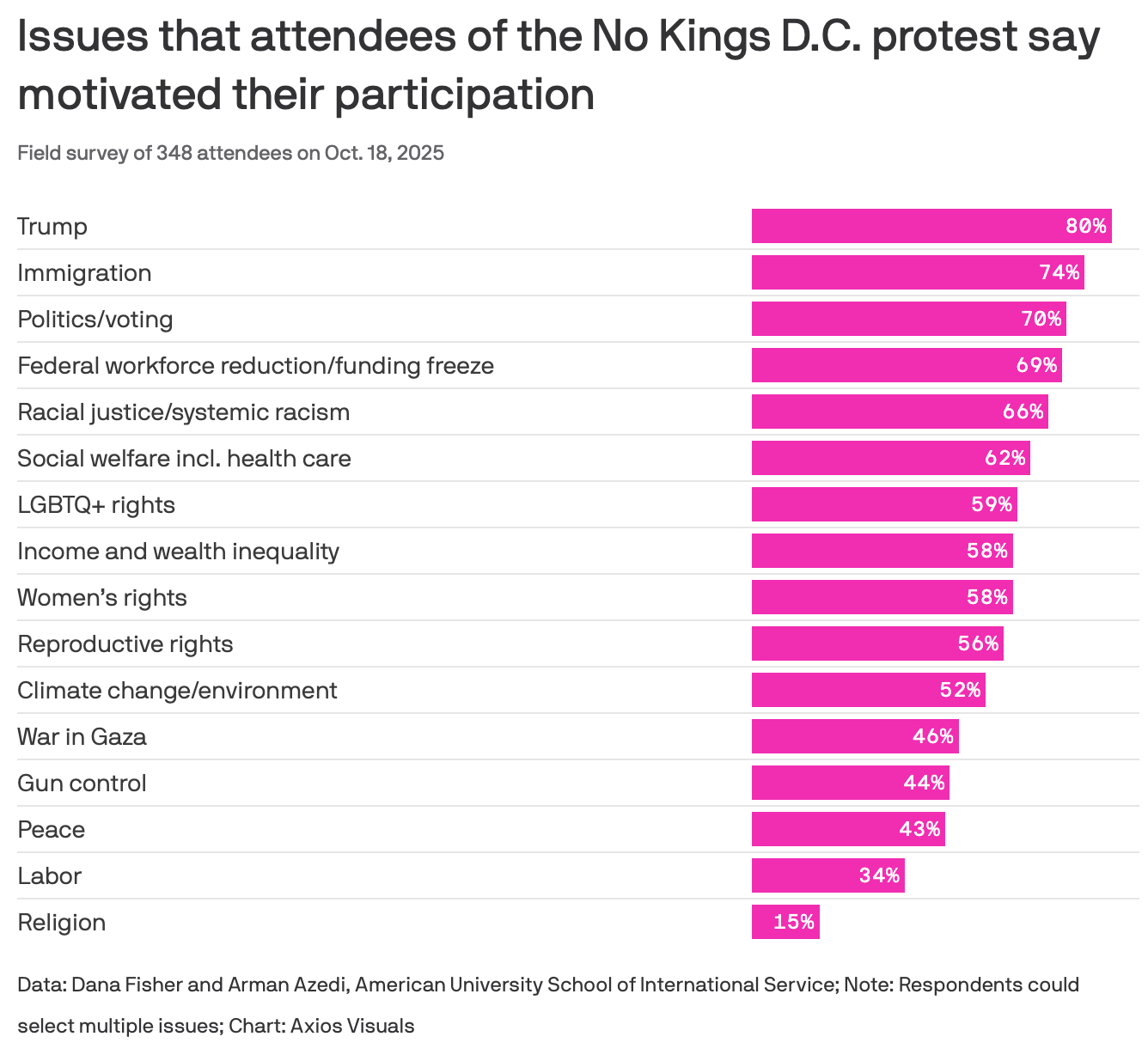
There’s King Trump himself on top, of course. But immigration rated considerably more highly among protestors than health care or social welfare, in contrast to the general public’s greater interest in economic issues. (Among the broader electorate, most voters citing immigration as their #1 issue are Republican-leaning — according to the AP VoteCast exit poll, they chose Trump over Harris by an 88-10 margin last year — while the No Kings voters are anything but that.) There are also some echoes of wokeness on the No Kings priority list: racial justice/systemic racism rated more highly than income and wealth inequality among the No Kings crowd, and LGBTQ+ rights on par with it.
In fact, some of the best critiques of Richardson have come from writers like Cohen and Nathan J. Robinson who are well to my left. Here’s Robinson in a 2023 review of Richardson’s book, Democracy Awakening:
Essentially, Richardson seems to believe that there is a war between democracy (good) and autocracy (bad), and that the forces of democracy are represented by the Democratic Party while the Republican Party are bigots, thugs, and would-be dictators. And while I wouldn’t quibble with any part of that description of the Republicans, I think Richardson is not nearly critical enough of the Democratic Party, which appears in her story almost entirely innocent and wholly devoted to the well-being of the American people. My own belief is different: I think until we recognize that failures by the Democratic Party helped to bring us Donald Trump, we cannot shore up the country against the authoritarian threat that Richardson and I are both alarmed by.
I don’t agree with Nathan Robinson on much, but I’d endorse almost every word of this. There’s no shortage of reasons to feel legitimate outrage about Trump, from January 6 to tariffs to disrespect for the rule of law to cronyism to gutting the CDC to even simple meanness, like his Truth Social post yesterday that attributed the tragic murder of actor Rob Reiner and his wife to “TRUMP DERANGEMENT SYNDROME”.
Where I find common ground with Robinson is in being skeptical that Richardsonism is helping the pro-democracy cause as much as it claims to. Robinson and I both have a low opinion of the political efficacy of the Democratic Party establishment, even if we’d undoubtedly recommend different sets of course corrections to it. But the Richardson wing of the party is as pro-establishment as it gets. Richardson twice interviewed Biden, and there was no pretense of journalistic distance.5 “Mr. President, it’s such a joy to be here with you in this historic room, on this historic day, with a historic president,” began her 2022 interview. Nor were there any questions about the war in Ukraine, even though Russia had invaded just a day earlier.
Purity politics and Richardsonism’s aversion to self-reflection
Indeed, while both the Capital-L Left and the Abundance Libs do their fair share of self-critique, it’s conspicuously lacking from the Richardsonists. In fact, the #Resistance Libs often reject any attempt to even characterize their approach to politics.6
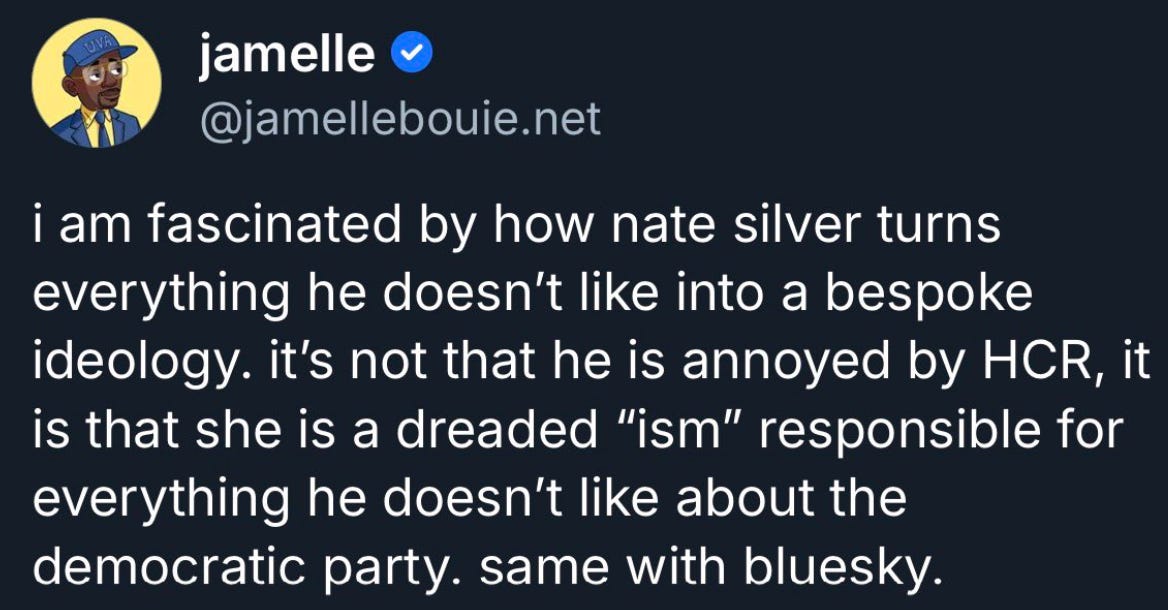
Yes, as the New York Times’s Jamelle Bouie points out, I’m fond of my little categories and “isms”. Blueskyism shares some attributes with Richardsonism, such as a reverence for academics, although they’re not exactly identical. (Bluesky has a mean streak that is very much not shared by the kinder, gentler Richardson, for instance.)
While you’re welcome to disagree, I think these anthropological explorations of the Democratic Party are one of the better beats we have going at Silver Bulletin. Furthermore, I think I can offer an interesting vantage point, being fairly liberal myself but having backed into politics in a weird way such that I’ve always felt like an outsider to the field.7
I also think these distinctions help explain both some of the seeming contradictions you’re seeing in the Democratic Party today and where it might turn next. The Left has some 2028 frontrunners like AOC; the Abundance Libs have Pete Buttigieg and Josh Shapiro, among others. For the #Resistance Libs, despite sometimes styling themselves as “contrarian”, the top candidate is Newsom — or perhaps even Harris again, who is reportedly leaning toward another presidential run. The podcaster Jennifer Welch was just hailed in a New York Times headline as the “Democrats’ Toughest Critic” — but she recently hosted a book party for Harris, which wouldn’t seem to represent a particularly critical position.
The aversion to course-correction reflects what I think of as “purity politics”. We are the good voters, the righteous ones, not like those racist, fascist, neo-Confederate and/or Christian ethnonationalist MAGA types. How would you even dare to criticize us?
The sense of being on the right side of history is compounded by two other factors that make Richardsonism resistant to criticism. One is the success of the business model. It’s hard to change lanes when you’re constantly getting positive reinforcement in the form of likes and subscribers.
The other factor is the claim to academic expertise, which is highly persuasive to Democrats who are rightly concerned about Trump’s war on elite higher education and the anti-scientific turn among people like RFK Jr. Still, this risks making voters easy marks for anyone with a PhD in their bio.
Richardson cites sources at the end of each edition of “Letters from an American” rather than providing links throughout her posts. This makes them seem more scholarly, but it obscures the fact that her sources are often just random partisans on Bluesky or Twitter. I’m confident that Richardson’s citations for claims about American history are often rigorous. But when it comes to analysis of modern electoral politics — i.e., my area of expertise — she often cherry-picks from the most unreliable sources.
She’s also frequently more partisan than principled. Joe Biden got a complete pass, in Richardson’s world, for pardoning his son Hunter. And while she spread misinformation about Kirk’s killer, she wrote highly sympathetically about Luigi Mangione after he assassinated a health care CEO. It’s hard to find even the most perfunctory attempts at appeals to higher principles in Richardson’s writing when they involve questionable choices made by Democrats.
Furthermore, it’s common to read things from Richardson that edge up against the definition of propaganda. Here, for example, was Richardson’s take the night after Biden’s disastrous debate with Trump last June:
Tonight was the first debate between President Joe Biden and presumptive Republican presidential nominee Donald Trump, and by far the most striking thing about the debate was the overwhelming focus among pundits immediately afterward about Biden’s appearance and soft, hoarse voice as he rattled off statistics and events. Virtually unmentioned was the fact that Trump lied and rambled incoherently, ignored questions to say whatever he wanted; refused to acknowledge the events of January 6, 2021; and refused to commit to accepting the result of the 2024 presidential election, finally saying he would accept it only if it met his standards for fairness.
Immediately after the debate, there were calls for Biden to drop out of the race, but aside from the fact that the only time a presidential candidate has ever done that—in 1968—it threw the race into utter confusion and the president’s party lost, Biden needed to demonstrate that his mental capacity is strong in order to push back on the Republicans’ insistence that he is incapable of being president. That, he did, thoroughly. Biden began with a weak start but hit his stride as the evening wore on. Indeed, he covered his bases too thoroughly, listing the many accomplishments of his administration in such a hurry that he was sometimes hard to understand.
A lot of this feels like gaslighting the reader, denying what they saw with their own eyes and ears. Biden’s only problem was that “he covered his bases too thoroughly” (!!!). “Pundits” criticized “Biden’s appearance and soft, hoarse voice” — Richardson is suggesting that Biden was struggling only on style points, when in fact he was frequently literally incoherent in uttering phrases such as “we finally beat Medicare”. Later in the post, Richardson claimed that “different polls gave the win to each” of Trump and Biden, which is another little nugget of misinformation. Every scientific poll showed Biden as the clear loser.
Democracy requires walking and chewing gum at the same time
More common than outright misinformation from HCR, though, are explanations of electoral phenomena that don’t align with the bulk of the evidence or the consensus of experts who study elections for a living. Here, for instance, is Richardson’s dispatch from Nov. 6, 2024, the day after Harris’s loss last year:
These results were a surprise to everyone. Trump is a 78-year-old convicted felon who has been found liable for sexual assault and is currently under indictment in a number of jurisdictions. He refused to leave office peacefully when voters elected President Joe Biden in 2020, instead launching an unprecedented attack on the U.S. Capitol to stop the counting of electoral votes, and said during his campaign that he would be a “dictator” on his first day in office.
It’s trite to invoke the apocryphal Pauline Kael line about not knowing anybody who voted for Richard Nixon, and therefore being surprised by his win. But even if Richardson herself was shocked by Trump’s victory, what sort of epistemic bubble is she living in if she claims the results were a surprise to everyone? Trump had won before, in 2016. And this time around, while the polls weren’t fantastically accurate, they showed as close to a toss-up as you can get: the final Silver Bulletin forecast was literally almost 50/50.
Should Richardson “stay in her lane” and only focus on history, not contemporary electoral politics? No, I’m not asking for that at all. But if you’re going to send out missives about electoral politics to 2+ million subscribers, you probably ought to “do the reading” about the many reasons that a Trump win was, at a minimum, highly plausible. Richardson, in her post-election newsletter, made almost no mention of immigration, for example, even though border crossings spiked after Biden adopted lax policies despite frequent warnings from more moderate Democrats about the electoral downside.
What did she blame Harris’s loss on instead? She does attribute some of it to inflation, along with racism and sexism. But the lynchpin was “disinformation”. Richardson even dropped a reference to “Russian political theorists” (and later cites the example of “Right-wing influencer Benny Johnson, previously funded by Russia”). So there are echoes of 2016 here, although she isn’t going full Russiagate:
Pundits today have spent time dissecting the election results, many trying to find the one tweak that would have changed the outcome, and suggesting sweeping solutions to the Democrats’ obvious inability to attract voters. There is no doubt that a key factor in voters’ swing to Trump is that they associated the inflation of the post-pandemic months with Biden and turned the incumbents out, a phenomenon seen all over the world.
There is also no doubt that both racism and sexism played an important role in Harris’s defeat.
But my own conclusion is that both of those things were amplified by the flood of disinformation that has plagued the U.S. for years now. Russian political theorists called the construction of a virtual political reality through modern media “political technology.” They developed several techniques in this approach to politics, but the key was creating a false narrative in order to control public debate. These techniques perverted democracy, turning it from the concept of voters choosing their leaders into the concept of voters rubber-stamping the leaders they had been manipulated into backing.
Indeed, this is another version of the Big Cope: attributing Democrats’ losses to unfair media coverage. We’ve covered the Big Cope extensively before, including in last week’s post, so I won’t dwell on it here. Richardson at least attributes more of it to Fox News and less to, say, the New York Times, which is the better version of the case.
Still, she deprives voters of having any agency: if you voted for Trump, you must have been duped. But how does Richardson account for her own surprise about the outcome?
And Richardson clearly reads widely, so she must be aware that many people pointed out the error in her assumptions about Kirk’s assassin. How does she explain her own role in spreading misinformation? Does she still think that Tyler Robinson actually was a Groyper? If it was inadvertent — she read something from a trusted source that turned out to be wrong — she ought to have corrected the record.
Or, is there a sort of utilitarian calculation here? Because Richardson views Trump as an existential threat to democracy, does that mean she sees her role as more that of a political operative — operatives are never held to high standards of accuracy in the first place — and less as an academic operating at arm's length? She’s well within her rights to do that, I suppose. Lots of prominent liberals — including Klein, for example — navigate a boundary between being a commentator and a player in the system. Nonetheless, Richardson’s scholarly, detached tone8 masks what is sometimes partisan cheerleading.
Moreover, democracy requires living in an electorate where many voters are misinformed — or otherwise exhibit ”deplorable” characteristics. So here’s my challenge to Richardson and other #Resistance Libs. Name one prominent electoral issue on which your personal view of what’s right might nevertheless harm Democrats in their effort to win elections?
One of mine is immigration. I’m an unabashed lib on this, to the left of probably 85 percent of the country. I favor enforcement at the border, but I’d like to see much higher levels of legal immigration: maybe not 1 billion Americans, but perhaps double or triple the current quotas.
This isn’t as unpopular as you might think.9 Nevertheless, if I were advising a Democratic candidate, I wouldn’t advocate for them to propose the Nate “let’s triple immigration!” plan. By a 44-35 margin, voters still trust Republicans more than Democrats on immigration. Trump’s approval rating on immigration is a net negative-5: not great, but considerably better than his overall numbers or his negative-17 on the economy.
What I’m suggesting here is something that ought to be pretty basic: in a democracy, you need to be able to walk and chew gum at the same time, keeping in mind that your political preferences might not match those of the median voter. Prioritization is also a consideration in an attention economy where voters have limited bandwidth. That doesn’t mean that you always want to roll over your political capital into the next election. Sometimes, you want to cash your chips in for a win. Democrats paid a high political price for Obamacare, for instance, but now millions more Americans have health insurance.
So, when people like Bouie write that “what substantively seems to annoy silver is the existence of people with principles”, they’re getting it wrong. No, what annoys me is people like Richardson or Bouie who don’t understand the is-ought distinction between the world they think ought to exist — where Biden won a commanding reelection victory and Trump is in jail — and the messy political world that we’re really living in. But who, at the same time, are not particularly principled when it comes to recognizing bad behavior on their own side. And who have other poor epistemic habits, including sometimes spreading misinformation themselves. I’d have more admiration for Richardsonism if it were either ruthlessly effective at politics or meticulously clear-eyed and consistent about its principles. It often winds up somewhere in between, squaring the circle with garden-variety Democratic Party partisanship.
But that’s normal. It’s usually what happens to political movements in a two-party system. And Richardsonism is coalescing into something more than a merely very popular Substack. Whatever you call it, it ought to be treated (like Abundance or theTech Right) as one of the winning political movements of the past several years. That means it deserves to be analyzed, criticized, mocked and celebrated, as any significant political movement is. And treated as harnessing a political gravity of its own, rather than just rolling with the evening tides on the Maine seashore.
If, however, lucratively. There are definitely perks!
As opposed to whole pizzas.
Not just Richardson’s; probably at least half of the Substack U.S. politics leaderboard these days falls into adjacent categories.
I understand that might seem like a controversial statement, given the Capital-L Left’s notorious lack of success in American politics. But a handful of explicitly left-wing politicians, especially Zohran, Bernie and AOC, are pretty damned good at politics, perhaps because they understand that they’re operating as underdogs and place a heavy emphasis on persuasion.
Not that Richardson would necessarily regard herself as a journalist.
This was also true of the Social Justice Left, which often objected to being identified as “woke” or by any other label, even though it shared distinct ideological and political characteristics that strongly distinguished it from both traditional leftism and traditional liberalism.
Although my policy preferences are clearly closer to the Abundance Libs than the other two groups.
In her newsletter — there’s not much detachment in the Biden interviews.
There’s been a backlash to the immigration backlash from voters who find Trump’s deportation policies abhorrent. (In one recent poll, 28 percent of voters favor increasing legal immigration versus 21 percent who would decrease it — those numbers have inverted from last year — while 49 percent prefer maintaining the same levels.)
My problem with this article is that it seems very much like a vibes based analysis than anything. I'm not an HCR reader, but some of the surrounding evidence used for critique of this supposed branch of Dems that she represents seems...not very rigorous.
For instance, what evidence is there to suppose that Kamala is the preferred nominee for Resist Libs? And what exactly makes Newsom more of a ResistLib democrat than an Abundance one? Is a podcast episode from Oct of 2024 somehow more representative than when Newsom explicitly name dropped Ezra Klein and the Abundance movement while signing CEQA reforms earlier this year? (And even by the podcast metric, Ezra Klein just had him on as a guest on his show.)
It seems like a lazy way to group people based on personal feelings.
I trust HCR more on history, Nate more on elections, and neither of them much on diagnosing where the Democratic coalition is headed. Nate's snark-ridden take on HCR is a prime example of why he needs to steer clear of this.