

What Trump's latest slump means for the midterms
Could anything save Republicans in the House? Plus, previewing tomorrow’s Michigan primary. And our midterms model is coming soon!


Next week, we’ll launch our midterms model, with complete forecasts of the 435 U.S. House races, 35 Senate races, and 36 gubernatorial races on the ballot this November, as well as the overall likelihood of each party controlling each chamber and all kinds of other details.1
The model performed quite well in 2018 after the code was basically rewritten from scratch, and again in 2022 after some further tweaks mostly to reflect increasing political polarization. So we’re not looking to reinvent the wheel. However, AI tools are helpful for refining existing code, so we’ve cleaned up some minor inconsistencies, made the code faster, and tested a few hypotheses that should help around the margin.
We feel pretty safe about the timing because we got the model basically fully “working” over the weekend. Still, we need a day or two to make some further coding refinements, a day to write up the documentation, a day or two to test out some further empirical improvements on our punch list, a day or so to finalize the graphics, and some time to double-check everything and kick the tires on anything that looks weird. We’ll also surely have some “take” for you about Michigan after Abdul El-Sayed and Haley Stevens have their primary on Tuesday night. That’s a finite amount of work, but it probably lands us at early next week, not this week, for model launch. We greatly appreciate your patience and are looking forward to having a model-heavy autumn with both the midterms and ELWAY.
In line with our protocol for 2024, we’ll publish polling averages of key races for everyone, while the probabilities and forecasts themselves will be for paying subscribers.
Full disclosure: we typically increase our monthly pricing for new subscribers when we have a time-sensitive model like the midterm forecast running. This will not affect annual pricing, and it will not affect any existing paid subscribers. Pricing at Substack is always grandfathered in permanently, so long as you remain continuously subscribed. In fact, you can still lock in our “off-season” pricing until the model officially launches next week.
Yesterday, I chatted with Eli about the model, the midterms and Michigan — and Trump’s approval rating, which once again recently hit a record low in our tracking. You can find the video below, though it’s choppy in places2 so there’s also a lightly edited transcript below.
Nate Silver: Hey Eli, how are you doing?
Eli McKown-Dawson: Doing pretty well. How about you?
Nate: Good. I’m going to have some news for you and for Silver Bulletin in a minute that explains why I’m sadly kind of bleary-eyed.
The model is working, which is good. That doesn’t mean it’s done, but it means that it takes these files that we — mostly you — spent months gathering. I think there are 68 different input files that we use in the program.3 It goes through 14,000 lines of code, and it spits out coherent projections for the state and the national picture.
There are a lot of things we still have to vet. By the way, you almost gave me a heart attack last night. One of the variables that we use is a candidate experience variable, which runs on a scale of 0 for never elected to anything to 3 for a senator or governor. In the [data] we were using, a candidate with no experience got coded as a 9. Nine is sometimes used for missing data. The model interpreted a 9 as you’re fucking Gandhi crossed with Reagan crossed with Obama crossed with the Pope. You’re the most popular incumbent ever. So it had all these [inexperienced challengers] crushing [incumbents]4, and I’m like, “wow, we’re really out of consensus. That’s interesting.” And then we fixed that, and it became more normal.
I will say, we are going to spend a little bit more time debugging, vetting, building better graphics, and looking at new features. My guess, in true honesty, readers, is that we will launch the model a week from Monday, so the 10th. It’s not official — we’ll talk about it in our planning meeting. If life depended on it, we could probably launch this week. We have a big primary this week in Michigan, which we’re going to talk about a lot. But basically, we are on the final lap, I would say, Eli. On the checkered flag lap.
Eli: I do just want to say, I saw that message yesterday about the nine versus the zero coding. I’m fairly certain your original message about that did say to code those people as nines. So maybe it’s not just me making the nine mistake. But that’s okay.
Nate: It’s a one-line change in the code. I recoded all nines to zeros and all blanks to zeros. But it scared the hell out of me.
We [published] the World Cup model a couple of months ago, and in that model, you have the bare bones of a simplified version that actually kind of works. And then you refine it, and there are more and more steps that you add. Maybe you add secondary data sources or better ways to algorithmically process the data. So you get to see the results refining in real time. Of course, you don’t want to be too results-oriented.
[But] with the midterm model, 80 percent of the work is in gathering these 68 fucking files that we have, and making sure that the 550-odd races5 that we’re forecasting — governor, House, Senate — making sure all that information is accurate, merging candidates’ FEC IDs with their pollster IDs and that kind of stuff. So by the time you actually see what the model says for the first time, you’re 90 percent of the way through the work.
What’s the national environment looking like?
Nate: Do you have any questions about the model? I don’t want to commit to what it says because we haven’t debugged it yet and we haven’t vetted any of the outputs.
Eli: About what it’s saying right now, you mean?
Nate: Yeah. I’ll be vague as needed.
Eli: This is a tough one, but it’s one of the races I’m more curious about. What is Maine looking like? Maine Senate. What does the model think about that?
Nate: It has (Troy) Jackson favored. [But] I’ll put it like this: the notion that Maine and Michigan could be more challenging states for Democrats than you’d expect … [that] doesn’t ruin Democrats’ chances of taking the Senate as much as you’d think. And now I’m really spoiling content that we should be putting behind a paywall.
I think people forget the longer tail of races like Iowa, for example. If you look at Iowa, it is polling as a toss-up, basically. With the fundamentals, my guess is the model will have it as “lean R” — I don’t remember offhand — but Iowa is a big deal. Even a state like Nebraska, potentially, where Dan Osborn is running as kind of a quasi-populist independent and presumably would caucus with Democrats if it came down to that. There’s this longer tail of races that might get a little bit neglected, and it’s a longer and larger playing field than I think people might assume. We’re not going to be too far out of the consensus. There are other models, some of them are good, and they’re kind of mostly pointing in the same direction.
The other thing that I thought was interesting: a lot of [this] will change after Labor Day — but a lot of the generic ballot data, and sometimes the horse race polls, are denominated in registered voter currency. The way our model adjusts for likely voters, it used to be that Republicans reliably had a turnout advantage in midterm elections. Now that’s changing, as Democrats have the higher-turnout, college-educated coalition. We at this point are just starting out with a prior that you have zero conversion from RV to LV. However, we look at polls that survey both, and in those polls, Democrats gain a net of about two-and-a-half points among likely voters versus registered voters. So when you see the generic ballot number, which is D +6.2 or something…
Eli: It’s D +6.5 right now.
Nate: 6.5, right. Some of those are likely voter polls, some of them are registered voter polls. If all of them were likely voter polls, then that probably pushes it up to a +7 or a +8. As we’ve discussed before, if you’re in a +7, +8, +9 environment, that’s when some of these red states that are PVI +11 come into play. They become almost toss-ups. Democrats have also had very good fundraising numbers, for example, even though the DNC is having a great deal of trouble, and even though Elon Musk has pledged to donate X number of millions of dollars to the campaign. But in individual contributions, Democrats use their enthusiasm [edge]. They use tools like ActBlue to really penetrate pretty far down the map. And some of these populist candidates — maybe the model won’t love them, they don’t tend to have a lot of elected experience, and that is a variable that empirically matters — did raise a lot of money, too. So those things are all explaining why the playing field is a little bit broader for Democrats than you might think.
We’re [also] going to look at, for example, whether the generic ballot is more stable now. It used to be that no one was paying attention to Congress until after Labor Day. In recent years, you’ve been locked into the environment a little bit quicker.
One [other] thing we always look at or reevaluate is how correlated different races are. If you think about a presidential map where you have Kamala Harris and Donald Trump on the ballot in every state, it would be impossible to imagine Kamala Harris losing Maine but winning Ohio. In the Senate, you have 35 separate races that all have different candidates. States will have very non-uniform turnout, depending on how much money is spent there and how many races are competitive. Some will have almost a presidential-year turnout. Some will be very light.
And in 2018 and 2022, the midterm results were more regionalized than people expected. I think in both years the first substantive, important state to report its results was Florida. Eli, you’re from Florida. Florida has turned quite red, and so in both those years, the first results for Democrats looked disastrous. It turned out that actually Democrats had a very good midterm in 2018, but they lost the Senate seat in Florida. And they had a fine midterm year relative to expectations in 2022, when an unpopular Biden was president.
You also had some regionalization here in the New York-New Jersey area in 2022. We had a little micro Republican red wave that didn’t show up anywhere else in the country. We kind of made our bread and butter on models that understand properly the correlation between different races. That, in some ways, was the big Silver Bulletin slash FiveThirtyEight innovation. But people overadjust. It’s not as correlated in midterm years as it is for the presidency itself. And furthermore, the correlation between presidential races and midterms is a little bit lower when you don’t have an actual president on the ballot, and instead you just have an expectation based on previous voting patterns.
We’re also going to make the model faster. These AI tools are both incredible and at times incredibly frustrating, but usually they can find improvements that just make the code run faster and more efficiently. Eli, what do you want to talk about? Do you want to go down to Michigan?
Eli: I think Michigan. We kind of hit on that a little bit already, talking about the Senate and the model and what it’s thinking. One thing to add before we do, though, just on the registered voter/likely voter split: I looked at this last week. Right now, in the recent generic ballot polls, still something like 60 percent of them are among registered voters. So over the next couple of months we probably will start to see more of that shift, because right now most people really are still polling registered voters. We’ve not hit the point where that shift is happening yet.
Nate: Which is reasonable, right? People don’t necessarily know if they’re going to vote right now, and to some extent we want surveys of public opinion based on the broader population. But yes, that’s about a two, two-and-a-half point gap. It can sometimes be even more in individual states [than] on the generic ballot.
The generic ballot is a very weird, abstract question that behaves differently from other polling series. You wrote about this6, and we’ll repurpose that piece as a Model Talk at some point. But other people’s generic ballots are too bouncy. For whatever reason, empirically, there’s not as much herding on the generic ballot as on other polls. Meaning, in this Michigan race, every single pollster is El-Sayed +12 in the primary.7 That’s a little herding-ish. On the generic ballot you don’t have that as much. There are very strong house effects, as we call them. Different pollsters have different views. They don’t seem to be anchored to anything quite as much. What that means is that you have to be more patient and wait for more data to have a reliable average. And people who haven’t looked at that empirically wind up with polling averages that bounce around too much.
There are mathematical ways to test this. You don’t want it to be autocorrelated. This is getting more technical than I thought for a Sunday morning quote-unquote brunch chat. But if [your average] goes from D +5 to D +6, the predicted reading for tomorrow should not be D +5 or D +7. If you’re efficiently accounting for [all] information, then you set things such that it moves in the way that best predicts next week’s value on the generic ballot.8 And you need to use fairly sluggish settings on the generic ballot as compared with presidential approval, where you have a higher density of polls and maybe more consistency in how pollsters ask those questions and how people interpret them.
Eli: We saw this a little bit over the past month or so. In our average, the generic ballot peaked at around D +7, and then it reverted about a point to D +6. Other averages that weren’t doing quite as much smoothing as us had maybe a three-ish point drop, which was way too much. Because even with the usual variation — just last week there were a lot of incredible polls for Democrats coming out, D +7, D +10 — you still do have people showing it at D +4. Some pollsters are just very, very consistent, showing the generic ballot not moving at all. And when you get these periods where that’s all that’s coming out, you don’t want your average to over-index on those polls and revert too much to the D +4 area, which is definitely too low for what the environment actually is.
Nate: And look, we also have some precedent based on history. If you are looking at what presidential approval is … and you account for the fact that we do have greater polarization now … you’d probably expect Democrats to be +7 or +8. That’s [also] a familiar number if you’ve seen recent, non-2022 midterms.9 Why 2022 was only a relative ripple for Republicans is an interesting question. It may reflect the Democratic turnout enthusiasm advantage. It may reflect the shadow of Trump being unpopular. It reflects candidate recruitment in some cases.
But people don’t change their minds about this abstract question of which party you would vote for for Congress as often as they do about Trump. Let’s say you’re a cross-pressured voter, so there are some things you like about Trump. Maybe you like him on the economy, and maybe you think it’s cool how he got our player unsuspended from a red card in the World Cup. But then the war with Iran starts up again, and you hear [about] that, and you see some YouTube video, and you’re like, “oh yeah, that kind of sucks.” You change your mind more [often]. Or if you’re [a voter] in the Stevens-El-Sayed race. That race has now stabilized, but you’re picking up lots of advertising, lots of information about the candidates. But party [affiliation] is much more glacial. It gets locked in pretty early, and I think we’re seeing the effect tangibly.
Trump’s approval, if anything, has tanked even further [though].
How low can Trump’s approval rating go?
Eli: Today, his net approval is -20.6, which is an all-time low, both first and second term. At least in our retrospective averages, that’s the new low.
Nate: And this has been kind of the pattern. I think we were early, Eli, about telling people that the floor on second terms is a lot lower. Bush became profoundly unpopular in his second term, for example. There’s no need to rehabilitate the candidate Weekend at Bernie’s style for re-election. Then people are aspiring for how they’re going to position themselves for 2028, potentially. People are like, “well, at some point you’re going to run out of repercussions here if I defy you.” And [other Republican candidates] are concerned about their own races in D +8, D +10 type environments.
Eli updates the approval ratings every day, sometimes twice a day, three times a day. Has anything surprised you about this? Or what patterns have you learned from studying this obsessively for a couple of years?
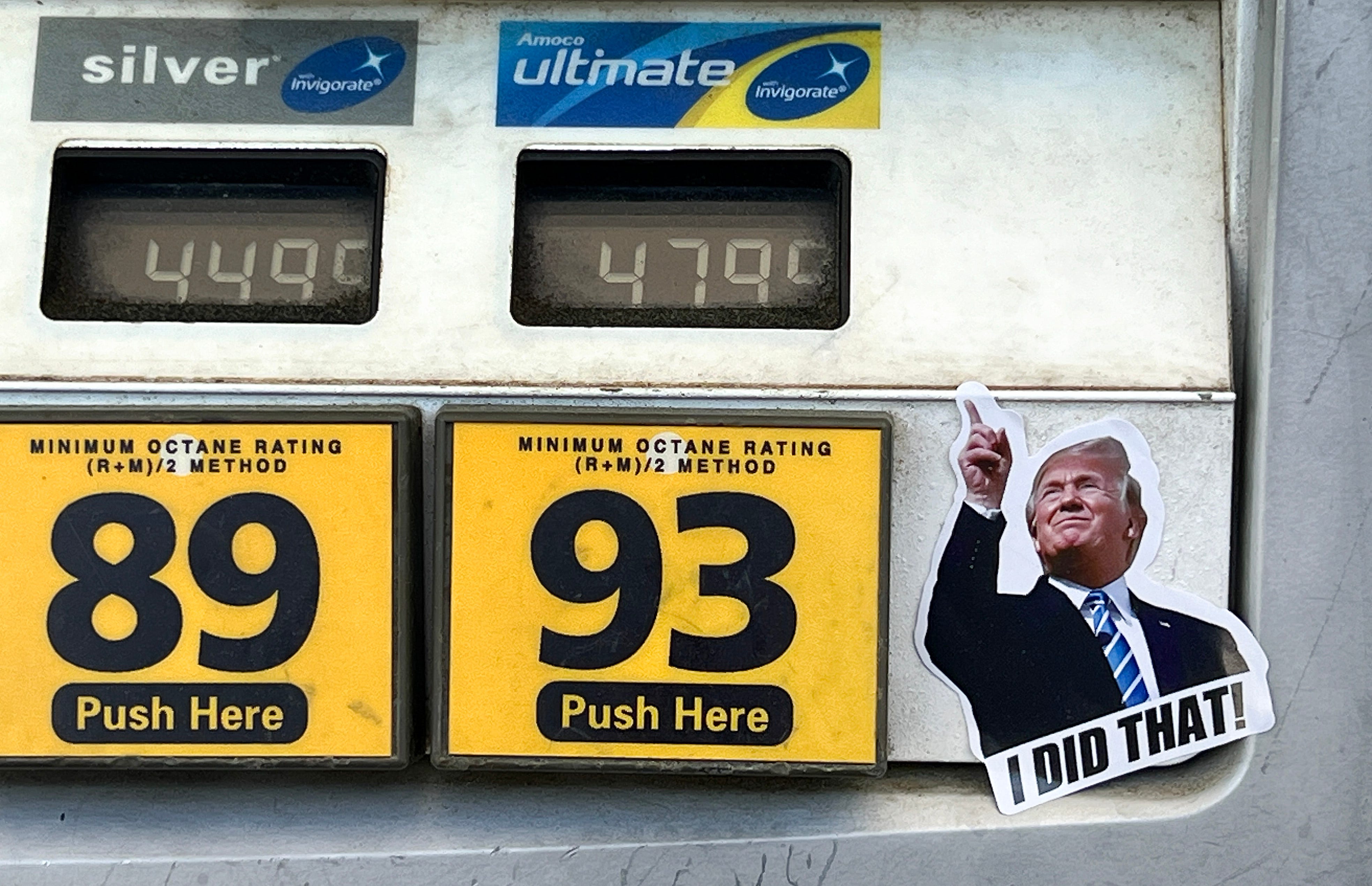
Eli: I do think it’s been interesting to look at these numbers in relation to the Iran War, because there really has been some movement based on what’s going on with that, and especially how it’s related to things like gas prices. We had this period a little while ago where there was a stretch of ceasefire-ish type stuff as negotiations were going on. Gas prices went down, and that was a period for a few weeks where Trump’s approval rating was actually ticking up — both in our average, and even if you looked at the same pollsters who poll every week or every month, you saw his numbers improving a little bit across the board. Now things have heated back up, gas prices are back up, and you’re really seeing now just a string of awful polls for him.
That and tariffs. People really do not like tariffs. Liberation Day was the first big drop we had in the average, very early on, and tariffs are also now popping back up. It’s been interesting to see how those two things — people don’t like them, and when they are salient, and when they start affecting gas prices or other prices, it does seem to really impact the approval ratings.
Nate: Gas prices are canonically an extremely visible artifact. Usually, you go into a foreign country in the Middle East, and you start a war, and things deteriorate gradually. Unless people have families in the military, or are defense contractors, [they] might not be following the conflict from day to day that much. Here, there’s a fucking buzzer, where anytime it looks like this ceasefire — or the Schrödinger ceasefire — is breaking down, then it’s reflected immediately in how much oil is going for, and within a few days you have producers trying to anticipate the effect on future gas prices and changing their prices in that way. So it’s a very, very quick feedback loop. Sometimes the stock market is a little bit of a feedback mechanism too. There is concern about the “is AI a bubble” story, along with Iran as this perpetual concern, and then [interest] rates.
I kind of annoyed some resistance-y Bluesky types a couple of weeks ago by saying that [some of the recent stories] about Trump are kind of boring and stupid. I think I was triggered by the second iteration of the White House Correspondents’ Dinner … he was insulting to some journalists in ways that were inadvisable. People [were] like, “oh my God, this is the worst thing to ever happen.” It’s like, it’s the worst thing to happen since two days ago or something. But the public actually does not follow politics in the way that people like us do — who are blogging about it every day, or doing Substack Lives every day.
Eli: No.
Nate: The public cares about big, substantive stuff. They care about economic anxiety. They care about Iran. Even the Epstein stuff — maybe it hurt Trump a little bit, but there’s not a clear line that you can draw. So tariffs and Iran are the kind of public triggers. Maybe ICE a little bit. He seemed to suffer a little bit when we had two people killed by ICE back in the winter. It’s actually fairly predictable.
Eli: That’s interesting too, because Trump’s immigration approval rating is also right around his second-term low again, at about net -13, which is where it was earlier with the two ICE shootings. So that’s also been on a bit of a downturn, even though it hasn’t been in the news as much.
Nate: But not as much as the tariffs number and the affordability-slash-inflation number. Those ones bounce around more. I think if you asked the White House, they’d say, “Well, sure, people aren’t happy about the economy, it’s not fantastic, but we can kind of win them back with cultural grievance type issues.” And it’s kind of almost the reverse, if anything. It’s like, “you know what? You’re full of shit about the ceasefire, it keeps breaking down. You’re full of shit about tariffs lowering prices. So maybe you’re full of shit about ICE too.” That’s kind of more how it works. It’s a negative halo effect, as opposed to being a distraction.
Eli, how low do you think Trump could get? What’s your 20th percentile estimate of approval as of, let’s say, February 2027 — half a year from now?
Eli: Right now, we’re pretty close to breaking 60 percent on the share of people who disapprove of Trump. I think I’d have to look a little bit at some of the other historical numbers. I think it’s possible that it gets a fair bit lower. It depends on what happens with Iran and that sort of thing. It feels like it could hit -30 at some point. That would be a very low [number]. But I think if things like gas prices do not improve, if the war in Iran becomes a more widespread conflict, I think that could start to cause bigger problems. And maybe even post-midterms, when Trump is even more of a lame duck, he could start to lose even more sway with the party, because then things really are going to kind of switch over more to 2028. What is your low estimate here? Do you have one?
Nate: By the way, to satisfy the many readers who understood that Biden’s age was a big problem: Trump turned 80, was it a month or so ago10? He’s also losing his fastball, if he ever had a fastball, a little bit more. But … if you look at actuarial curves, there’s an inflection point around 80 — he has the hardest job in the world, [so] give him that much credit — [but] that could lead to more poor decision-making.
What’s the chance of Trump on some day in the next six months achieving a -30 net [approval rating]? I think the chances might be 25 percent or something. It’s not too crazy.
[And] if you look at his strong approval numbers, only 20.8 percent of people have a strongly approving view of him. People fuck that up. They think, well, he might only have — what’s his overall approval number?
Eli: It’s 36 or 35 percent.
Nate: People say “he might only have 35 percent, but they’re the most dedicated 35 percent.” And that’s not true. If anything, the disapprovals are stronger: 47.6 percent of people have a strongly disapproving view of Trump. So if you look at that spread, it’s already a -27, and so far that has been a leading indicator for how other people feel. There is some floor. [For] the net approval [to go] below -30 — or the gross approval below 30 percent — that seems harder. But who knows?
Eli: You do have, in those 20-ish percent of people who strongly approve, some of them are going to stick with him no matter what happens. I’m not sure how much lower that strong approval is going to go. But maybe we’ll break 50 percent strongly disapprove at some point. That seems more possible.
Nate: That would be noteworthy. There can be a permission structure too. These [soft Trump disapprovers] are not people who are going to vote for Pete Buttigieg or AOC in 2028. A lot of them are people who would probably even vote for Trump again if they absolutely had to. But — and to get [back to] the midterm model — you’re seeing this differential in fundraising, you’re seeing this differential in voter enthusiasm as measured by likely voter versus registered voter polls. And people might just be like, “you know what, I’m just not going to turn out for this midterm.”
Turnout was very high in 2018, and pretty high in 2022. One irony: there are polls where you ask how enthusiastic voters are — our model actually calculates a turnout number; we’re gathering that data. Democrats might not mind one-sided turnout in 2026. Trump has never been a particularly helpful president as far as helping [other Republican] candidates. And in a midterm, (a) he might endorse candidates who are not particularly winners, and (b) he’s not the most enthusiastic campaigner, and so forth. Are they having that stupid fucking convention?
Eli: Yes. It’s in Texas. It’s going to be in Dallas.
Nate: I thought it was somewhere fun. Nothing wrong with Dallas. Maybe we go or something. Dallas in September, see the Cowboys, maybe. [Thinks.] There’s zero chance we’re going to go to that, or even spend more than two seconds watching a YouTube clip. I don’t like conventions. I don’t like the State of the Union. I like debates, man. Debates are fucking awesome.
Eli: I do like debates.
Nate: But I don’t like the constructed stuff in politics so much. It’s stagecraft.
Eli: Often it’s just a show, and there are formalities that go on, but it’s nothing particularly newsworthy — unless you’re one of the people who goes through everything Trump says line by line and clips it for X.
Republicans need at least 2 big things to go right to hold the House
Nate: So, prediction markets — I’m not going to reveal our [model’s take] yet — give Democrats around an 80 percent chance of winning the House and a 50 percent chance of winning the Senate. Maybe it’s up to 82 or 83 for the House, I forget.
Eli, describe to me the world where that 20 percent [chance of a Republican House] happens.
Eli: Oh man, okay. I think it’s either a world where there’s a huge reversion in the generic ballot national environment, or the polls are just wrong in some big way and we’re heading for another year where we’re really underestimating Republicans. I think it would have to be a world where Trump gets a little less unpopular over the next few months. Gas prices go down. Maybe the war in Iran ends and it goes very well, and gas prices go way down. And he’s like, “oh, you know what, tariffs are canceled, we don’t like tariffs anymore.”
I think there would have to be a lot of things that go either right for Republicans or wrong for Democrats for that to happen. Right now, if the polls are at all accurate, the national environment is just too blue for Democrats to lose the House realistically, because there just aren’t that many competitive districts. You’d really have to see a big change in what the national environment looks like — maybe people get really unhappy with Democrats for some reason. Because really, if we’re in not a D +6 or 7 environment but a D +3 environment, Democrats can lose the House, because [the map] sort of favors Republicans. They narrowly won the redistricting wars, at least for this cycle. And so if we’re off in that direction, it’s possible. But based on other indicators like gas prices, like Trump’s approval rating, you’d have to have a lot of things that are all pointing in one direction be off. It’s a 20 percent chance, but I don’t know.
Nate: I don’t know. Sometimes there are, from a meta-forecasting question, the 20 percent chances that you [can] see [happening], and then there are some that you don’t. You know what I mean? We don’t really use our gut per se in the model, that’s why you have a model. Sometimes I’ll have a gut instinct: “well, if I were to bet on this, I’d bet one side or the other.” I don’t think I’d bet the 20 percent side, really.
The [other] thing we are looking at, that I talked about before, is: has the political environment become more stable from the summer through November, as a result of greater polarization locking things in earlier?
Everyone has a way to convert the generic ballot plus other inputs into individual race forecasts, and they seem to show that somewhere around a D +3 is the break-even point, where if Democrats win the popular vote for the House by [only] three, they could lose the House. By the way, there are lots of complications. Democrats have nominated candidates, I think, in all but three House races. This is usually a good sign. They’re not going to win in these deep red states in Alabama, but it’s usually a good sign of a healthy party. Republicans have more blank districts.
But anyway, I think you need maybe two or three ingredients. One of them is a big systematic polling error of the sort that we haven’t had in a midterm recently, but we have in some of the recent presidential years.
Eli: Yeah.
Nate: Two is bullish, consumer-facing economic signs in the … third quarter. That certainly requires some de-escalation in Iran. It requires that you don’t have an AI bubble popping, or other kinds of trauma to the economy in different ways. But if gas prices were declining, we’ve seen tangible impacts already on [Trump’s] polling going from bad to catastrophic [when gas prices increase].
And the third theme, that I’m sure we’ll be discussing a lot for the rest of the year, is: are Democrats leaning too far left? There’s the micro and the macro. In individual races, are Democrats nominating candidates who — if you believe in the median voter theorem — are suboptimally far away from the median voter? And can Trump turn that into a national storyline, that the Democrats are crazy and woke is back? Can they nationalize that story beyond individual races? Because Democrats are nominating [moderate] Roy Cooper in North Carolina, for example. Talarico has a pretty progressive record, frankly, but has been kind of quietly running to the center in that race in Texas. But the DSA-type candidates tend to be more unapologetically proud of being on the left, and don’t necessarily seem to be team players in quite the same way.
So can you have two out of the three: the economy magically recovers, a polling error, or Dems in disarray slash the median voter theorem is still powerful, and [Republicans] win the meta-argument over “are [Democrats] too far to the left?” Two of those three would make the race competitive. And three of them probably means a Republican hold.
Eli: And I think it’s also difficult because — it’s a small sample size, obviously — but usually the out party will gain a few points on the generic ballot between now and the midterms, historically, if you look back at our averages. Obviously, there have been some exceptions, like after 9/11, that was an exception where the out party didn’t gain. But otherwise, it’s another sign in Democrats’ favor.
Nate: Trump’s approval is at -21, rounding off. The generic ballot is at -6 for Republicans, or -7. There is a universe of people who are open to “orange man bad” arguments, and a lot of them will vote for their local Republican member of Congress. But you know what’s going to happen, Eli? A lot of them aren’t going to vote. They’re like, “I’m a Republican who is sick and tired of tariffs and Iran, and if you ask me at this point, I’d say I disapprove of Trump. Maybe I’m excited about 2028 or something. I’m just not going to vote. I’m going to go to the gym or something instead of taking the time to vote, or watch TV.”
The Michigan Senate primary is far from a toss-up
Nate: Eli, we have not talked about Michigan. We should do Michigan before we wrap up.
Eli: Yeah.
Nate: Who’s going to win the primary on Tuesday?
Eli: When it went from a three-person race to a two-person race, you had two polls come out that were conducted right after Mallory McMorrow dropped out, where Stevens was leading by a couple of points. Since that point, though, every poll has shown El-Sayed +10 to +15. It’s been really consistent. Now, a lot of those have been polls from relatively favorable sources — they were conducted by some pro El-Sayed PACs — but you also have nonpartisan polls showing basically the same result.
You have potential for large polling errors in primary polls, and that is a thing that could happen. But that’s also a fairly robust lead. And I think even if you were looking at the older polls before it became a two-person race, that’s not too surprising. I wrote about this a few weeks ago: Stevens would have had to win 80-plus percent of the former McMorrow voters to actually pull even with El-Sayed, who was already leading in that three-person race. So I think El-Sayed is in a very good position to win this primary, unless again there’s some massive polling error such that all the pollsters — even the usually good-track-record Michigan-specific pollsters — are very wrong about what this electorate is going to look like. Plus the DSA left — I know El-Sayed doesn’t call himself a democratic socialist, but he’s very much backed by those same people — they have been doing incredibly well in Democratic primaries this whole cycle. So that’s another point in his favor.
Nate: And they’re organized. They turn people out, including in places where turnout tends to be low.
The sequence, as you mentioned, is a little weird, in that a month ago El-Sayed’s leading in all the polls by 10 or 12 points on average. And then a bunch of stuff happens. There’s this Graham Platner fiasco. McMorrow drops out. Stevens starts to get more media attention. I’m from Michigan, and I might say Haley Stevens possesses one of the more exaggerated versions of Michigan mannerisms. It’s not how the median Michigander talks. It’s not even how the 90th percentile talks.
But anyway, you have these polls. It was El-Sayed +10 or whatever. Then stuff happens. The next two polls actually show Stevens winning by some margin. You can look at our article in real time. We do not say, “oh, now she’s the favorite.” We say, “oh, it’s probably tightening.” Then there are some El-Sayed internal polls that show, no, they’re like, fuck you, we’re still winning by 13 points. And then nonpartisan polls show the same thing. Everyone kind of has the same number: El-Sayed +10, 12, 13, 14, 15, or whatever else.
By the way, when there’s consensus, I don’t regard that as a good sign in polling. I think Michigan polling can be a little bit of the blind leading the blind. It’s one of those upper Midwestern states where there have been problems in recent years. And this is a race where you have big splits between Black voters and white voters. What happens to Arab, Palestinian, Middle Eastern voters in these polls depends on the pollster. They can get clustered into some cross-tab, when you probably want to survey them individually. The voting patterns can be very different.
But yeah, look, I’ll put it like this: if you’ve been kind enough to listen to 45 minutes of this Eli-Nate live stream, here’s some gambling-adjacent advice. Stevens was, when I checked last night, at 3 percent on Polymarket and Kalshi. You’re going to lose this bet almost always. But 3 percent probably has to be too low.11 If you look at — I think people aren’t adjusting for how error-prone polling is in primaries. If this was a general election, 3 percent would be the correct number, or maybe even a little too high.
Eli: Yes.
Nate: All the disastrous polling that we had in 2016 — the biggest errors were off by a net of four, four and a half points. Well, El-Sayed leads by 11 points in the polling average, so it’d be two and a half times that. [But] there are just much wider margins of error in congressional primaries. El-Sayed is counting on getting younger people out to vote who may not vote in primaries ordinarily — though Michigan has a fairly high-turnout state. And you have had a relatively large amount of news.
The thing I totally omitted: at some point after those polls came out — the first couple showing Stevens actually leading, and then the El-Sayed internals — Gretchen Whitmer, who is still quite popular, endorsed Stevens. If we had done this [chat] a week ago, we’d say, “okay, well, look, all of the polling evidence probably favors El-Sayed, but it’s uncertain, and you have this endorsement.” I would have been surprised that that endorsement didn’t apparently move the numbers more. Are you surprised by that? Our timing is good — we [would have looked] like idiots for saying, “oh now, it’s a toss-up,” which it probably [wasn’t]. But I thought that [endorsement would have] moved things a little bit more.
Eli: I kind of did too. [Stevens has] done well on the Michigan endorsement front, because of course the current holder of that seat [Gary Peters] also endorsed her — that happened a few weeks earlier — but that plus Whitmer, I thought that might have moved the needle a little bit. But so far, at least based on the polling, it hasn’t much. I don’t necessarily know what Gretchen Whitmer’s strategy is here, because it’s going to look very bad for her if she’s done this last-minute endorsement and then it doesn’t work. I’m not sure what the calculus there is. But I think we do look better doing this now [instead of a week ago], because we’re not saying, “oh, it’s a toss-up because of the endorsement.”
And yes, I think three to four percent is too low. Again, if this was a general election, that would make more sense. But people do forget how error-prone primary polling actually is. But again, that still doesn’t change the fact that El-Sayed is absolutely the favorite.
Oh, okay. Well, it looks like Nate has left the stream. I know he’s been having some internet issues, so I guess we’re going to wait and see if Nate hops back on.
Nate: Now I’m on my phone. For some reason, the technology stack here at Silver Bulletin headquarters is not as robust as one might hope.
Will El-Sayed win the general?
Eli: I was just talking about Michigan more. We got a question about what this is going to look like in November if El-Sayed does win.
Nate: Let me put it like this: it’s a race that would have to be monitored carefully [for November], as opposed to one that you would assume would be a Democratic pickup with a more conventional candidate in a D +8 environment.
Eli: Yeah.
Nate: Now, with that said, there have been a couple of polls for El-Sayed lately against Mike Rogers that have been quite bad.
Eli: Yeah, he’s been behind in those, while Stevens, who’s also been tested, has been leading. And you know, that’s not a great place to be in Michigan when you have other candidates in redder states who are winning their polls. Democrats like Talarico have been doing well, and Peltola in Alaska, obviously.
Nate: Yeah, if Talarico were to win and El-Sayed were to lose… But I do want to say one thing. At this point in time, when you are at the end of a long, contentious primary, your general election polls tend to suffer. Because maybe Stevens voters, or vice versa, are like, “El-Sayed? Fuck that. They’ve been beating up my candidate, and I’ll vote for Mike Rogers, just watch me.” [But] whoever wins on Tuesday, Democrats will have three months to persuade voters to come back into the fold and not do that. And that’s a pretty important mechanism that usually works for parties.
But still, it would not be ridiculous to see Democrats lose that race with El-Sayed. And the way I look at it, it’s data. We have had this abstract debate for years about how much, if at all, does moderation help. The answer is it actually helps quite a bit, if you’re trying to actually look at empirical historical data. But now we won’t need to have hypothetical data, or data inferred from House races people don’t pay attention to, because you’re going to have cases like the Senate race in Michigan, cases like the gubernatorial race most likely in Wisconsin, where you have explicitly progressive candidates.
Although we will say, El-Sayed has advocated for Medicare for All, but he’s not a member of the DSA. He calls himself a capitalist. He says, I’m a capitalist, and I understand the flaws of capitalism as a capitalist. So he has interesting messaging that’s not quite as boilerplate. It’s sometimes just more interesting than Graham Platner. Graham Platner was a kind of Reddit DSA candidate. And El-Sayed is an interesting candidate, a former podcaster running for office.
Eli, there’s hope for all of us. If the podcaster can become a U.S. senator, then it can happen for anyone.
Eli: I think the other point goes back to what we were talking about a little while ago with the general environment for Democrats. These candidates could end up underperforming by a large amount and still win. Right now, on our generic ballot tracker, we have state-level projections based on the current generic ballot. For Michigan, right now, it’s D +6.5. So El-Sayed could win the primary, underperform by five points, and still potentially win the Senate race. And you could end up seeing that in other places too, like Wisconsin. If you have a very, very good environment for Democrats in November, bad candidates can still win these elections. I’m not sure that’s going to do wonders for the factional fights in the Democratic Party.
Nate: I do want to distinguish governor races from Senate races, because if you are voting for a national body, then people are more partisan, and rationally so. You might say, well — and this was kind of the argument the Platner bros were making toward the end of the race — this is really awful, but the alternative is Donald Trump controls the Senate still.
That logic isn’t as persuasive for a gubernatorial race [which has fewer national implications]. It’s like, “well, fuck you, you nominated that candidate. Nominate a non-DSA candidate next time.” And so I would differentiate that, and our model will too. It will weigh partisanship less in governor races than in Senate races.
But one thing that helps the narrative for progressives — I know it sounds dumb, what about the substance, who cares about the narrative? Well, the narrative matters for how Democrats behave in the future. If El-Sayed wins by three in a D +8 environment, all the smart-alecky people will be like, “well, according to WAR, he was fine, but he was below replacement.” And that won’t persuade people. People just talk about W’s and L’s. They aren’t looking at margin of victory very much. It’s ironically the same type of thing that you wind up looking at in sports betting a lot. It’s very hard, if you lose a football game or a soccer game or a basketball game, for people to say, “oh, it was relatively good relative to expectations.” It’s a very nerdy Eli-and-Nate way of thinking that won’t carry the day in a Democratic primary.
But to be fair, what if El-Sayed wins by 10 points? You’d have to give credit to that, and you have to update your views based on the evidence. There are some reasons to think that everything apart from partisanship is becoming less important, so there might be less of a penalty for nominating a quote-unquote far-left or far-right candidate.
Things are also overdetermined. We do not, I believe, currently have any Arab Americans in the U.S. Senate. Michigan has the largest Arab American population — proportionally, I think.
Eli: Yeah, per capita.
Nate: But that kind of thing can matter. If you look at Dearborn, Michigan, the most Arab American city in the country — what did Harris get, 42 percent of the vote12? And Jill Stein got a bunch of votes.
Eli: Jill Stein got a lot of the vote in those areas in 2024.
Nate: And midterms are kind of low turnout. Maybe El-Sayed sparks more turnout among young voters. Again, that’s not the way I’d bet — I’d bet on him underperforming — but we have to always be open to evidence. Politics is changing in certain ways, and progressives are benefiting from that.
Do you think Stevens and El-Sayed are quote-unquote bad candidates or do you think they’re quote-unquote good candidates?
Eli: If you look at Stevens historically, she’s a meh candidate. She’s fine. Her Split Ticket WAR is around R +1 to D +1 across her various cycles. So she’s just, at least in her House races, been very much a neutral-ish type of candidate, which I guess is what I’d expect if she won and was in the general this year. Which again, in a year that’s going to be good for Democrats, neutral-ish I think is great. I think you’d win with neutral-ish.
El-Sayed, it’s hard to tell. If I had to bet, I think he would underperform a little bit, at least based on these initial polls. Maybe he won’t. Maybe the sort of energy that’s going through all these Democratic primaries right now, where these kinds of candidates are doing very well, maybe that really will carry over into the general, and all these young people are really going to be energized and turn out, and he’s going to overperform. But if I had to put money on it, I would imagine he would underperform at least a little bit, because Mike Rogers will be a decent candidate.
Nate: [Rogers] is as close to a normie, old-era Republican as you can get. Absolutely.
Eli: This isn’t a Texas situation, where the Republican candidate is a mess and you get the benefit of a bad opponent.
Nate: That’s right. I could go on a long thing about why I think Talarico isn’t as fantastic a candidate as the amount of donations he’s getting would seem to suggest. But he’s running against a kind of objectively terrible and scandal-plagued candidate, and that helps a lot. And by the way, his polling has been pretty good.
Eli: It has been pretty good. I see so many Talarico donation ads pop up on YouTube, always asking me for money.
Nate: I never want to be too prescriptive with our readers, and I don’t like giving any type of partisan recommendation on where to spend money. But I will say this, because I’ve said it before: you probably don’t want to donate to the high-profile race that you’re hearing the most about. Those candidates have more fucking money than they’re ever going to need for anything useful. So whether you’re a Democrat, Republican, independent, whatever else, think about your ROI in terms of, does this candidate actually need more marginal resources, or are you getting really heavily diminishing marginal returns?
Eli: And Talarico has a lot of money. As someone who has been spending a lot of time recently digging through FEC filings for the model — he has a lot of money.
Nate: Anything surprising in the fundraising data, Eli? Or is it pretty consistently better for Democrats than Republicans?
Eli: Yeah, Democrats do really well with this. For context, for the listeners, our model is using individual contributions here, as opposed to money from PACs or self-funding. And I think the Democrats are doing really, really well on that front. Honestly, as long as I’ve been paying attention to things, it’s been very consistent, and that’s definitely continuing. Whereas on the Republican side, lots of self-funders like Ramaswamy.
Nate: And we don’t count that, because we aren’t using fundraising as a sign of resources so much as a measure of voter enthusiasm and organizational strength.
In fact, we actually weight contributions from within your state five times more heavily than contributions from out of state, because that indicates local support. We actually refined this process [this year] — it was originally implemented in 2022, but let’s be honest, there were a couple of things that were not as smooth as they could have been about that implementation.13
And it is true, you have this Jaime Harrison race in South Carolina a couple of years ago for Democrats, where he was probably not going to beat Lindsey Graham, and wound up losing by 10. And there was a lot of money that went into this probably pipe dream of a race. Of course, you don’t know what’s a pipe dream ahead of time. It could be that Iowa or Alaska is kind of a white whale race for Democrats this year, potentially.
But Democrats, they like donating. They like smashing that button and donating money to their candidates, and that’s shown up more and more in the data. And Trump, by the way, because he’s kind of self-funded slash funded in mildly corrupt — sometimes more than mildly — quid-pro-quo ways, he’s probably not terrific for the more traditional small- to medium-sized donor Republican fundraising channel. Whereas Democrats like donating to campaigns.
Eli: Yes, absolutely.
Nate: Eli, what else have we got? What else is on your mind? What else are you looking forward to debating, or not debating, about the midterms?
Eli: It’s been so much candidate quality stuff lately with all the Democratic primaries. Genuinely, for my own curiosity, I kind of do hope El-Sayed wins, because I want to see what that kind of general election campaign looks like. Because again, the Democratic candidates of this DSA-adjacent wing have been doing very, very well, but a lot of that wing’s early wins have been in very blue districts or blue areas, like New York City with Mamdani, for example.
I’m very interested to see what a general election campaign from that style of candidate looks like in a competitive state, because so often you end up having these candidates win Democratic primaries in places where the Democratic primary basically is the race, and the general is more or less a formality because the Democrat is almost certainly going to win. So I think that’s why you often see that wing very focused on beating Democrats in primaries. And so I’m interested to see how a general election in a purple state in a neutral year would actually look.
Nate: And [El-Sayed] is not scandal-plagued in the way that Graham Platner is.
Eli: No, so it’s a cleaner test. He was a Rhodes scholar. He’s a doctor. So if he does poorly, it’s not going to be because of scandals.
Nate: Personality is a different category, and he was literally a former lax bro. He’s got a more aggressive personality that people might find either fun and charming or off-putting. I’ll be interested to see the gender splits in this race a little bit, whether he’s getting younger men as much. But it’s a pretty fucking clean test of how much ideology matters in a race like this.
And I will say, for all the WAR-type data, when nerds gather data on underperformance or overperformance in Congress, all of that is from fairly low-stakes races, where they’re not competitive. It’s like, “oh, you’re supposed to win your blue district by 40 points instead of 32. There’s support for moderation.” But this is a clean test. I’ll put it like this: if he were to lose the race — especially if Democrats have a good night overall, or if they don’t, I think either way — if [El-Sayed] loses, then you’ll hear about that race until the end of time from the moderates. If he wins by anything more than a nail-biter, then probably the opposite.
Eli: You’d hear a lot about him from progressives. And maybe he’ll run for president.
Nate: Unlike Zohran, he’s from the United States. That’s not meant to insult Zohran, but you have to be born in the United States to be eligible to be president. And he’s young — I guess he’s 35, right?
Eli: Yeah, he must be at least 35.14
Nate: It is interesting. It’s kind of a selection effect thing. A lot of those progressive candidates are quite charismatic, at least the ones that win their primaries. You don’t have to like Abdul, but it’s a brand of charisma. A certain kind of … charisma, in the way that Haley Stevens has both charisma and anti-charisma in a very strange kind of way.
But there is something to the fact that the archetypal left-wing candidate everyone knows is Bernie Sanders. I think you could call Bernie frumpy. I don’t think Bernie would even mind being called frumpy. Most of these candidates — I mean, Zohran is wearing the suit. El-Sayed is clean-cut. AOC. All these people are pretty good-looking, well-presented people. That’s not a total coincidence. Politics is part symbolism, and it’s part saying, “okay, I’m going to play the part of the more normie role in society.” But that’s going to be an interesting contrast, I’d say.
And it is important too — I know I’m repeating myself — that you have a relatively normal Republican. There are other states where they would nominate Mike the fucking pillow guy Lindell, or whatever … but this is a state where you have one of the more traditional, OG Republicans.
Eli: And that does matter, because otherwise it’s not a good test at all, because you can’t tell what’s going on, whether it’s a bad Democratic candidate or a bad Republican candidate causing problems. And I do think the results of these sorts of races are going to matter for Democrats going forward, in terms of when they’re thinking about 2028, who to nominate, that sort of thing. If progressives do very well in the midterms, that wing of the party is going to use it as evidence that their brand is going to be a winning way going forward — maybe nominating AOC.
Nate: Yeah, look, the thing we haven’t mentioned — we haven’t mentioned Israel and Gaza and AIPAC very much. The second biggest theme after Medicare for All has been AIPAC, AIPAC, AIPAC. Maybe the biggest theme, frankly, coming from El-Sayed.
Eli: I saw some interesting data, I think from The Argument, a couple of weeks ago. They were looking at how often candidates are mentioning Israel or AIPAC in their emails, and I think El-Sayed was maybe the second or third most frequent mentioner of those topics in his fundraising emails.
Nate: And of course, AIPAC is complicated, because it can be kind of this motte-and-bailey thing, where on the one hand it can be a question about Israel, obviously, and a proxy for Israel policy. On the other hand, it can be this question about corporate, national donors. And look, I don’t think it would be the worst thing if there were more of a stigma for candidates who raise money from big PACs and corporations. Maybe it’s time to have that conversation.
Obviously, Israel is very divisive. Maybe it won’t be so divisive [for Democrats in the future] though. Maybe people will just think, well, if you’re a Democrat, you have to be kind of explicitly pro-Palestine now, and that might be the message that people take away. Keep in mind that Democrats in general, especially establishment Democrats, are not the most risk-taking people. They tend to be followers. They don’t skate where the puck is going, they skate where the puck was five seconds ago, behind the play. But that does make them predictable in a lot of ways.
I think people will extrapolate very heavily from this race, and properly so. You could make excuses for the moderates in the New York City mayor’s race — “okay, well, New York is pretty progressive.” Michigan is Michigan. Michigan is exactly what it looks like. We were looking last week at historical primary results. Michigan is now an early voting state, maybe the most important early voting state, because it comes right before Virginia and Super Tuesday. But Michigan voted for Bernie in what was it, 2020?15 It voted for John McCain in 2000, when that was one of the few states where he beat Bush. It voted for George Wallace in 1972, back in the day. It voted for Jesse Jackson. So Michigan has a little bit of a rebellious streak that maybe Ohio doesn’t.
Here’s my proposal, Eli: why don’t we take one of the Ohio senators and give it to Michigan?
Eli: Then they’d get three?
Nate: Michigan is quite a bit of a better state than Ohio, I would argue.16
Eli: I don’t have a dog in either fight, but I guess if I had to pick, I’d pick Michigan. I’m not a super partisan on either the Michigan or Ohio side. But if I had to pick, I’d go with Michigan.
Nate: No, I mean, Ohio doesn’t bother me. If you had to get rid of states, if you had to go to 48, obviously you would fold Delaware into Pennsylvania, and merge the Dakotas.
Eli: The Dakotas is the first, yeah.
Nate: And then what’s next on the chopping block? Rhode Island?
Eli: It’s got to be, right? You’ve got to do the small ones. I think after the Dakotas, you have to go by size.
Nate: Yeah, I think Rhode Island probably gets it next. Rhode Island [merged] into Connecticut.
So, readers, listeners: our plan for the week is that we’re going to probably have a “think piece” — well, it depends if Michigan is actually close — it might be more of a diagnosis of what’s going on. Probably Wednesday morning or late Tuesday night, we’ll have some type of what-it-all-means piece, and then we’re mostly focused on the model. Hopefully we’ll get you a sports article or something at some point. But full disclosure, we’re probably looking at a week from Monday, give or take a day, for the model. If it winds up being this week, it wouldn’t be the thing that surprised me the most in the world. But usually it’s pretty rare that toward the deadline things resolve faster than you’re expecting.
Eli: And we’ve also usually found that unless you’re trying to launch before some sort of deadline — for example, before the NFL season starts17 — it’s good to take some extra time with the landing pages to make them look nice and work well before we launch them.
Nate: The honest truth of when will the model be ready? It’s probably Friday or Saturday. You don’t want to launch things on a Friday or Saturday, especially in the middle of August. That’s some standard media advice that we’ve found holds up in the Substack world.
[Though] here we are, Eli, on a Sunday, having a very, very, very wonky conversation. Maybe more wonky than I expected. But maybe we’ll end on that note. So everyone, lots coming soon. There’s lots of backlogged content that I’m looking forward to writing when these back-to-back projects with the World Cup and the midterms are ready to go. So a little slow for a week here, but then I think we’re going to have a great August.
Thank you so much for listening and for subscribing.
Eli: Yeah, have a good week, everybody.
And joint distributions, e.g. the chance that Democrats win the House but Republicans keep the Senate.
I’m still trying to refine the IT setup at my new apartment. For some reason, Substack Lives seem to run with a lot of latency even when other stuff is basically fine.
Yes, there are literally 68 input files for our midterms model; our typical models feature more like 10-20. This is part of why it has taken a little longer to launch than we were hoping. For most models, gathering and vetting the data might take a week or two; for the midterms, it’s a lot of hours.
In the live chat, I got this flipped, and said “incumbents” where I meant to say “challengers” and vice versa.
Actually, closer to 500.
In an as-yet-unpublished story.
This was slightly overstated; but since two polls came out showing Stevens with a lead, there’s been a streak of 7 polls that show El-Sayed by margins ranging from 10 to 19 points.
To clarify this: the way we set up our polling averages is to choose settings that best predict where new polls will land. So if we have Democrats up by 6 on the generic ballot, that’s our best guess for what new polls will show. An overly aggressive model that moved the average from +5 to +7 on the strength of one or two strong polls for Democrats wouldn’t minimize the loss function. Nor would an overly conservative one that only moved the average to +5.2 or something.
For example, Democrats won the popular vote for the U.S. House by 8.6 points in 2018, and Republicans won it by 5.7 points in 2014. So a mid-to-high single-digit win is typical for the opposition party; 2022, when Republicans won the popular vote for the U.S. House by 2.7 points, was a notable exception.
Trump had his 80th birthday on June 14.
Though, it is a thankless kind of bet. If Stevens is trading at 2 or 3 percent when she should be at 5 percent, that bet has a high ROI, but you’re still going to lose it 95 percent of the time.
Actually, Trump got 42 percent of the vote in Dearborn and Harris got just 37 percent.
In 2022, we used state-by-state contribution data, but that restricted the universe to only itemized contributions, which excluded small donors. This year, we’ll be looking at the proportion of itemized contributions that came from a candidate’s home state, but then extrapolating that to her entire set of individual contributions, including unitemized (small donor) contributions.
El-Sayed is 41 years old.
Nope. Sanders beat Hillary Clinton there in 2016, but Joe Biden won Michigan in 2020.
Full disclosure: I’m from East Lansing.
FWIW, we feel confident that ELWAY will launch before the NFL season starts this year, unlike in its debut in 2025. It’s much less challenging from a data-gathering standpoint than the midterms model, and we’ve already put much of the work in.
What's with the low video quality?
Is there a way to use what you generate with your model to estimate the effects on state legislative races? Not necessarily a specific prediction, but some range of influence, given the model's view of how things are changing (say, from 2024 or from 2022) to get an idea of how much we'd expect the same legislative district and candidate(s) to change?