

Kamala Harris has Liz Cheney Syndrome
Centrists think Harris is a leftist, and leftists think she’s a centrist. But she’s not the only candidate with this sort of problem.

Couple of quick announcements before our main event today.
Given all the turmoil in the media, I’m going to reopen our job listing for an Associate Editor for two more weeks (through Feb. 24). This is a part-time position initially, but it could grow into full-time down the road. There are a few promising candidates already; if you’re in this bucket, we’ll be in touch soon to set up a time for an interview in early March. But this is an important role for us, so I wanted to widen the net a little bit. The Associate Editor role has more specific requirements than for past positions we’ve hired for — we really need someone with at least some real-world, hands-on editing experience. If that describes someone you know, please don’t hesitate to pass the listing along!
Also, we’re overdue for another SBSQ soon — so you can submit questions here. Since the January version spilled into multiple parts, this one will probably be on the shorter side, or maybe a lightning round edition.
Harris wasn’t a “centrist”, though that oversimplifies the issue
One of my pet peeves in the Great Moderation Wars is when I see the claim that Kamala Harris ran as a centrist. What actually happened is that Harris ran a largely substance-free campaign, hoping to win on vibes, quietly disavowing some of her past progressive positions without explaining why she’d changed her mind or replacing them with much of anything. The one notable exception was Harris’s convention speech, where she took a more assertive, notably male-coded approach, but she quickly abandoned those themes.1 At no point did she take any costly signal that would have risked offending any major Democratic constituency, left or center. And she couldn’t identify a single mistake that she or Joe Biden had made.2
So most voters defaulted to the assumption that Harris was left-wing — a rather reasonable assumption based on her very liberal voting record in the Senate and the aggressively progressive presidential campaign she ran in 2019. Not to mention that she’d been vice president for four years and the Biden-Harris administration had been quite progressive too. And yes, $20+ million in “Kamala is for they/them” ads helped to entrench this perception. But the whole reason the ad was effective was that what seemed like a hyperbolic Republican attack — Harris really wanted taxpayer-funded gender transition surgeries for prisoners?!? — was attested to by Harris’s own past words and statements.
Even if you personally think that Harris is a centrist, you’re in a substantial minority. In fact, surveys conducted by YouGov in late 2025 found that 37 percent of voters characterized Harris as “far-left”, the same percentage who said that about the new New York City mayor, Zohran Mamdani. Another 38 percent of voters described Harris as “left” or “center-left”; only 6 percent said she was a centrist.3
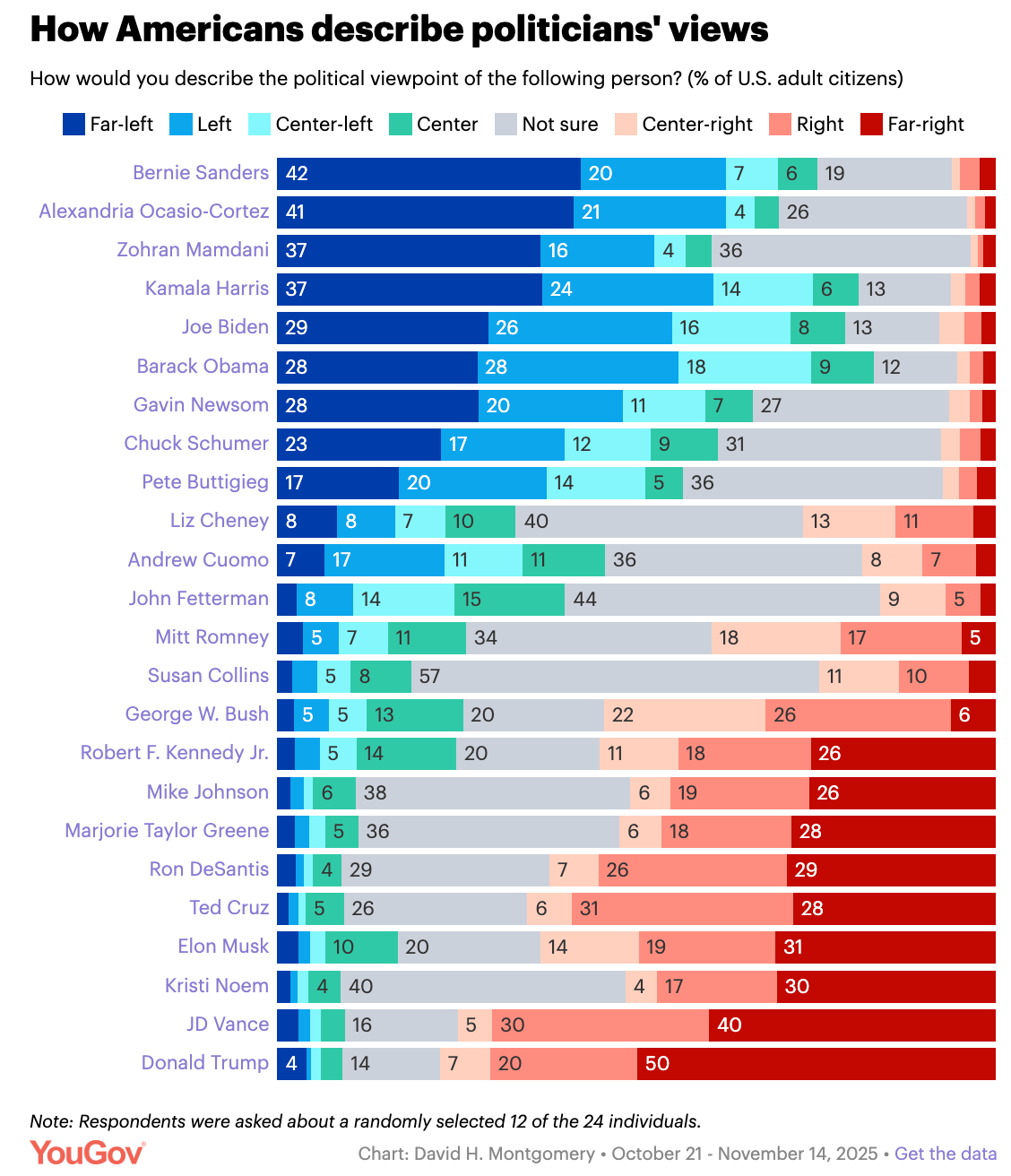
To be fair, a considerably higher percentage of voters said they weren’t sure about Mamdani’s ideology than said that about Harris. Among voters who did place the candidates on the ideological spectrum, Mamdani (along with AOC and Bernie Sanders) were seen as more left-wing. But the differences aren’t that big. Suppose you assign a number to each rating on a 100-point scale, so 0 is “far-left”, 50 is “center”, 100 is “far-right”, and so forth. According to the average voter4, Harris rates as a 19.5, (basically, “left” but not “far-left”). Bernie Sanders rates as a 17.0 on the same scale.5 So Harris is actually closer to Bernie in the public’s eyes than she is to, say, Pete Buttigieg (26.4).
What you’re seeing here is how voters place a lot of emphasis on cultural signifiers as opposed to, say, capitalism versus “democratic socialism”. In 2019, Harris’s brand was sort of “Diet Woke”. It didn’t sell and she dropped out well before Iowa. She got Biden’s VP nomination anyway. (This being summer 2020, Democrats were quite open that Harris’s race had been a big factor in the decision.6)
Suddenly, she became the presidential nominee despite having been treated as a political liability by the Biden folks during her tenure in the White House. “Brat Summer” was a fun, Cinderella story, but it didn’t tell voters very much about what Harris stood for. And Harris didn’t tell voters much about what she stood for either! So voters deferred to their priors based on her previous campaign, their expectations based on her race and gender, and the messaging they were hearing from Trump, all of which reinforced one another. To the extent that Harris’s campaign 2024 convinced anyone she was a centrist, it was high-information progressive Democrats, the one group that didn’t want her to moderate!
What is Liz Cheney Syndrome?
Even as someone who thinks that moderation usually helps, I don’t believe there’s any intrinsic electoral disadvantage from being highly progressive or conservative. Rather, what matters, according to the median-voter theorem and other spatial models of voting, is how closely your views align with those of voters. If you’re running to become mayor of a small, extremely liberal college town, it’s electorally advantageous to be super progressive.
Still, usually ideology is more complicated than this, and voters disagree with one another about how they perceive the candidates. The best candidate, according to this theory, is neither a progressive nor a conservative nor a centrist, but one whom progressives believe is a progressive, centrists believe is a centrist, and conservatives believe is a conservative.
This is hard to pull off, of course. Barack Obama was able to do it to some degree in 2008, when he ran to Hillary Clinton’s left on issues like Iraq but also appealed to centrists and independents with his “post-partisan” rhetoric — though by 2012, Obama lost independents to Mitt Romney and relied heavily on base turnout instead.
Donald Trump’s ideology also has been hard for some voters to pin down, in part because he ran against the Bush-McCain-Romney Republican establishment and flipped around some of the party’s priorities. (Much more right-wing on immigration; less emphasis on abortion or Social Security reform.) In 2016, a large number of voters thought of Trump as a moderate. Even in 2024, more voters thought Harris was “too liberal or progressive” than thought that Trump was “too conservative”. Once he gets into office, voters are quickly disabused of the notion that Trump is anything other than right-wing7 (and not coincidentally, he persistently has a low approval rating). But as a candidate, particularly one who relies on lower-propensity voters who invest less time in following politics, he can be more slippery.
For the most part, though, candidates have the opposite problem. Take Liz Cheney, the former Congresswoman from Wyoming, who was essentially cast out of the Republican Party for her opposition to Trump. She rates right in the middle of the political spectrum according to the YouGov poll with a 48.8 rating on the 100-point scale. That might seem pretty ideal, since voters rate themselves at 49 on average on the same scale.
However, if you look at responses from individual voters on how they compare themselves to Cheney, few found her to be a close fit. Right-leaning voters rated Cheney as a 28.4 on this scale, somewhere between “left” and “center-left”. But left-leaning voters rated Cheney at 65.8, placing her far to their right.
This is an unusually large gap; John Fetterman, by contrast, has a similar overall rating (46.2) to Cheney but seems better able to convince voters that he’s actually a moderate or at least otherwise on their side. And Fetterman is reasonably popular in Pennsylvania, though more so with Republicans than Democrats.
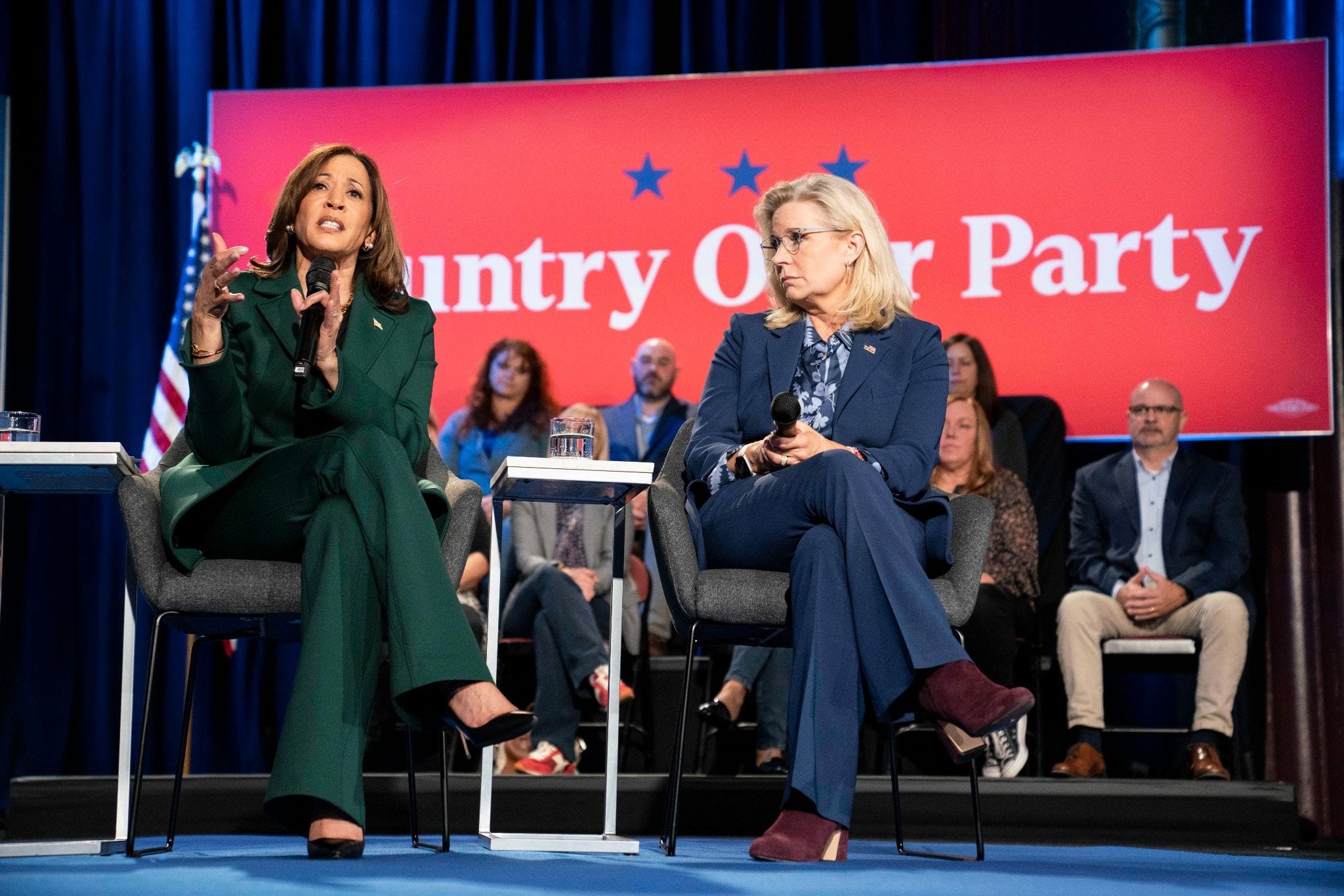
There’s really no home in American politics for true anti-Trump conservatives, however. Cheney has an extremely conservative voting record, and I think it’s pretty nuts to consider her left-wing, but opposition to Trump will get you branded that way by other Republicans. Harris campaigned with Cheney to appeal to this narrow constituency, and I understand the impulse behind it, but Cheney is an unpopular figure and this may have served only to annoy progressives without convincing much of anyone.8
In any event, Liz Cheney Syndrome is the phenomenon of everyone being convinced that you’re their ideological opposite: conservatives think you’re a liberal, liberals think you’re a conservative. Harris has some of these problems, too. Although few voters think she’s a conservative, neither leftists or centrists really see her as an exemplar of their preferences, either.
In fact, we can quantify this more precisely. For every voter in the YouGov poll, I’ll compare their self-reported ideological rating with their view of each candidate. For instance, say a voter describes themselves as “right” (an 83 on the 100-point scale) and thinks of Harris as “center-left” (33). That’s a gap of 50 points. The lower the average gap, the better, since that means voters think the candidate is more closely aligned with them.
Here’s what that looks like on a chart. (I recognize this is one of the less intuitive charts that we’ve run in the newsletter recently, but we’ll work our way through it.)
The U-shape trendline indicates that, on average, candidates who are seen as being closer to the center are also better matches for voters. It’s something of a myth — often perpetuated by people who argue about politics online and tend to be highly partisan — that there are no moderate voters. In the YouGov poll, in fact, 46 percent of voters self-identified as “center,” “center-left,” or “center-right.”9 Some candidates whom political junkies tend to hate, like Fetterman, are fairly popular with normies. But there are some candidates like Cheney whom nobody sees as a reliable ideological ally.
Harris also has a high average distance from voters, 43.1 points. This is similar to Trump (44.3), who has been losing credibility with any normies who mistook him for a moderate.10
Obama has a considerably better rating than Harris of 39.9, however. (To repeat, lower is better here). Buttigieg has a 37.8. (Maybe he deserves a boost the next time we do a Democratic draft.) Even Bernie (41.9), AOC (42.6), and Zohran (42.9) have (slightly) better ratings than Harris despite being seen as more left-wing. Voters on the left trust them more than they trust Harris, while other voters don’t necessarily perceive that big a difference between them and Harris for the reasons we’ve already covered here.
To some extent, this suggests that politics is a “skill game” and that more successful communicators can convince voters that they’re on their side. Or failing that, they’re at least able to immunize themselves against attacks from their opponents. Because Harris entered the campaign as more of a cipher and her campaign seemed disinterested in standing for much of anything, she was more easily defined by paid Republican advertising and attacks by Trump.
Harris may also have had a harder time as a woman. In general, I think the evidence for women candidates facing an electoral penalty is pretty unpersuasive, as Jerusalem Demsas covers here. In the YouGov poll, however, women candidates (shown with orange diamonds in the chart) were perceived as having a larger average ideological gap by voters.
The difference is statistically significant whether you control for the candidate’s ideology or not. It’s not a large sample of candidates, so I don’t want to take this too far. But women may face the challenge of being more easily typecast, being plugged into some proscribed number of gender roles, and being less trusted when they try to break out of them.
So, do I think Harris would have won if she’d been more assertively centrist — say, actively throwing the left under the bus on an issue or two? Well, it’s hard to know, but honestly probably not. Given that the perception of her as a woke-adjacent progressive was fairly entrenched, I think voters might not have bought it anyway or she’d have been attacked as a flip-flopper.11 To be fair, I think Harris had a very difficult task: overcoming both the unpopular positions she’d taken in 2019/2020 and the unpopularity of her boss. All while trying to become the first woman president. Rather than cycling through various half-hearted attempts to rebrand her, Democrats should probably have chosen another candidate instead.
I’ve seen it asserted in various places that Harris slumped in the polls following her convention, but that’s not really true. Instead, both Harris and Trump gained vote share in the polls at this period in the campaign, partly because RFK Jr. dropped out. Harris gains were a bit larger than Trump’s, in fact, though below the standards of a typical convention bounce. What was more noteworthy is how Harris’s numbers faded down the stretch run in October; her standing in our national poll average actually peaked at 49.4 on Oct. 14 and then dropped to 48.6 in our final polling average. (And then she actually got 48.3 percent of the vote while Trump overperformed his polls again.) It’s a unusual for a candidate’s numbers to decline in the last few weeks of a campaign since they’re usually at least able to pull undecided voters into their column. What was going on then? Well, there was a lot of scrutiny of Harris’s past positions, scrutiny that was lacking during the “Brat Summer” phase. And the they/them ad was running in very heavy rotation at this time, as reflected in the number of Google searches for related issues.
Progressives might have wanted Harris to articulate a more explicitly pro-Palestine/anti-Netanyahu position — she didn’t — but this was a continuation of the administration’s previous policy. The Middle East is also an issue that’s treated with far more salience by highly politically engaged voters than by the handful of swing voters in the electorate.
Meanwhile, 6 percent of people described Harris as being on the right. Some of this is the Bluesky crowd, sure. But it’s also some voters who are very disengaged from politics and don’t necessarily know much about the left-right political spectrum or who are just clicking buttons.
Ignoring “not sures”, as I will throughout this analysis.
Mamdani is a 14.0 and Ocasio-Cortez is a 13.5.
Biden had also previously committed to picking a woman as his running mate.
His rating in the YouGov poll was an 85.2 on the 100-point scale.
The more successful ex-Trump or Never Trump political figures eventually tend to “lib out” on other issues too, since that’s where the audience is. Not that very many of the Never Trumpers have become successful politicians, but there are those that have popular Substacks, podcasts, etc.
Again, excluding voters who said they weren’t sure about their ideology.
Though note that the YouGov polling was conducted before the killings of two civilians in Minneapolis.
Not to mention potentially had problems with base turnout, however much I think this is an overstated problem.
Yes I find myself more drawn to both Josh Shapiro and Mamdani than Harris/ Newsom type politics. I have tried to think about why I viewed Mamdani’s moderation, who I find far too left wing especially on foreign policy, more sympathetically than Harris’s flip flops.
Maybe I’m overthinking but I think it’s because with Mamdani, you could sense real convictions underneath and watch him actively narrow them under the responsibility of governing. I remember listening to him on the NYTimes Daily podcast being pressed about apologizing to police and his past rhetoric, I was convinced he understood the need to respect officers and that he no longer wanted to defund the department. But when asked whether the NYPD is systemically racist, you could hear the pause, the belief he still held, and then the choice to say “no.” It sounded like someone painfully swallowing a conviction in order to lead responsibly, and carrying the discomfort of that choice. That visible friction felt almost human. His youth probably matters too, it’s easier to extend grace when someone seems to be learning, awkwardly and in public, what responsibility demands.
I never felt that kind of inner tension with Harris. Her shifts often felt like emptiness being rearranged, not conviction being disciplined. Don’t mean to make too much out of this, obviously all politicians are a mix of policy convictions and careerist ambitions. Yet even though I think Josh Shapiro would be the best candidate out of the current lot, I do think a genuinely untainted young outsider that appears earnest would be the best option for 2028. There is an incredible amount of grace that would be extended to that person’s journey. It was also basically what we got with Bill Clinton and Obama.
I agree Harris was a disaster. The thing that kills me is Dems have now run three presidential campaigns in a row where the final, closing message to voters was "Vote for us because we're not Donald Trump and will adhere to basic societal norms." There are young Americans who will cast votes in the 2028 election who were two years old in 2012 and literally do not remember the last time a Democratic presidential candidate made an electoral pitch on the merits of their own ideas and policies instead of a specific repudiation to Donald Trump.
Whoever the candidate is in 2028 needs to have something to stand on that is not the status quo. I know major blocks within the Democratic Party will consider this heretical, but I genuinely don't care if it's someone from the moderate bloc or the progressive bloc. Just give the country someone with actual ideas they're passionate about and willing to fight for. I don't care if it's AOC or Buttigieg or Pritzker or Warnock or Ossoff, just for the love of god we cannot nominate another empty, status quo "norms and values" candidate (which Newsom seems to be positioning himself to run as).