

The 51 biggest American political moments of the 21st century
For Christmas, I’m giving you a listicle.

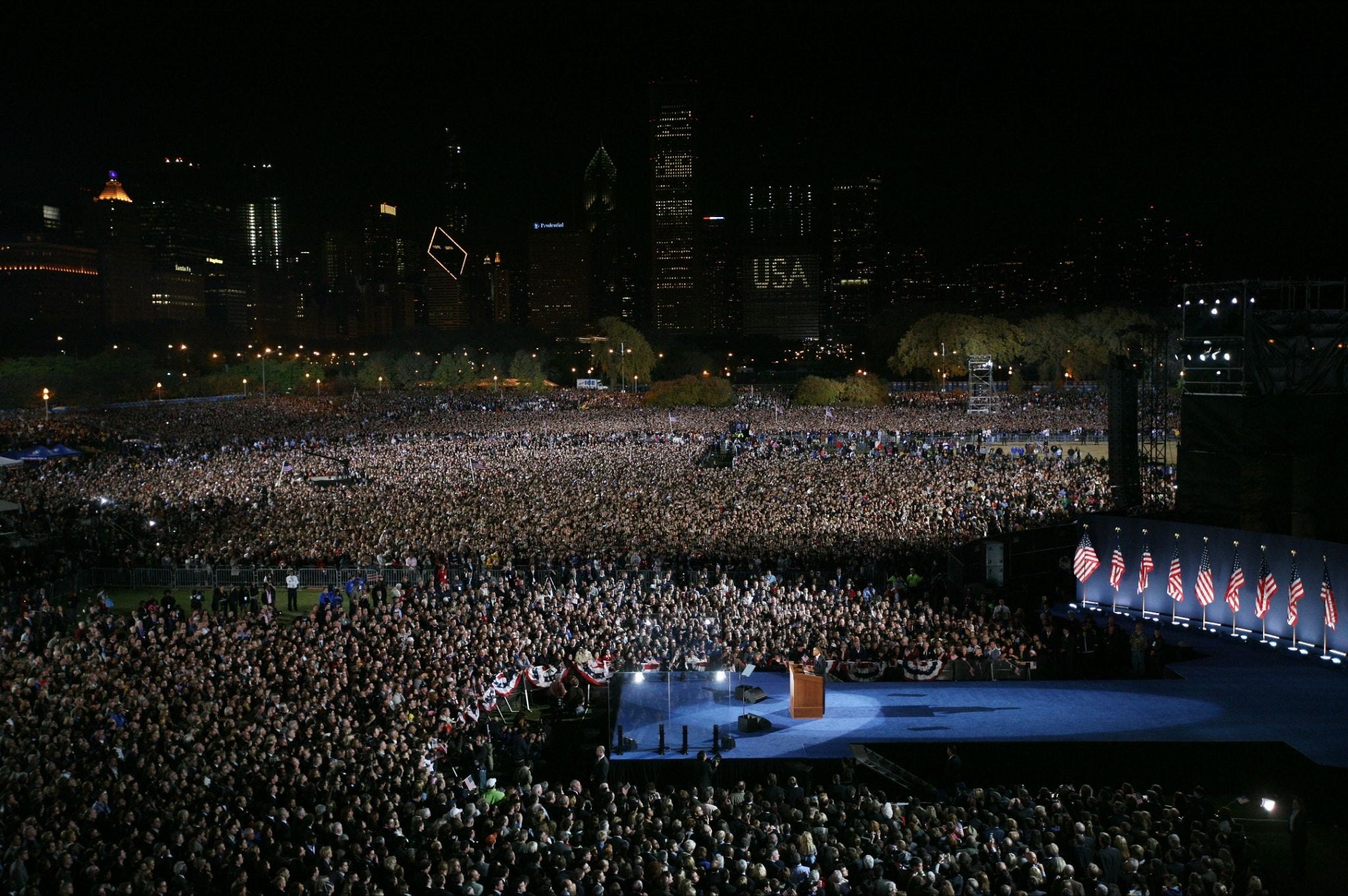
I hope you’ve had a Merry Christmas and/or happy holidays so far! As Matt Yglesias writes, it’s usually hard to find traction on newsletters this time of year. At the same time, the rest of the industry may overcompensate by hardly publishing any fresh content at all. And I’m sure some of you are waiting out airport delays today, or peeking at your phones while Uncle Stu tells the same story for the fourth time.
So I can’t resist the urge to swim upstream by publishing a semi-serious post, with a question inspired by The Ringer’s countdown of the top 100 sports moments of the past quarter-century. What are the most important American political moments of the 2000s so far?
Although the headline says “21st century”, I’ll allow events taking place in 2000 even though they were technically in the 20th century. So we have 26 years of history to consider here, in other words.
As usual, paid subscribers are welcome to argue about this in the comments. But be nice: it’s the holidays! And please think of my list as a draft, written in pencil. I undoubtedly have my biases, including probably rating elections more highly as compared to non-election events than others might. There are also various criteria that one might use to judge big moments:
The impact of the event on the future direction of politics. This might privilege surprising events versus predictable ones.
The objective consequences for the lives of American and global citizens.1
Drama and the sense of “living through history”.2
And as a tiebreaker, agency — meaning that the event reflected the consequences of deliberate decisions made by American political actors. In that sense, a war that the U.S. initiated counts more than, say, a natural disaster.
There’s another slightly tricky component to this. As a conceit, I’ve assigned each entry to a particular date. But some events don’t map onto dates so neatly. For the Iraq War, for instance, you could use the day the Senate authorized the use of military force (Oct. 11, 2002) or when the war actually started (March 20, 2003), or even Bush’s premature declaration of “Mission Accomplished” (May 1, 2003). In some cases, the dates on this list represent the cumulative impact of events that unfolded over weeks, months, or longer.
And yes, I consulted ChatGPT, Gemini, Claude and Grok for suggestions. They’re helpful in situations like this. But they had their share of oddities and omissions, and some events listed here didn’t come up on any of their lists.
51. October 27, 2022. Elon Musk completes purchase of Twitter.
In “listicles” like these, the first item is sometimes intended to be a bit spicy or to reflect the author’s personal obsessions. I write about both social media and Elon a lot, and Musk’s purchase of Twitter even sort of precipitated the founding of Silver Bulletin. Still, while the downstream political effects of changes in the media ecosystem can be overstated, I think this was an important one. Elon Musk’s 2022 purchase of what was then known as Twitter coincided with a conservative vibe shift. While that shift has lost momentum, the increasing insertion of Trump and other conservative actors into mainstream media institutions remains a big story (including news on that front just this week).
50. June 24, 2025. Zohran Mamdani wins New York City mayoral primary.
Recency bias? NYC bias? Maybe.3 But this is probably the biggest American left-wing electoral win of the past quarter-century. It’s far from clear that the left will prevail in the competition for influence between the various emerging Democratic Party factions. Still, the primary scores high on drama because of Andrew Cuomo’s heel turn and the fact that Mamdani had been an obscure figure just a few months earlier. And it signals what may be generational turnover in the party — long overdue turnover, if you’re asking me.
49. June 10, 2014. Dave Brat upsets Eric Cantor in Virginia congressional primary.
Lately, I’ve been thinking about the Tea Party movement, drawing comparisons between it and the Democratic #Resistance. The Tea Party’s birth is often linked to a rant by CNBC correspondent Rick Santelli on the floor of the Chicago Mercantile Exchange on Feb. 19, 2009.4 Santelli’s performance was, in many ways, one of the weirder moments of the quarter-century — among other things, having had a very strong editorial slant at a moment in American media when journalistic norms still tilted more toward neutrality.
But perhaps the biggest downstream impact of the Tea Party was in changing the types of candidates that Republicans nominated. So in wanting to tip my hat to the Tea Party, as I did for the left, I’m listing the upset of then House majority leader Eric Cantor in 2014 by an obscure college professor as the more seminal event of the Tea Party era, which presaged a shift away from the Republican “establishment” that Trump would capitalize on in 2016.
48. May 30, 2024. Trump convicted on 34 felony counts in hush-money case.
Our more #Resistance-y readers may want to place this class of events higher. But generally, I find it hard to believe that the various attempts to prosecute Trump were politically successful for Democrats, and he’s been immune from any consequences. If anything, the prosecutions entrenched Trump’s dominance in the 2024 Republican nomination race.
47. January 19, 2010. Republican Scott Brown wins U.S. Senate special election in Massachusetts.
Brown’s win after Ted Kennedy had died was just a huge deal at the time — Democrats lost in Massachusetts? — reinforcing that Obama’s halo had worn off, while also costing them a filibuster-proof majority in the Senate. However, its impact is slightly muted because Democrats pushed ahead and passed Obamacare anyway.
46. Aug. 29, 2008. John McCain names Alaska Gov. Sarah Palin as his running mate.
The Tea Party also had precursors before Santelli — most notably in Sarah Palin being more of a “game changer” in 2008 than McCain had bargained for. Lately, Palin hasn’t particularly carved out a space for herself in the crowded market for conservative influencers. But that obscures just how big a deal she was in 2008; many Republicans were crazy for her while she drove Democrats crazy.
Palin ended up being one of the least popular VP nominees and something of a cautionary tale. But that may have made the GOP complacent about the rise of populism in its ranks, which it fended off in 2012 but not in 2016.
45. June 16, 2015. Trump descends the golden escalator at Trump Tower to enter the 2016 Republican race.
44. July 27, 2004. Obama’s keynote speech at the Democratic National Convention.
If Trump and Obama are the pivotal figures of American politics in the past quarter-century, it makes sense to have them on this list several times each. Conventions are usually dull, but Obama’s keynote speech in 2004 immediately made him a star, as well as introducing some of his “post-partisan” themes. (You know, the whole “we coach Little League in the Blue States and have gay friends in the Red States” shtick. Hey, some of us still like it.)
I’ve paired it with the day that Trump entered the Republican primary — but he was mocked rather than celebrated, his chances dismissed, including by yours truly. The escalator ride scores high on the agency criterion because it’s easy enough to imagine Trump not running if he hadn’t been roasted at the 2011 White House Correspondents’ Dinner.
43. May 3, 2016. Trump effectively wraps up the Republican nomination with win in Indiana primary.
42. March 4, 2020. Biden decisively overtakes Bernie Sanders in Democratic nomination race on Super Tuesday.
Primaries are more fun to cover than general elections, in part because they proceed sequentially rather than all at once, almost like a sports season. That can make it harder to associate them with particular dates, however. Still, it’s worth thinking through a couple of major what-ifs.
The 2016 Republican primary was closer than people might remember. Trump had actually lost the Iowa caucuses on Feb. 1st. But Marco Rubio’s choke job in a debate five days later in New Hampshire was one of those moments when I began to realize that my early prognostications about Trump were probably going to be wrong. Republicans didn’t really have a plan to stop him, nor appealing enough alternatives. So both Ted Cruz and John Kasich suspended their campaigns after Trump won all 57 delegates in Indiana when just a few weeks earlier, a contested convention had still seemed possible. Cruz getting booed at the 2016 GOP convention while urging delegates to “vote your conscience” served as the denouement to all of this.
Meanwhile, Bernie Sanders deserves recognition, having been one of the more effective politicians of the era. His win in the Michigan primary in 2016 reflected one of the biggest polling misses ever and was one of the last cuts from my list. Still, in 2016 Sanders was never particularly close to upending Hillary Clinton. In 2020, by contrast, he had a real shot at the nomination after winning two-and-a-half of the first three contests (having essentially tied Pete Buttigieg in Iowa). But with the pandemic looming, Democratic leadership took a heavy hand in rallying behind Biden ahead of South Carolina and Super Tuesday, and the race shifted exceptionally quickly.
41. Sept. 27, 2018. Brett Kavanaugh confirmation hearing.
This ranks highly on pure drama — the day that Christine Blasey Ford testified and that Kavanaugh cried/teared up. It was also one of those days when politics really did seem to be in flux from moment to moment — you could see the tug-of-war playing out in prediction markets as Kavanaugh’s confirmation chances fell then rose again. However, it was arguably not all that high-stakes: if Kavanaugh hadn’t been confirmed, another conservative presumably would have been.
40. August 29, 2005. Hurricane Katrina makes landfall in New Orleans.
Apart from the terrible human impact, and an event that called into question American resilience and state capacity, Katrina is canonically associated with the demise of Bush’s political standing in his second term. Polling nerds like me like to point out, however, that the decline in Bush’s approval ratings was fairly linear and might not easily be attributed to Katrina in particular.
39. May 9, 2017. Trump fires James Comey.
38. October 28, 2016. Comey reopens investigation into Hillary Clinton’s email server.
Trump’s firing of the FBI director in 2017 was one of the few things that really did impact his approval ratings and gave Democrats (false?) hope that the wheels were coming apart. It was ironic given that Comey had done Trump a big favor. His letter to reopen the FBI investigation into Clinton because of files found on Anthony Weiner’s laptop quite plausibly cost Clinton the election.
37. Sept. 10, 2025. Charlie Kirk assassinated.
When I came up with this idea for this list, I knew there would be a couple of items that would be uncomfortable to think about — or that would be hard to rank because they’re very recent. And this one is both. But Kirk’s horrifying assassination needs to be listed somewhere.
36. January 5, 2021. Democrats win two runoffs in Georgia to win control of Senate.
Although Georgia has now turned purple, Democrats winning two Senate seats there would have seemed extraordinary if you’d predicted it at the start of the century. The runoffs also gave Biden a working majority in the Senate, a majority that he actually made productive use of. For about half a day, it seemed like Trump, who had been unhelpful to Republicans in runoffs, was fading out of the picture — but then the next day was January 6.
35. January 3, 2008. Obama wins Iowa caucuses.
I went back and forth on how many Obama moments to list, including Iowa, his 2004 DNC speech and of course his general election win, but not his inauguration in 2009. For me, it was Iowa when it felt like we were really living through history, with one of the whitest states in the country voting for the man who would become the first Black president. And Obama’s margin of victory was decisive — although not a surprise if you had trusted the Selzer poll.
34. June 7, 2001. Bush signs first of two major tax cuts.
33. July 28, 2017. Obamacare repeal fails in Senate.
32. Aug. 16, 2022. Inflation Reduction Act signed into law.
Various hallmark events for fiscal policy. To take a stylized conclusion from the past quarter-century, Republicans will sacrifice everything for tax cuts, but have found it much harder to repeal social welfare programs. The Obamacare failure gets some bonus points for John McCain’s dramatic thumbs-down. Biden’s Inflation Reduction Act, meanwhile, was the most significant piece of climate legislation signed in the century so far. But it didn’t really live up to its name, and inflation became an albatross for Democrats in 2024.
31. Nov. 8, 2022. Democrats retain Senate and limit damage in House in midterm elections.
30. Nov. 5, 2002. Bush adds to majorities in midterm elections.
29. Nov. 6, 2018. Democrats gain 41 House seats but lose ground in the Senate in the midterm elections.
28. Nov. 7, 2006. Democrats win control of Congress in midterm elections.
If we’re going to list 51 events, every midterm probably needs to rank somewhere on the list (the two midterms not listed in this batch will appear later). You could argue about the order of these. Bush’s gains in 2002 were historically unusual and reflected what was a sustained high-water mark for him after Sept. 11. The 2006 midterms signaled Bush’s lame-duck status and previewed further gains for Democrats in 2008, however. The 2022 election was more of a stalemate, if relatively impressive for Democrats under the circumstances, while 2018 would rank higher for Democrats they’d won Senate races in Florida or Texas.
27. Oct. 3, 2008. Troubled Asset Relief Program passes.
Maybe I have this a bit underrated — the AI models mostly have TARP in their top 25. Although I don’t think the long-run political fallout from the financial bailout is entirely straightforward with Obama ultimately receiving a lot of the blame for it.
26. Oct. 25, 2001. PATRIOT Act passes U.S. Senate 98-1.
25. May 2, 2011. Osama Bin Laden killed in special forces operation.
The bookends to the War on Terror. I’m citing the date of the Senate’s passage of the PATRIOT Act rather than Bush’s signature the next day just in case people forgot about the sweeping bipartisan consensus that Bush had after 9/11: only Wisconsin’s Russ Feingold voted against it.
Meanwhile, the successful mission to kill Osama bin Laden is a reminder that newsworthy events don’t necessarily need to reflect bad news. I’m not sure how much it ultimately swayed the 2012 election, but it’s one of those moments I remember: on a plane somewhere with a bad internet connection, with the news having been broken by a relatively obscure Twitter account.
24. Feb. 13, 2021. Trump acquitted by Senate in second impeachment trial.
The second impeachment of Trump did not produce a conviction in the Senate, with the vote failing 57-43, short of the two-thirds majority required. But that tally did include seven Republicans voting to convict. While there was never necessarily that much uncertainty about the outcome, one can ask what it would have finally taken for the dam to break on Republican support for Trump if the events of January 6 hadn’t been enough. Some Republicans had wrongly concluded that Trump’s moment in politics had passed — when if they’d voted to convict him, they could also have precluded Trump from running for office again four years later.
23. June 27, 2024. Biden-Trump debate.
22. July 21, 2024. Biden withdraws and is quickly replaced by Kamala Harris.
You could rank these even higher. But I’m trying to hedge against bias since I’ve written about this sequence of events so much. The debate was among the most dramatic events I’ve covered in politics because it was apparent within a few minutes that it was going to be a disaster for Biden. And the 24 days that followed it were the ultimate case of “Dems in disarray”, with various moments of Biden seeming to firm up his standing only to screw up again. July 21 would rank more highly if Harris had come back to beat Trump.
21. Sept. 18, 2020. Ruth Bader Ginsburg dies.
Even though this might seem obvious enough, control of Supreme Court seats is extraordinarily important given the nature of lifetime appointments. RBG’s death in 2020 came amid the pandemic and the closing weeks of the election, and Democrats would have been able to replace her with a liberal justice given that they would soon win the presidency and Senate. Instead, Republicans quickly confirmed Amy Coney Barrett.
20. June 26, 2015. The Obergefell decision legalizes same-sex marriage.
Another moment I remember well — I literally went out to check out the scene at the Stonewall Inn. This also reflected what I’d consider the high-water mark of Obama-era liberalism: note that it came just 10 days after Trump’s escalator ride.
19. July 13, 2024. Trump nearly assassinated in Butler, Pennsylvania.
It’s hard to know quite what to do with near-misses, events that could easily have been much worse. This turned into an iconic moment for Trump, however, and I suspect is a bit underrated as a reason that he’d go on to win the election in November, associated with an improvement in his favorability ratings that he retained throughout the campaign.
18. Nov. 4, 2014. Republicans gain 9 seats to flip Senate in midterms, and expand majority in House.
17. Nov. 2, 2010. Republicans gain 63 House seats and 6 Senate seats in midterms.
The 2010 election was more dramatic in the moment, with Republicans setting a post-WW2 record for gains in the House, refuting the idea that Obama had ushered in some sort of post-partisan consensus. But 2014 was probably just as important: since Senate terms last for six years, flipping nine seats is a huge deal. The Senate rout in 2014 prevented Obama from replacing Antonin Scalia with Merrick Garland, helped set up Trump to confirm three justices of his own, and reflected the increasing shift away from Democrats in rural, white states. Taken together, these two losing midterms also gave Democrats a weak bench, with few younger Dems winning Senate or gubernatorial races in swing states, contributing to their struggles to nominate compelling presidential candidates since Obama.
16. Nov. 6, 2012. Obama wins reelection.
15. Nov. 2, 2004. Bush wins reelection.
Amidst an increasingly anti-incumbent mood, these are actually the only two times since 1996 when the party in power retained the presidency. I rank 2004 higher because it was closer in both the polls and the eventual outcome; John Kerry would actually have become president if he’d won Ohio. Obama’s successful reelection in 2012 was arguably the most impressive campaign of the entire period, however.
14. June 24, 2022. Dobbs decision overturns Roe v. Wade.
The backlash to this decision very likely provided a boost to Democrats in the 2022 midterms, but that’s not why it needs to rank highly. Rather, it’s because of the revealed preferences of both parties in just how high the stakes were. Overturning Roe reflected the culmination of decades-long efforts by Republican activists to shift the court in a more conservative direction.
13. May 25, 2020. George Floyd murdered, sparking wide protests and unrest.
12. Jan. 6, 2021. Insurrection at the Capitol.
If we’re being honest, the whole pandemic sequence from early 2020 through early 2021, when the world finally started to open back up again, still feels uncomfortable to talk about.
In polls, American voters have not regarded January 6 as being as significant as some of the other events on this list. But it could have been much worse, and I’m not sure they should feel so sanguine about the failure of a peaceful transition of power.
Meanwhile, the spring/summer 2020 protests, sometimes associated with outbreaks of violence, were probably not monocausal, reflecting both longstanding concerns about police brutality and Americans feeling pent-up during the COVID shutdowns. Debates about what impact they’d have on the election proved to be a touchy subject, with Floyd’s killing also sparking a broader “racial reckoning”. It was probably the most left-wing moment of the past quarter-century even though Trump was still president.
11. March 23, 2010. Obama signs the Affordable Care Act into law.
A big fucking deal: probably the most consequential domestic legislation during the past quarter-century. And one that reflected some uncharacteristic willingness by the Democratic Party to take a risk, as the ACA was unpopular at the time and contributed to the landslide against them in November 2010.
10. Nov. 3, 2020. Biden wins election.
9. Nov. 5, 2024. Trump wins election, becoming first nonconsecutive president since Grover Cleveland.
I want to avoid recency bias and the trap of suggesting that every election is the “most important” ever. But anything involving Trump is inherently high stakes. I rank 2024 more highly than 2020 because of the dramatic nature of Trump’s comeback after his various convictions and impeachments. And 2024 was more of a toss-up going into the evening — though 2020 took longer for the networks to call.
8. Sept. 15, 2008. Lehman Brothers declares bankruptcy.
7. March 13, 2020. White House declares COVID national emergency.
6. March 20, 2003. Invasion of Iraq begins.
Talk about some apples-to-oranges comparisons. We’re getting into some truly world-historical events and I probably don’t need to sell you on their importance. The long-run political impact of COVID5 is perhaps the hardest to figure out — ironically, Biden wound up winning by about the same margin that he was ahead in polls before the pandemic hit American shores. Still, COVID has been the most high-impact human catastrophe for the United States in my lifetime, killing more than one million Americans.
The other two events reflected the twin failures of the Bush era — though as I mentioned earlier, Obama also took his share of blame for the financial crisis and the bailouts. If you’re one of our younger readers, you might not remember just how scary the global financial crisis was, with the stock market losing more than half its value in the span of just over a year.
5. Nov. 4, 2008. Obama wins election, becoming first African-American president.
In part because of Lehman’s bankruptcy, the 2008 election ultimately wasn’t very close, with Obama instead running up the score with wins in surprising states like North Carolina and Indiana. But without wanting to lapse into cliches, the election of a Black man named Barack Hussein Obama to the presidency was a turning point in American history that many people would never have imagined to be possible.
4. Nov. 7, 2000. Election heads to recount after Florida is incorrectly called for both candidates.
3. Dec. 12, 2000. Bush v. Gore decision secures the election for Bush.
You could argue about whether the 2000 or 2008 election has been more consequential for the country in the long run. But for short-term uncertainty and dramatic moment-to-moment headlines, 2000 takes the cake.6 Bush’s final margin was 537 votes, fewer than the number of votes that Gore probably lost due to a bad ballot design in Palm Beach County and a reminder that history can turn on seemingly random contingencies.
In fact, I think we need two entries for 2000 — both election night itself, a total shambles because the media twice called the state of Florida prematurely, and then the Supreme Court’s decision to put an end to the recount 35 days later. In addition to reflecting the increasing partisanship of the court, the recount also signaled the increasing influence of the conservative media — Fox News was starting to have a much bigger impact, as evidenced in coverage of events like the “Brooks Brothers riot”.
2. Sept. 11, 2001. Terrorist attacks on the Pentagon and the World Trade Center.
If you were old enough at the time, you’ll probably remember 9/11 with uncanny clarity. It woke America up out of its post-Cold War complacency; there hadn’t been a similar attack on American shores since Pearl Harbor. The resulting political mood was as conservative as I can remember in my lifetime, with Bush’s popularity surging. But the prosecution of the War on Terror produced quagmires in Iraq and Afghanistan and the resurgence of Obama and the Democrats instead.
1. Nov. 8, 2016: Trump wins election.
We can endlessly debate how predictable Trump’s win was, or wasn’t. But nothing in American politics has ever been the same since.
But to be clear, this is a deliberately U.S.-centric list.
This list basically coincides with the period when I’ve closely been following politics. As another tiebreaker, events that pass the test of my remembering where I was when I found out about them are ranked a little higher.
But note that the very next item on the list is a Tea Party upset in a Congressional race, and New York City has roughly 10x the constituency of a single congressional district.
And a conference call by conservative activists the following day.
Personally, the day I most remember from this period was March 11, 2020 — i.e. the day that both Tom Hanks and Rudy Gobert were diagnosed with COVID — but March 13 works just as well.
For what it’s worth, the AI “panel” also preferred 2000 to 2008 by a 3-1 margin, Claude being the dissenting vote.
This is a fun read and good list. A few comments:
I think it’s a little short on legislative policy. You have the ACA, Bush tax cuts, Inflation Reduction Act, ACA repeal fail, TARP, and the Patriot Act. I think the CARES Act (March 2020) is an obvious oversight, but maybe that just falls into COVID. But Medicare Part D (2003), CHIPS (2022), No Child Left Behind (2002), the bipartisan infrastructure law (2021), Dodd-Frank (2010), and ARPA (2021) seem like plausible candidates for policy/political impact.
You might also be a little short on court decisions. You have Obergefell, Bush v. Gore, and Dobbs, but boy, Shelby County, Citizens United, and especially Heller all seem pretty darn big.
I think at least one congressional procedure change deserves to be on the list—the nuking of the filibuster on nominations (2013 by Dems for lower courts and executive nominees; 2017 by GOP for SCOTUS nominees). This paved the way for much more partisan nominations, and forever changed how nominees interact with the Senate. Maybe this could be rolled into the Kavanaugh nomination on the list.
So what gets chucked if you add 2-4 things from my suggestions? I’d get rid of at least one of the Obama moments. Winning Iowa seems very time-period local. Will anyone care about that 50 years from now? And I get the point that every midterm is important, but I still think you have to chuck one or tow of them—you don’t have every SCOTUS nom on here, and that’s arguably always bigger than a midterm. I’d chuck 2022 “Dems limit damage” and 2002 “GOP adds to majorities.”
April 13, 2022
Texas sends its first busload of migrants to NYC.
Greg Abbott deserves credit for pulling off the biggest political stunt of the decade (and, perhaps, the century to date). Other Republican governors followed suit. Immigration suddenly became a hot topic in blue states far from the southern border and a leading electoral issue nationwide.
The effects of Abbott's stunt shaped the 2022 and 2024 elections and are still being felt today.