

Can Talarico win in November?
Plus, were prediction markets right or wrong about Texas? And did Talarico beat Crockett because he was more moderate?


James Talarico, a 36-year-old state representative, won the contentious Democratic primary for U.S. Senate in Texas last night. With 93 percent of the vote counted, Talarico leads U.S. Rep. Jasmine Crockett by 7 points. There is a fair bit of vote left to be tallied in Dallas, a Crockett stronghold, which might shrink that margin a bit, but it should be a comfortable-enough win. Turnout is already more than 2.2 million votes, eclipsing GOP turnout by 100,000+ votes and more than doubling the 967,503 Democrats who turned out in the 2024 Senate primary. I’m not a big believer in primary turnout being predictive of general election outcomes, but this is nevertheless a big number for Democrats in a red state.
Meanwhile, on the Republican side, we’re headed to a runoff. Incumbent U.S. Senator John Cornyn leads Ken Paxton 42-41 with 94 percent of the vote in, but that’s well short of the 50 percent needed to advance automatically. The runoff is scheduled for May 26, so we’re going to be hearing a lot more about this race.
In today’s newsletter, I’m going to take an almost SBSQ-like approach by splitting it into three parts:
Following up on last week’s story, what should we make of the difference between prediction markets and polls in Texas?
Was this a win for moderates versus progressives?
And then the main course: an early look ahead to November and how we should think about Talarico’s chances.
We’ll run the first two parts for everyone and leave the third as a bonus for paying subscribers.
Prediction markets got a big “W” on Talarico but took an “L” on Cornyn
Although most of the attention was on the Dem side, one could argue that the GOP result was the more surprising and significant one. In the final seven pre-election polls, Paxton led by an average of 4 points. Given how (in)accurate primary polls tend to be, a 1-point loss isn’t that far from the mark — and making the runoff is what matters most. As Eli covered last week, the case reflected in hypothetical runoff polling is that Paxton will pick up the bulk of votes from the third candidate, U.S. Rep. Wesley Hunt, another conservative/MAGA type, probably enough to put him over the top.
However, the conventional wisdom has been rattled because this is one of those cases where, along with the prediction markets, it got ahead of itself in the first round. At Polymarket, Cornyn had fallen to as low as 5 percent to win the first round as of 10 a.m. Tuesday morning; those chances are now 98 percent.
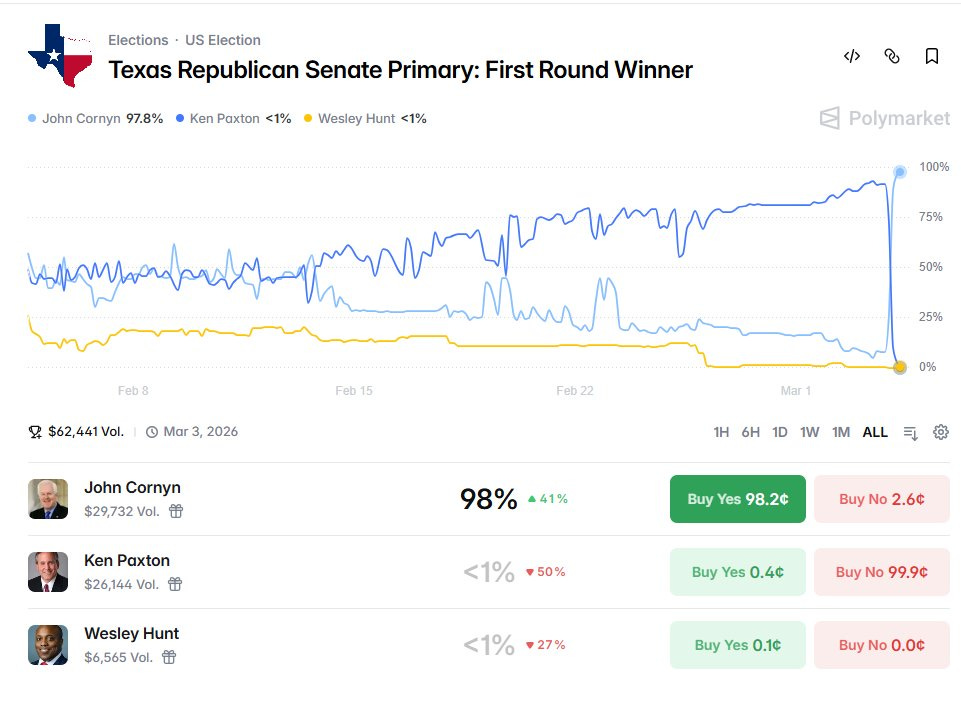
And the runoff is now nearly trading as a toss-up — another big boost for Cornyn from 17 percent as of yesterday morning.
The perception of a disappointing night for Paxton is also reflected in media coverage of the race: Politico described the Republican result as an “unexpectedly strong showing” for Cornyn. But it may be that those expectations were miscalibrated. Texas is only projecting to be a 5-point polling error (Cornyn +1 rather than Paxton +4), which is well below average for a primary. One of my longstanding complaints is that even relatively well-informed political observers don’t do enough to distinguish the robustness of a polling lead: how an 8-point lead is much less likely to result in an upset than a 4-point lead, for example, or how a 4-point lead is much more solid in the general than in the primaries.
Still, the perception of overperformance has contributed to speculation that President Trump will endorse Cornyn — or at least not endorse Paxton — and that would be a big deal.
On the Democratic side, though, this was a big “W” for prediction markets. As I covered last week, prediction markets were always more confident in Talarico than the polling alone could justify.1 And then Talarico’s stock soared further on Tuesday afternoon when turnout numbers were stronger where Talarico needed them. Last night, prediction markets were much quicker to essentially “call” the race once votes started to be counted than the news networks were.
My conclusion to last week’s story was that Talarico probably did deserve to be considered the favorite despite the mixed polling, but not to the extent that prediction markets had him. Half-right, half-wrong, I guess?2 I’m not quite sure how to feel this one, especially given that these same markets were overconfident on the GOP side.
Crockett might not be more liberal, but she was more partisan
At the New York Times yesterday, Nate Cohn had a good story about how while Talarico might have been perceived as more moderate, that isn’t necessarily justified if you look at their voting records and stated issue positions. In Congress, Crockett’s voting record has been closer to the middle/mainstream of the Democratic Party than the left wing. Meanwhile, Talarico, despite emphasizing his background as a Presbyterian seminarian, mostly has conventionally left-progressive positions.
Undoubtedly, race and gender also play some role in how these candidates are perceived. I don’t think Crockett was entirely wrong to question the notion of “electability” as applied on this basis.
However, I think both these perspectives leave something out — because there’s more going on here than how Talarico and Crockett might fill out some sort of ideological questionaire.
Another longstanding Silver Bulletin pet peeve is how observers frequently confuse partisanship for ideology. Partisanship means loyalty and adherence to a political party or organized faction — such as the Democratic Party. For example, I’d argue that Democrats who defended Joe Biden even after his disastrous debate last June were being extremely partisan, but this had little to do with whether you were left or center.3 Indeed, the faction of the Democratic Party that I’ve called the #Resistance is often highly partisan — sometimes more so than the populist left.
And Crockett frequently played into that partisanship. Not only did she defend Biden after the debate; she went on TV to defend the pardon of Hunter Biden. (Ironically, Crockett nevertheless received the endorsement of Kamala Harris last week in the latest sign of Harris’s terrible political instincts.)
And while Crockett has emphasized the importance of Democratic turnout rather than persuasion, there’s more going on than just that. Crockett is also known for schoolyard insults, such as in calling Texas Gov. Greg Abbott, who uses a wheelchair, “Governor Hot Wheels.” She’s flirted with election denialism at times, like by calling Trump “the person who allegedly got elected”. And Crockett went full-on Blue MAGA in kicking an Atlantic reporter out of a rally last week.
Their January debate also provided some clues to their respective attempts at persuasion. Talarico and Crockett weren’t necessarily coming to majorly different conclusions on substance. But these are emotionally different approaches, with Crockett tending to run “hot” while Talarico ran as righteously angry but more detached and even-keeled:
“I am not just sitting in D.C.,” she said. “I am getting out into the streets. And right now, to be perfectly honest, if we’re going to win and keep our country, we’re going to need somebody who can file bills but also knows how to be a street fighter.”
Talarico, meanwhile, highlighted his experience as a middle school teacher and his record fighting “tooth and nail” in the Texas House, where he frequently went viral over clips of his exchanges with Republicans on proposals including private school vouchers and a mandate to display the Ten Commandments in public school classrooms.
“The best indicator of future behavior is past behavior,” he said. “I have gone toe to toe with the billionaires who are trying to dismantle public education in this state.”
While Crockett’s partisan brand of messaging obviously has its appeal in a primary — her 46 percent of the vote is hardly embarrassing — this may help to explain why voters saw Talarico as more moderate. Especially in a state like Texas that hasn’t elected a Democrat to the U.S. Senate since Lloyd Bentsen in 1988, partisanship is a tough sell from an “electability” standpoint. Incidentally, voters might not be wrong about this. In the Silver Bulletin election models, the measure we used to evaluate “ideology” is actually a partisan loyalty score based on voting records in Congress. We’ve found that candidates who buck their party more often — who are less partisan — perform a few points better, other things being equal.
Meanwhile, one can detect an element of Zohran Mamdani in Talarico’s approach, in emphasizing economic populism rather than cultural hot buttons and in being more of a happy warrior. Still, as talented as I think Mamdani is, that sort of message is easier to sell in New York City than in New Braunfels. And GOP ad-makers will search through every clip of Talarico’s heated primary with Crockett to identify instances where he seemed out of touch with a still-very-red state.
A look ahead to November
It’s easy to make fun of Beto O’Rourke, the former U.S. Rep. who flopped in a 2020 campaign for president and then lost to Abbott by 11 points in the 2022 gubernatorial race. But O’Rourke also had the best showing for Democrats in years in the 2018 U.S. Senate race by losing to Ted Cruz by less than three points. So let’s take a quick look at how 2018 differed from other recent elections where Democrats haven’t even come close.