

SBSQ #29: Will AI terminate democracy? And why did Gallup terminate its approval ratings?
The case for why AI will produce greater economic and political inequality. Plus, what's up with Gallup?

This is the Rod Carew (#29) edition of Silver Bulletin Subscriber Questions. You can leave questions for SBSQ #30 — you can probably guess who it will be named after! — in the comments below.

Since last month’s SBSQ got a little out-of-hand and split into three separate posts, let’s keep it to two questions this time:
Why did Gallup cancel its approval rating polling?
Will democracy survive a rapid AI takeoff?
Why did Gallup cancel its approval rating polling?
kezme asks:
For next SBSQ: What are your thoughts on Gallup canning their Presidential job approval polling?
I think it stinks. Gallup has a history of risk-averse decision-making that provides some plausible deniability; we’ll get to that. But could this have been a political decision? That’s highly plausible, too. I’m not sure that the choice to end a polling series that Gallup has run continuously since the 1930s, and which provides the firm with significant prestige and visibility, makes much sense otherwise.
Gallup is a major federal contractor, having been awarded around $190 million in grants since FY 2008. Meanwhile, Trump has said that polls he doesn’t like “should be a criminal offense”. And he actually sued Ann Selzer after her (yes, very wrong) Iowa poll in 2024.
I can’t find any examples where Trump singled out Gallup with this sort of comment. However, they’ve been notable in typically showing bad numbers for him. Across 10 approval rating polls Gallup published in 2025, Trump's net approval rating averaged 8.7 points lower than the Silver Bulletin average at the same time.
In my periodic hot takes about the media here at Silver Bulletin, I’ve been somewhat ambivalent about the extent to which I see news outlets paring back on Trump-unfriendly coverage as a business strategy based solely out of wanting to please or placate Trump or avoid lawsuits. To be clear, I think that’s clearly part of the equation, but there are other factors like the political beliefs of the publishers and the fact that the media business is perpetually struggling. But there’s a troubling pattern developing: independent media seems increasingly responsive to political pressure from the White House. Not in all instances (and there’s plenty of left-leaning political bias, also). But in too many of them. I can’t blame anyone for wondering whether Gallup’s decision is part of the pattern.
To be fair, Gallup isn’t a “news outlet”. Instead, it’s a privately-held business that’s basically a big management consulting and public relations shop that uses public polling as a loss leader. It’s not a particularly cheap loss leader, because doing good traditional polling is expensive. However, various estimates1 say that Gallup does about $500 million in revenue per year and has about 2000 employees. Spending, I don’t know, a few million in public-facing polling every year might be a reasonable marketing investment to improve its prestige and increase its profile.
Because Gallup definitely has an outsized brand name relative to the magnitude of its business. Here, for instance, is a comparison of the volume of Google searches for Gallup and the management consulting firm I used to work for in my 20s, KPMG.
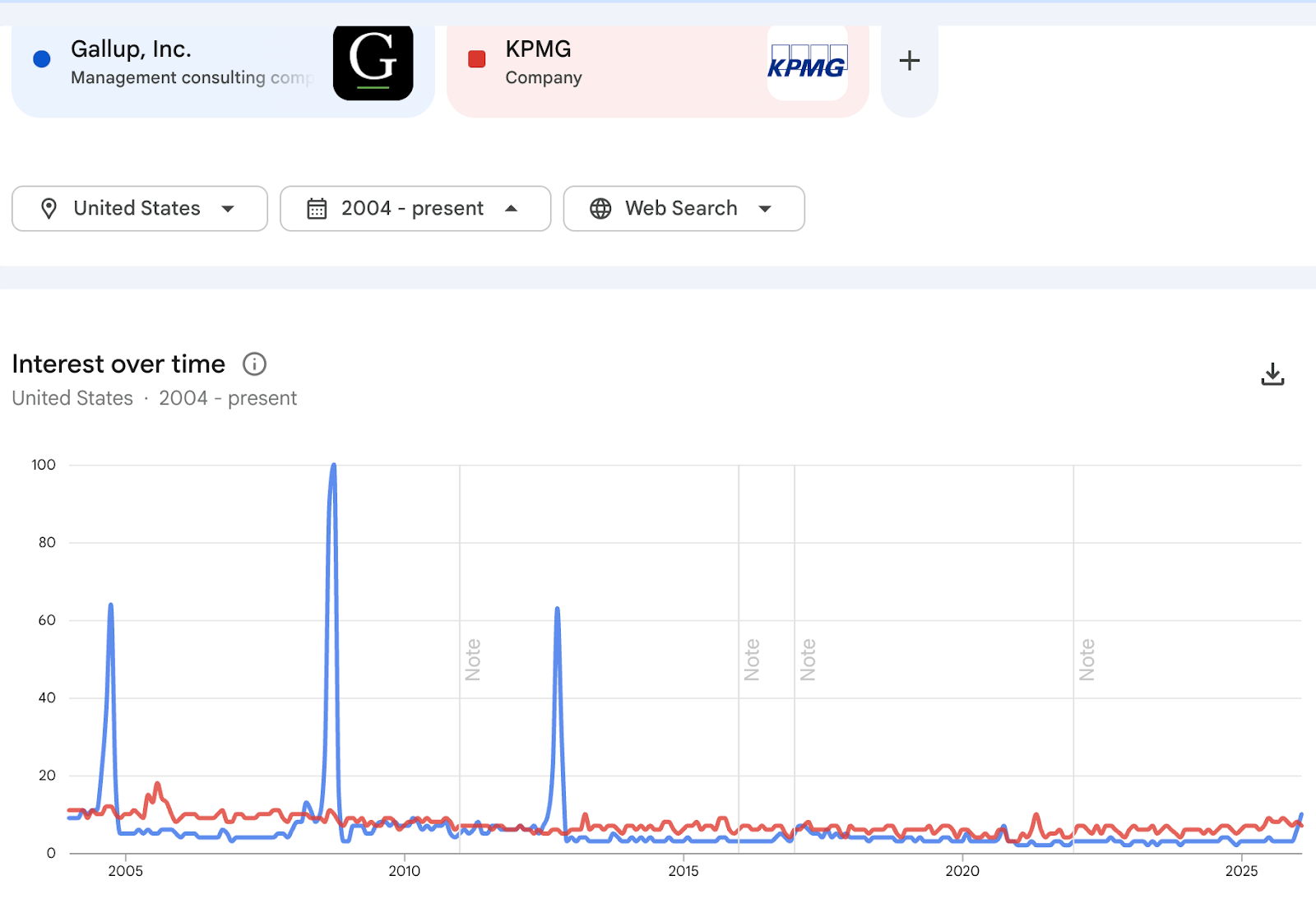
KPMG has something like 100x Gallup’s annual revenue. It’s objectively a much bigger business. And yet Gallup is roughly as well-known in the United States based on the Google search data. Because of its polling, Gallup is a much bigger brand name than it otherwise would be.
And then there are three huge spikes that Gallup had in 2004, 2008 and 2012. Those reflect, of course, interest in its horse-race polling2 near election peaks. So what happened after that?