

Knicks in 5!
5 thoughts about a 53-year wait from a guy who used to live across the street from Madison Square Garden.

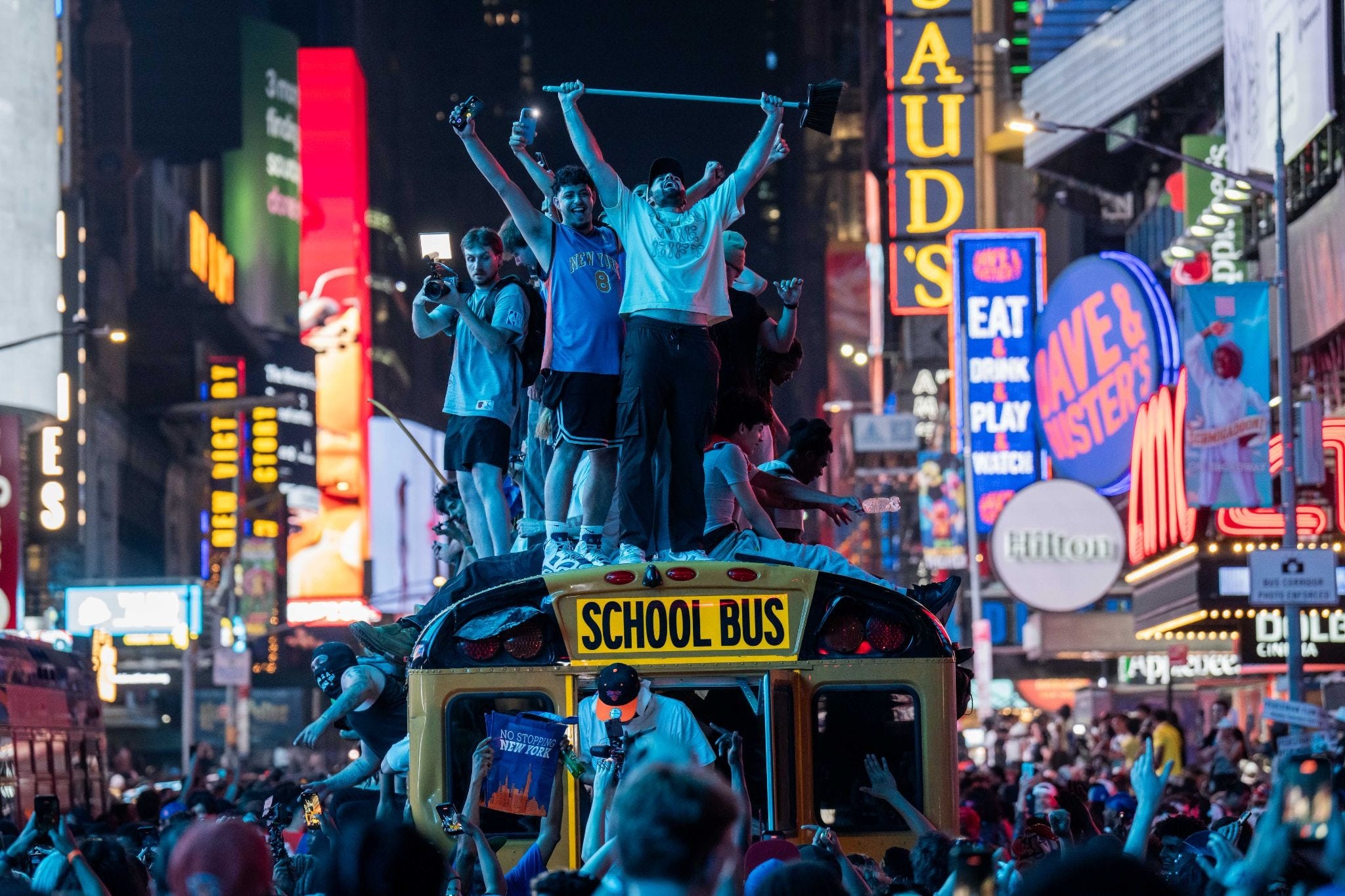
Did that really happen? Although I might or might not have consumed a beer on a public walkway last night, my memories of the evening are fairly intact. And when I woke up this morning, the New York Knicks were still NBA Champions, making for the eighth distinct champion in eight seasons. Objectively speaking, I can’t claim to be surprised — I literally bet on the Knicks! But between the Knicks, Cubs and Red Sox in recent seasons, we’re starting to run out of sports curses — though apologies to our readers who are fans of a Canadian NHL team or the Buffalo Bills.
Silver Bulletin hasn’t been around that long, but if there’s anything resembling a tradition in these parts, it’s writing a piece of praise and analysis about the eventual NBA champion:
This year’s edition is harder to write only because I’ve already exhausted a couple of the most obvious routes, having analyzed the Knicks’ transformation into a great basketball team before the Finals and written a personal tribute to the Knicks last year. (I “adopted” the team shortly after moving to New York City in 2009. I almost literally lived across the street from Madison Square Garden for more than a decade, so that’s my excuse.)
So I’ll instead give you five spare thoughts, to coincide with the number of games the Knicks needed to close out the series.
1. Dynasty-or-bust NBA strategies are overrated
One constant in these championship write-ups is that analysis of what it takes to win the title can be myopic, with teams slotted into an overly narrow range of archetypes. Four of the past eight winners did not have a top-5 MVP finisher on their rosters — indeed, Jalen Brunson didn’t receive an MVP vote this season. The CW that a team can’t thrive in the post-season when a small guard is its best player also hasn’t held up well lately between Brunson and Steph Curry.
And recent postseasons haven’t been particularly friendly to favorites. The Knicks weren’t even that unlikely to win, having been +900 (implying a 1-in-10 chance) in futures markets to start the year; the Spurs (at +6600) would have been far more unlikely champions (indeed, the most unlikely winners ever). Nevertheless, among the eight non-repeat champions, only the 2024 Celtics were preseason favorites or co-favorites. This reflects a reversal of a streak in which the favorite won the majority of the time — 18 out of 34 tries — between 1985 and 2018.
This recent trend has contradicted the conventional wisdom that teams ought to basically adopt a variance-maximizing strategy of “dynasty or bust,” even being willing to tank entire seasons for the opportunity to acquire one or two superstars. We’ve even implicitly endorsed that attitude here at Silver Bulletin; our Future of the Franchise rankings are calibrated off our expectations for how many championships a team will win over its next 10 seasons, with everything else literally not mattering. (We had the Knicks 9th and the Spurs 2nd in the most recent edition.)
I’d like to point out, though, that even during that streak of favorite dominance, 18 out of 34 is not a particularly large sample size. What if the Timberwolves had drafted Steph Curry instead of Ricky Rubio and Jonny Flynn? What if the Bulls hadn’t traded for Scottie Pippen on draft day in 1987? The 1979 pick that brought the Lakers Magic Johnson originally belonged to the New Orleans Jazz. Maybe the league is changing, and modern salary cap rules are making dynasty building harder. But it seems plausible that favorites ran a little bit above expectations during this stretch.
In poker, there’s sometimes a debate about whether it’s worth adopting lower-variance strategies to minimize your risk of ruin. For instance, a more conservative approach that theoretically yields $100 in expected value per hour but has a standard deviation of ±$500 might be preferred to a more aggressive strategy that nets $150 in EV but has a standard deviation of ±$1000. Generally speaking, though, these approaches are not advisable: the best way to avoid a losing streak that makes you go bust is to play as optimally as possible and to build up a cushion against the inevitable unlucky periods.
In the NBA, the situation is sort of reversed, with teams like the “Trust the Process” 76ers swinging for the fences and taking variance-maximizing approaches. But I wonder if that tactic is wrong, also, because it requires one too many things to go right. The Knicks have never been particularly rewarded by lottery luck; since taking Patrick Ewing #1 overall in 1985, the highest they’ve picked is 3rd (RJ Barrett in 2019). The Leon Rose-led Knicks, instead, could be typecast as a high-floor, lowish-ceiling team willing to “settle” for merely being pretty good, having indeed gone all-in on their current roster with the Mikal Bridges trade. Mitchell Robinson was the only important rotation player to be drafted by the team.
But sometimes “planning” to win 50-something games, rather than gambling on a dynasty, pays dividends too. For one thing, it makes the product more compelling for fans, as evidenced by the Knicks selling the most expensive tickets in NBA history during the Finals. Also, although “leaps” in ability are much rarer for veteran players than for young ones, they do happen occasionally. Karl-Anthony Towns, although he didn’t close out the Finals particularly well amid a mess of foul trouble, has transformed himself into a point-forward on offense and was basically as good as anyone in the playoffs at guarding Wemby. OG Anunoby was ranked as only the 40th best player in the NBA according to The Ringer in April, but by my estimation, he should be more in the 15-20 range.1 Sometimes coaching changes can help, too. It might be healthy for the NBA if more teams were willing to “settle” for being merely pretty good, and, under current cap rules, having a puncher’s chance of winning the Finals is better than most alternatives. Cases like the 2026 Knicks or almost the 2025 Pacers might become more common.
2. Momentum is underrated
A decade or two ago, stat nerds like me were fond of downplaying the importance and sometimes even the existence of momentum in sports, as illustrated by this XKCD cartoon:
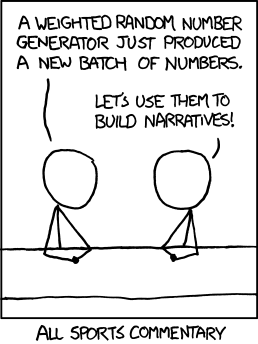
But while it’s probably still true that most fans overrate the hot hand, I think the stat nerds were wrong to treat momentum as, at best, being a rounding error. And there have been two types of momentum on display in this NBA playoffs.
One was the Knicks’ incredible hot streak in the postseason — they went 15-1 after losing two out of the first three to the Atlanta Hawks, and finished with easily the best playoff point differential in NBA history.
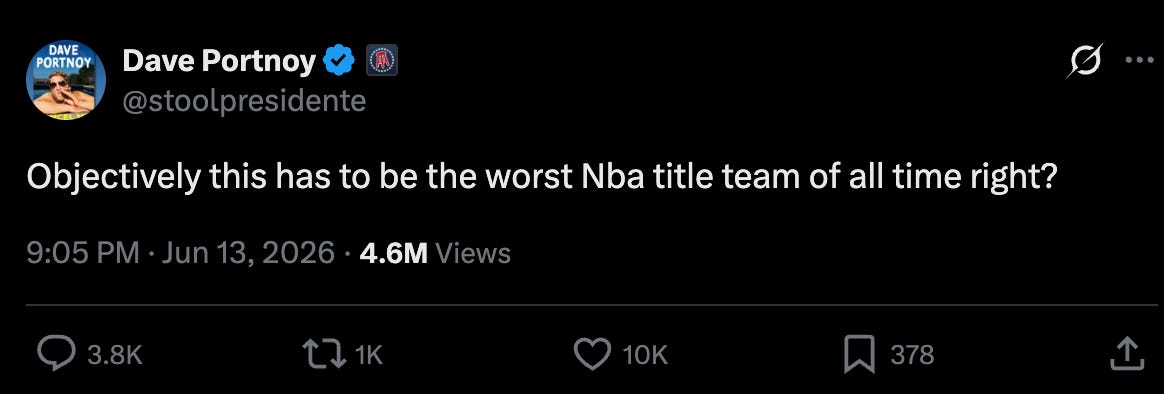
While meaning no particular offense to, say, Dave Portnoy of Barstool Sports, it’s ironic that a certain class of pundit types are now downplaying the Knicks’ accomplishments.
Even if you weight 19 postseason games equally to 82 regular-season games, it really boosts the Knicks’ standing, taking them to +7.8 PPG across a 101-game season instead of +6.2 over 82. But that’s far too conservative an approach. The playoff sample came against strong opponents — no, the 76ers and Cavs aren’t world-beating teams, but they’re also not the Wizards or the Kings. And it’s recent data.
Basically, all the sports models I’ve built in recent years are Elo-type systems, meaning they continually revise a team’s rating after each game. How aggressively to update the rating is governed by a parameter called the “K-factor”, which can be determined empirically. In hockey or baseball — fairly random sports where even the best teams might only win two-thirds of the time — one game doesn’t tell you all that much. But in basketball, you should generally be pretty aggressive with your K-factors. One hundred possessions per team per game is a large sample, and the best teams can win in excess of 80 percent of their games.
Just look at some of the other teams on the list with the Knicks: they’re literally the consensus best teams in NBA history, including the Curry Warriors and the Michael Jordan Bulls. It’s very hard to sustain that sort of performance over a 19-game playoff sample without being really good. The Knicks weren’t even that hot, shooting 39.1 percent from three as compared to 36.7 in the regular season. It’s basically why I bet on them; I thought the market was treating them as a 53-win team and rounding up a bit, when there should have been a larger correction.
The other pertinent form of momentum is within-game momentum. I joked after the first quarter last night that the Knicks were taking a risk by only being down by 10. According to this Reddit post (I haven’t verified this independently), the Knicks are 8-62 in the playoffs since 2024 in games where they trailed by at least 14 points; the rest of the NBA is 10-110. You might have come across some data like this highlighting the Knicks’ incredible comebacks in the series:
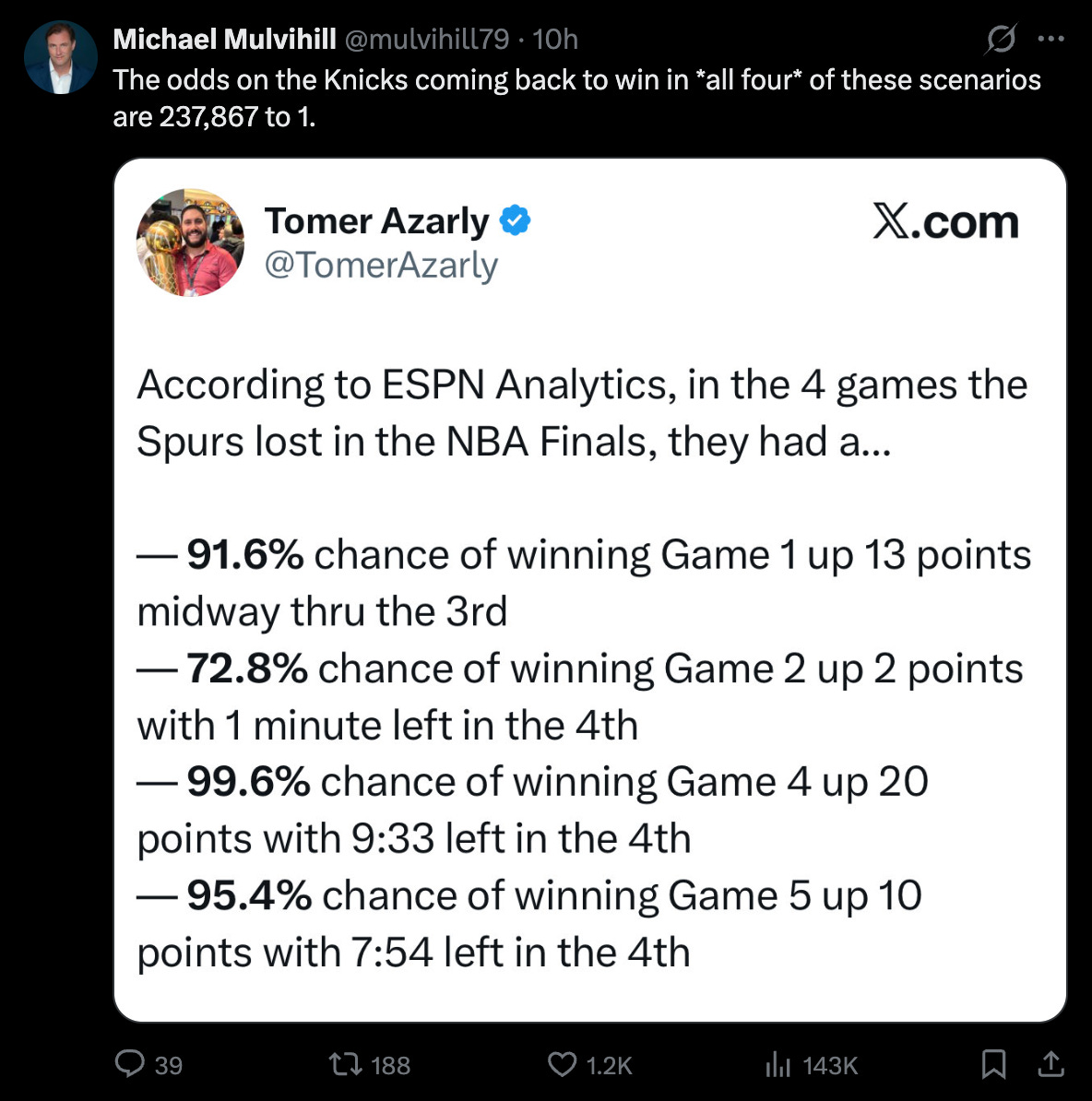
I should say that I don’t quite believe these numbers as stated. Win probability models are a difficult problem, but as I covered in SBSQ #21, they probably understate the probability of big comebacks. Certainly live betting lines during these games didn’t have the Knicks quite so far out of it, and the betting consensus is usually better than the models.
There’s also the question of whether particular teams are more likely to make comebacks — or more likely to blow leads — based on experience or other factors. In other words, whether there’s a clutch factor. While I haven’t found much evidence of clutch performance in the NFL and only a little bit in baseball, the NBA is plausibly different.
One reason why is that teams score more often after a defensive stop in basketball — particularly on a fastbreak/transition possession. Although that’s a relatively subtle factor, it inherently creates some streakiness. A steal not only reduces your opponent’s expected points to 0 on their possession, it often also produces an easy bucket at the other end.
But also, NBA playoff basketball is at some sort of happy medium where it’s an incredibly high-intensity sport, but also one, I’d argue, where players do have time to think out there. It’s not a pure muscle-memory sport like baseball or hockey. It’s a sport where a player really can get into your head or the pressure of the moment can get to you.
My reporting for my book, as well as my experience playing poker in some occasionally extremely high-stakes moments, has changed my position on the clutch question a bit. I believe the best research suggests that human beings are essentially functioning on different operating systems in high-risk or high-stakes moments, that some people intrinsically adapt better to this than others, and that one plausibly gets better at it with experience — which brings us to this.
3. Playoff experience is underrated
As I mentioned in the Finals preview, the Knicks have played the most postseason games in the league since 2023, while the Spurs are one of the least experienced teams ever to make a deep postseason run. They’re basically getting a little bit of credit here for Harrison Barnes’s runs with the Warriors and not much else, and Barnes played less than 10 minutes per game during this year’s playoffs.
Joseph wrote about how impressed he was by the Spurs’ poise in their path to the Finals. I guess it’s one of those takes that “didn’t age well”, but if I’d assigned myself the Spurs’ half of the preview, I’d have written the same thing. As you may have noticed, SAS are also on the list for top postseason point differentials despite their loss to NYK, and their path was more difficult. (Yes, the opening round against the Blazers was something of a gimme, but the Wolves and the Thunder are extremely tough outs.)
“Poise” is not the term I’d use to describe the Spurs’ performance in the Finals, certainly, with a disastrous Wemby turnover in Game 2 and Wembanyama also sort of acting his age in the post-Game 5 press conference. But we’ve found in our past NBA modeling work that playoff experience can be predictive. It’s a difficult problem to study with the risk of various confounders3, but the 2026 Finals are going to be a high-leverage data point for anyone doing future NBA analytics work.
4. Jalen Fucking Brunson!
My taste in NBA players is pretty conventional. Off the top of my head, I’d list Steph Curry and Nikola Jokic as among my favorite players to watch, and Wemby was getting there before morphing into more of a villain role (at least from a Knicks’ fan perspective) in the playoffs.
And of course, Jalen Brunson.
There is one thing these players have in common. Curry, Wemby and Jokic are notoriously hard to compare to any other players in the history of the league. They’re the players who literally seem like a cheat code at times.
I’d argue that Brunson, who had 45 points in Game 5, fits that description as well, even though he isn’t quite in the same tier of stardom.
As a player, he’s a little bit contradictory. He has 10/10 intangibles, having now won a high school, NCAA and NBA championship, and he’s the son of a former NBA player. But he was drafted in the second round and underappreciated by the Mavericks. And he’s a very physical player despite not being particularly athletic by NBA standards. His ability to literally sort of force his way into decent shooting opportunities in the paint and in the midrange in some ways resembles a bigger player, but he’s rather generously listed at 6’2”. He’s plodding; literally no NBA player has the ball in his hands more often.
So who are Brunson’s best comps? Concerned that I’d missed someone obvious, I asked ChatGPT and Claude, but they came up with a list of players who don’t quite work. Isiah Thomas kind of fits, but Isiah had a much better pedigree as the #2 overall pick and was a significantly better defender and inferior shooter to Brunson. Chauncey Billups isn’t a bad suggestion, but is a tier below Brunson. Tony Parker? Also a relatively late draft pick, which helps, but a much worse perimeter player. The models even got creative, suggesting non-point guards like Adrian Dantley and Paul Pierce.
The point is that Brunson is an archetype. Some future scrappy, big-bootied point guard drafted late in the first round or early in the second after a deep run in the NCAA tournament will be compared to Brunson, not the other way around.
Advanced stats don’t particularly love Brunson, and he’s a negative on the defensive end by nearly everyone’s estimation. It’s hard to be a Top 5 NBA player unless you’re at least a decent two-way player. I do wonder, though, if there’s something about the variety of ways he can score (a little bit of everything except dunks; he’s had exactly 1 in-game dunk over the past two regular seasons and playoffs) that leads these models to underrate him.
If nothing else, Brunson is sort of inherently playing clutch basketball, given his tendency to burn through the shot clock. I don’t necessarily think this is advisable, and I prefer the Knicks when they play with more ball movement. But he hit 51.7 percent of his long 2’s this season (two-pointers of 16 feet or more). That provides a real tactical advantage on high-intensity possessions, of the sort that become more common late in playoff games. It sets a very high floor for avoiding wasted possessions. No NBA team maximizes all of its ~100 possessions, but between Brunson and their superior offensive rebounding, the Knicks come about as close as any team I’ve seen; maybe they’re going 96 or 97 for 100. Anyway, Brunson is probably the most popular New Yorker since at least Derek Jeter, and deservedly so.
5. New York Fucking City!
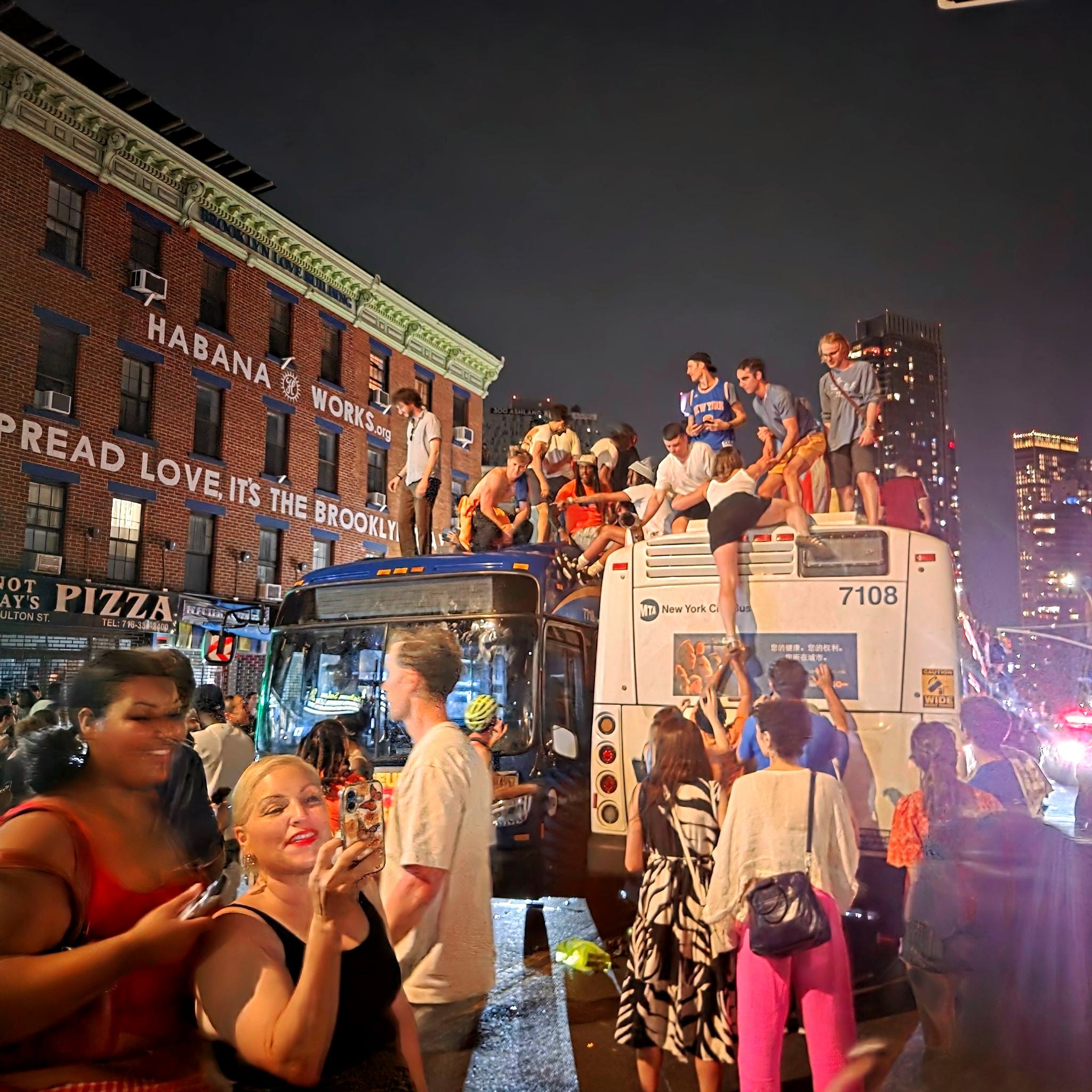
I’ve decided not to make a tribute to New York City the principal theme of this newsletter. That just felt a little bit too clichéd, even though, in a very tangible sense, I’ve invested more in NYC than anything save my relationship (20+ years) and my business. But the cliches are fucking true. There’s really nothing that unites New York like the Knicks, except maybe everyone going out to run/drink/mingle on warm early-spring/late-summer days, and lately we’ve had a lot of both. And there’s no better place to live than New York when the city is at its best. Here was a representative scene in Fort Greene last night:
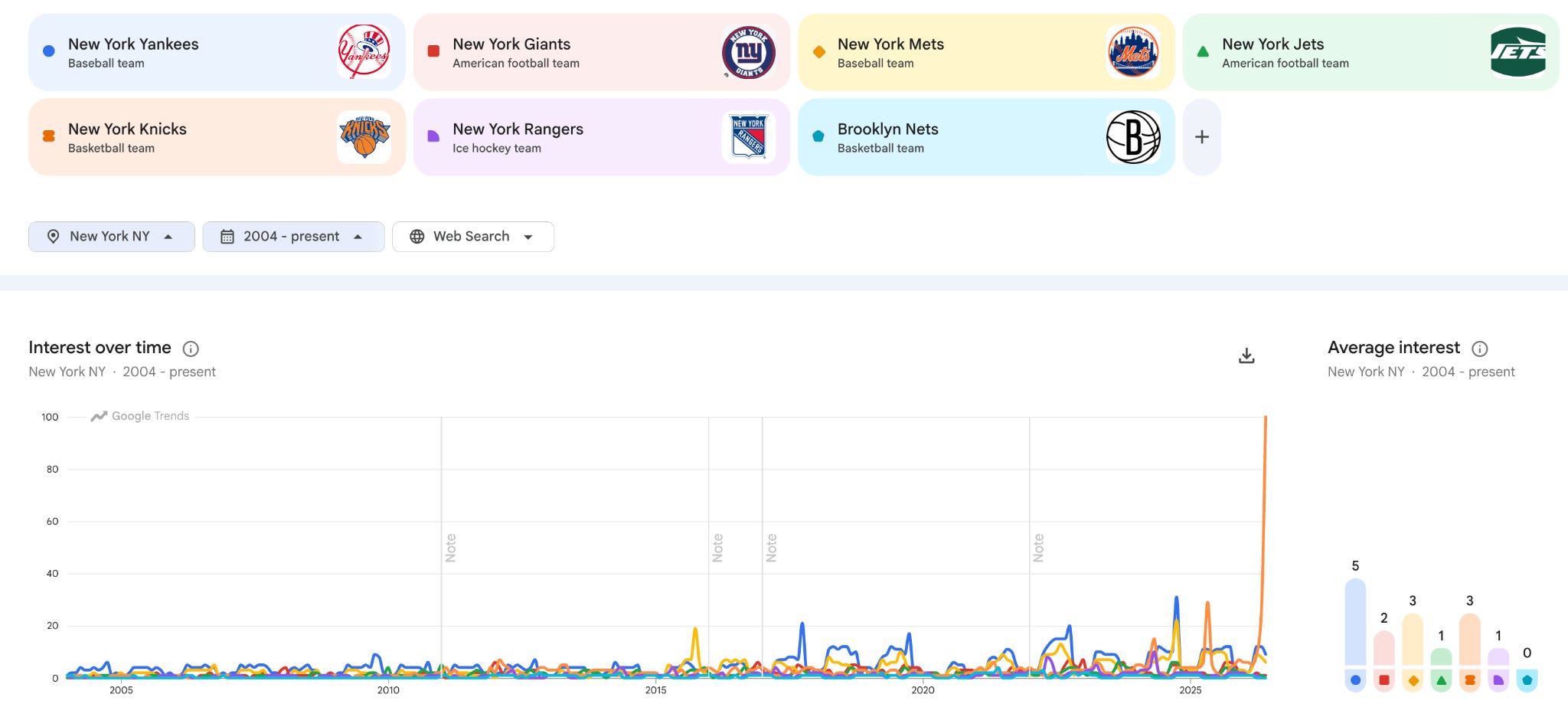
While the Yankees and Giants have won championships since I moved here in 2009 — and the Rangers, a bigger deal locally than you might assume, have come close — there hasn’t really been any moment like this except maybe the 2020 election (when everyone sort of came out of their COVID shells). In baseball, there’s too much of a Mets contingent, and rooting for the Yankees does feel like frontrunning. The Giants play in New Jersey, and hockey is just a little bit too obscure. The throngs of multi-ethnic, multi-everything crowds are only going to emerge for truly monumental moments, like the Knicks winning their first championship in 53 years.
One thing you might not get about NYC is that it’s not a particularly gate-keepey place. We wait on line because it’s crowded, but it’s not a city of velvet ropes (or at least not if you’re “doing NYC right”). Some 37 percent of the population is foreign-born, and more than half was born outside New York state. Although I do have some NYC heritage4, I never felt like I wasn’t a “real New Yorker” even when I had less experience under my belt in the city. It’s an extremely self-selected city, and if you select into the high cost of living and frequent near-chaos, you’re allowed to select into the Knicks. That’s part of the deal, and given the Knicks’ legacy, it’s not as though this has been a particularly high ROI choice over the years.
I’ve been getting ribbed by my friends for attending Game 3 — The Trump Game — because it was the only game out of their past 16 that the Knicks lost. It wasn’t a cheap ticket, though I got a pretty good value relative to prevailing market prices. I suppose I felt like New York had something to prove and I wanted to be there for it. Another thing that people may not get is that New York is a loose culture, not a tight one; we’re not necessarily that big on officially following the rules, from jumping subway turnstiles to tolerating illegal weed stores. But it’s also one of the most efficient and productive places on earth. So I wanted the narrative to be that, for all the chaos surrounding the event, universally regarded as a “shitshow” by the fans waiting on line with me (about an hour and fifteen minutes from lining up on 6th Ave to getting into the MSG seating bowl) — that New York would get it right in the end.
The crowd at Game 3 wasn’t particularly great. It seemed to lose momentum by the second half, perhaps because of the choppy play dictated by the officiating and the long wait to get in. Sitting toward the front of the 200 Level, I basically had a big responsibility for whether the fans behind me were sitting or standing. At one point late in the fourth quarter — this is very much not in character for me5 — I turned around and implored people to stand up, screaming something like “this is the fucking NBA Finals!”. “We” didn’t get the outcome we wanted that night, and the walk home through corrals of police barricades was sort of a downer. But waiting five more nights was a small price to pay — let’s not talk about the Ticketmaster fees.
He’ll certainly be ranked ahead of #38 De'Aaron Fox in The Ringer’s next edition.
It was 7-6 according to the Reddit post, but that was before their Game 5 win, when they overcame a 16-point deficit.
For instance, that veteran teams sometimes don’t have anything to prove in the regular season and won’t always but the effort in over an 82-game schedule
My mom was born in the Bronx although raised in Westchester County.
Despite what you think based on my “Twitter persona.”
Sometimes it's just nice when your team wins. Congratulations Nate!
"Everyone is better than Jalen Brunson until it is time to be better than Jalen Brunson." 🏀