

The Knicks might actually be great?
With a more tenacious defense, a new KAT, and a new coach, they've found an unprecedentedly high gear. But are they good enough to beat the Spurs?

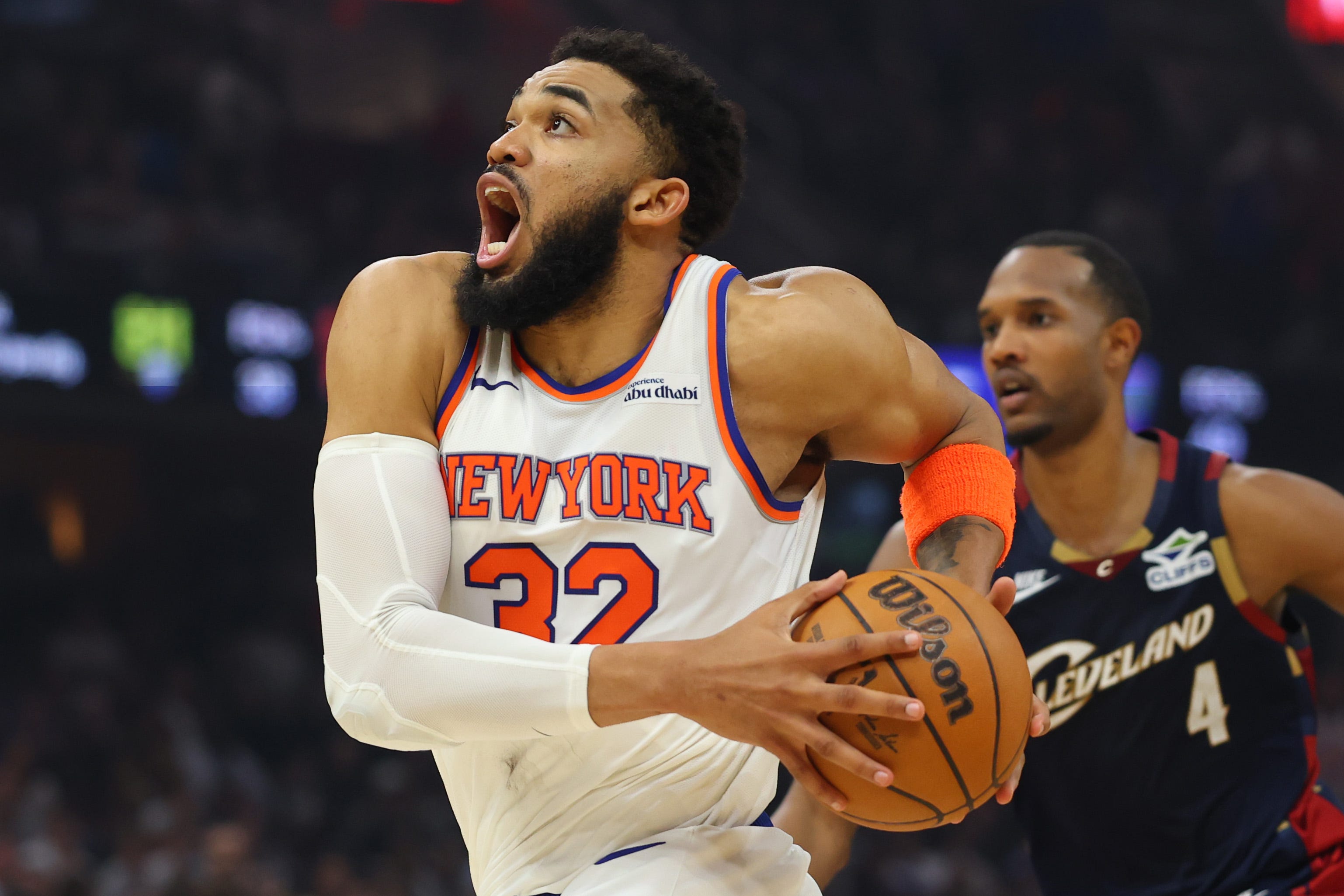
With San Antonio finishing off Oklahoma City, the Spurs and New York Knicks are set to face one another in a rematch of the 1999 NBA Finals that could be the most fun matchup in years. This is the first of our two-part NBA Finals preview; I’m making the case for the Knicks, while Joseph George took on the Spurs in Part II. We also did an NBA Finals Substack Live with special guest and friend of the newsletter, Nate Duncan; you can find that in Joseph’s story.
I can’t claim to be a long-suffering Knicks fan, but I’m not exactly a bandwagon-jumper, either. I moved to what is technically northeast Chelsea in 20131, but which is really more of a no-man’s land between Midtown and various places south2, a micro-non-neighborhood defined by its abundance of parking garages, “Irish” sports bars, illegal weed stores, and most of all, its proximity to Penn Station and Madison Square Garden. When a team’s stadium is almost literally across the block — for a time, my apartment was constantly bathed in red light from an extremely vibrant Rao’s Pasta Sauce ad on the MSG outdoor billboard — and that team is notoriously, chronically underachieving, you are provided with the option to adopt it in midlife, as clearly articulated in §14.2.7 of the 1955 Sports Fandom Accords.
Linsanity also helped whet my appetite. Those days in February 2012 were proof of concept for how the city would go absolutely crazy for the Knicks. They also felt like something out of the movie Awakenings: glorious, but glorious precisely because they were obviously too good to be sustainable. Indeed, Lin played just one season with a team, with the Knicks declining to match an offseason offer sheet from Houston. Fans might have been ready to get over it following a fluky 54-28 record in Anthony’s third season with the team in 2012-13. But after a second-round exit at the hands of the Pacers, the Knicks never again made the playoffs for the rest of Carmelo’s tenure in New York.
The Jalen Brunson Era has obviously been a revelation as compared to the false dawns that preceded it. (I haven’t even mentioned Kristaps Porzingis.) But my take on the current iteration of the Knicks has long been that they were a canonical, high-floor, limited-ceiling team: a good watch but bound in by middling defense and roster inflexibility after a series of all-in moves. I supported the replacement of Tom Thibodeau with Mike Brown largely on the grounds that the Knicks didn’t have many other options to improve.
I actually did bet on the Knicks to win the Eastern Conference before the playoffs began and doubled down while they were in the midst of their 140-89 shellacking of the Atlanta Hawks in Game 6 of the opening round. (The odds were good, though my proceeds are quickly being squandered on World Series of Poker buy-ins). But I assumed that would be as far as it went before a 4-1 shellacking against the Thunder or Spurs.
I’ve changed my view. I think the Knicks could actually win the NBA title — and win it fair and square. Not just because of incredibly hot shooting — though that would help — or a Spurs injury, in other words. I wouldn’t bet on them at even money, especially with Game 7 scheduled for San Antonio’s Frost Bank Center, not MSG. But I think this might be a great team, not merely a very good one.
What to make of a truly insane playoff run
You’ve probably seen stats like this: the 2025-26 New York Knicks currently have the best playoff scoring margin in NBA history at +19.4 (!!!!!!!) points per game. It’s been such a dominant stretch that all three of the Knicks’ vanquished Eastern Conference opponents have to deeply reconsider their futures — the 76ers fired Daryl Morey, indeed.3 Of course, the playoffs aren’t over yet, and I wouldn’t count on the Knicks beating the Spurs by 19 points in the Finals. They’re in truly elite company, though: Jordan’s Bulls, Kareem’s Bucks, the Shaq-Kobe Lakers, and Steph’s Warriors are the others in this stratosphere. Wemby’s Spurs have also outscored their opponents by double digits so far in the playoffs, though, I’d note.
But a hot streak in basketball isn’t merely a curiosity; it can also be predictive. Here’s some additional context that I’m pretty qualified to provide, having spent thousands of hours developing sports rating systems like RAPTOR, COOPER and PELE. Recent performance should be weighted fairly heavily, especially in the NBA, which is perhaps the most deterministic sport since each team gets around 100 possessions per game. In the NBA, 14 games is not a small sample and especially not in the playoffs. If you’re calibrating your expectations for the Knicks based on their 53-win regular season, you’re doing it wrong.
What’s unusual, though, is that the Knicks aren’t in either category of teams that usually make this sort of leap. Middle-aged in basketball terms, the Knicks are not a young team that is suddenly coming into its own. But they’re also not a team that has so proven its bona fides that they can lollygag their way through the regular season in the style of the 2000-01 Lakers. In fact, that’s sort of the antithesis of Brunson’s approach, or Thibodeau’s or Brown’s.
The Knicks do have a lot of playoff experience, however, something we’ve found in the past is also predictive. In Brunson’s four years with the team, they’ve played 56 playoff games; only the Celtics have played more during this period, and the Knicks will surpass them when they take the court for Game 2. They have a 35-21 record despite catching what you could argue to be various bad breaks. They did also win the NBA Cup this season, defeating (drumroll) the Spurs.
The Knicks’ defense suddenly got way better
The Knicks’ 53-29 regular-season record was similar to last year’s 51-31 and 50-32 from two seasons ago. But that, plus a midseason slump when they went 2-9 over 11 games in January, tends to obscure some real improvement. The difference came on defense: the Knicks’ regular-season defensive rating jumped from 14th in the league last year to 7th this year. Moreover, the defense got better as the year went on and Brown had more time to shape the approach.4 The Knicks allowed 114.9 points per game in games through Jan. 19, the last day of that slump. But after limiting the Brooklyn Nets to just 66 points on Jan. 21, they only allowed 104.9 PPG for the rest of the regular season — and it’s been 100.6 so far in the playoffs, with the Knicks having the best defensive rating in the league in the postseason.
“Very good offense, average defense” is a plausible formula to win the Eastern Conference. “Great offense, good defense” is what they’ll probably need to beat San Antonio.
The fiercer defense also makes the Knicks feel much more Knicks-y. The Knicks have always risen and fallen with their defense; the Patrick Ewing teams actually had a below-average offense even in the years they reached the Finals, but a defense that would beat you into submission in a manner that perhaps only the Bad Boy Pistons ever matched. (The average scoreline of the 1999 NBA Finals, also against San Antonio, was Spurs 85-Knicks 80.) The strengths of the 1970s championship teams were also concentrated on the defensive end.
But is the newfound elite defensive performance sustainable? Listen to enough NBA podcasts, and you’ll frequently hear the take that the Knicks have two massive defensive holes to patch: Brunson at the point and Karl-Anthony Towns in the frontcourt. So even with a trio of very good “wing-stopper” defenders in OG Anunoby, Mikal Bridges and Josh Hart, they’re sort of treading water.
The critique of Brunson is fair. He’s not a black hole like Trae Young out there, and he gets his share of steals, but his low center of gravity does not really translate on defense according to either the eye test or the advanced stats. However, I’d argue that the Knicks have one big defensive liability, not two. According to EPM, Towns had the best defensive season of his career and was a slight defensive positive overall.
Some of that is because KAT is a terrific rebounder, averaging 13.8 rebounds per 36 minutes this year, a career best. Rebounding has become underrated among analytical types: it doesn’t count as a defensive stop until you grab the board.
Admittedly, KAT is perhaps the weirdest player in the NBA, spectacularly talented without being particularly athletic or confidence-inspiring. He is almost never described as a “unicorn,” despite probably being the best-shooting 7-footer in NBA history. Towns had a reputation coming out of college for being a “very good shot blocker”, but after a rookie season in which he averaged 1.7 blocks per game, that’s never been how he makes stops, relying more on his size than the threat of a swatted shot.
Furthermore, Jordan Clarkson and Tyler Kolek aside, the Knicks’ defense often improves with their bench units, which isn’t common in the league. With Miles McBride and/or Mitchell Robinson out there, the Knicks do more than just hold the opposition to a draw. In the regular season, the Knicks outscored their opponents by 10.6 points per 100 possessions with McBride in the lineup, and by 8.7 points per 100 with Robinson playing.
There’s no doubt that the Knicks have also benefited from some shooting luck in the playoffs. So far, their opponents have hit just 30.5 percent of their shots from three and 73.1 percent of their free throws. Both of those quantities are extremely mean-reverting (defense doesn’t affect an opponent’s three-point success much, or its free-throw percentage hardly at all5). So OK fine, apply the league-wide playoff averages of 34.7 and 76.9 percent shooting instead. That would yield an extra 78 points for the Knicks’ opponents over 14 playoff games, which is meaningful. Even with those revisions, though, the Knicks would still be outscoring their opponent by +13.8 PPG so far in the postseason.
Basically, the math adds up: one big minus (Brunson), one neutral (KAT), and otherwise a bunch of positives sums up to a pretty good defense — if not a little better than that.
It can be a little unorthodox and require high possession-by-possession effort from the wings, however. High floors don’t necessarily imply low ceilings. The Knicks tend to get away with medium effort on both sides of the ball better than most teams, but that doesn’t mean there isn’t a higher gear. It’s easier to find it more often when you don’t run your players ragged with such a heavy minutes load as Thibs did. Hart, Bridges and Anunoby all ranked in the top 5 in minutes per game in 2024-25. That’s a lot to ask of anyone, let alone two-way players who you’re also hoping will be active in transition.
KAT has reshaped the offense
There’s probably been some luck on offense too — the Knicks are shooting an even 40 percent from three in the playoffs, up from 37.3 percent in the regular season. Still, offense and defense aren’t as separable in basketball as is commonly assumed. The Knicks are scoring a spectacular 1.32 points per possession in transition in the playoffs; they actually aren’t getting that many steals, but the ones they do get, largely from their wing defenders, have often been pick-sixes at midcourt that set up automatic points on the other end.
Is anything else different on offense? Well, it’s really just one thing, but it’s major:
They’ve let the KAT out of the bag. (Sorry, I couldn’t resist.) Towns’s assist rate has roughly doubled from the regular season, to the point where he’s a full-on point forward, assisting on shots at nearly the same rate as Brunson. There is a trade-off here: KAT’s usage rate (the percentage of possessions he ends via shots, free throws or turnovers) has fallen, something I wouldn’t necessarily have recommended because he’s a very efficient scorer.
But the critique of the Knicks’ offense one could have raised before is that it was sometimes plodding and predictable under Brunson, even if he’s one of the most effective players in the league late in the shot clock. The Knicks just have a lot more optionality with Brunson and KAT as twin fulcrums in the halfcourt, making better practical use of their spacing. It’s the sort of tweak that elevates the offense from good to great.6
Health matters also, and the Knicks are more or less fully intact. (Though now Robinson has mysteriously injured his pinky finger.) They bulldozed through the Sixers to the point where you almost didn’t notice Anunoby’s absence to close out the series. While the Knicks didn’t have any catastrophic regular-season injuries, Hart missed 16 regular-season games (and played another 13 from the bench), Miles McBride missed half the regular-season schedule, and even Brunson missed 8. While I’m not in love with the deeper part of the Knicks’ bench, it hasn’t been needed as much — many of the minutes have been in garbage time in the various blowouts — and Brown’s “bench mob” mentality gets players who know they’re only going to get a 6-minute stint to go full balls-to-the-wall in those minutes.
The Knicks are more than the sum of their parts
If the Knicks do win their first title since 1973, you might see some recalibration in the conventional wisdom on the much-debated question of “how good must a team’s best player be to win a title?” In April, The Ringer ranked Brunson as the 12th best player in the league. I say that’s too low — I’d take him above Jaylen Brown, for sure, and probably ahead of Donovan Mitchell. But he’s basically a one-way player, and that caps his capacity to compete for, say, the top five. EPM, meanwhile, actually thinks KAT is the Knicks’ best player (!) with Brunson and Anunoby (!!) tied for #2. I’m not sure I totally believe that, either.
On the other hand, I’ve always thought the notion that you must have a top-5 player to win the title is more of a correlation than a causal mechanism. We have a Silver Bulletin tradition of writing about the new NBA champion, and the recurring theme is that the archetypes people have in their heads are too rigid. The Steph Warriors were too young and too small until they weren’t; Nikola Jokic’s defense was supposed to be too much of a liability; the Raptors’ one-year rental of Kawhi Leonard was the sort of thing that had never worked in the past.
Basketball is a team sport, and this is the best team that New York has seen since the 1970s. The front office overpaid for Bridges on the theory that being more than the sum of one’s parts could outweigh mismatched high-end talent of the sort that Cleveland and Philly fans just saw fail. Although the Thibs Knicks were considered overachieving, it’s Brown who has seen the vision through. I’m not gonna lie: Knicks fans are probably going to remember this season fondly even if we’re on the wrong end of a 4-0 sweep. But with a defense that has gone from average to good and an offense that might be legitimately great, the Knicks just might have it in them to find four more wins.
I moved away about a year ago.
In other words, places where people actually want to live.
Daryl is a friend.
It’s plausible that coaching changes produce short-term pain for long-term gain. I haven’t looked at this for the NBA but I have looked at it in the NFL in the context of ELWAY, which accounts for coaching changes. We found that a team often struggles in its first few games under a new coach, but the effect evaporates once they accommodate to the new system.
There can be some small effect from which offensive players a team chooses to foul.
It also feels like the Knicks are playing at a faster pace, but that isn’t actually true: their playoff pace rating (95.6) is down a tick from the regular season (96.8), though it’s up on a relative basis because postseason games are much more deliberate.
Surprised that NS’s comments don’t reference the caliber of the teams the Knicks beat. Am i off in thinking that the West, not just the Thunder, were better than the East. Doesn’t that need to be discussed and factored in? Spurs in 5 or 6.
It’s funny how you can go all over the country and find Giants and Yankees fans, but basically no one outside New York is a Knicks fan.