

The Spurs are too young to flinch
Experience is supposed to matter in the NBA playoffs, but Victor Wembanyama and Dylan Harper didn't get the memo. Plus, our NBA Finals chat with special guest Nate Duncan!


It’s a busy week here; thanks as always for reading Silver Bulletin! While we’re not neglecting politics, we’re very excited about this year’s matchup in the NBA Finals, which start tomorrow. I made my glass-half-full case for the Knicks on Sunday; today, it’s Joseph’s turn to make the argument for the Spurs.
Joseph and I also chatted with Nate Duncan of the Dunc’d On podcast yesterday — one of our absolute favorite shows — about the Finals and other pressing NBA storylines. So you’ll see the video first (I believe this is Joseph’s video debut at Silver Bulletin!) and then his Spurs story.
One other heads-up: with rosters being finalized today, our World Cup forecast will launch imminently, we believe tomorrow, but don’t kill us if it slips to Thursday. When we have a short-term feature of this nature, we increase pricing for newly initiated monthly subscriptions. This does not affect annual pricing or people who are already subscribed. We just wanted to disclose that ahead of time; the pricing won’t change until the World Cup forecast is published tomorrow or Thursday. —Nate Silver
Our NBA chat with Nate Duncan
The case for the Spurs
by Joseph George
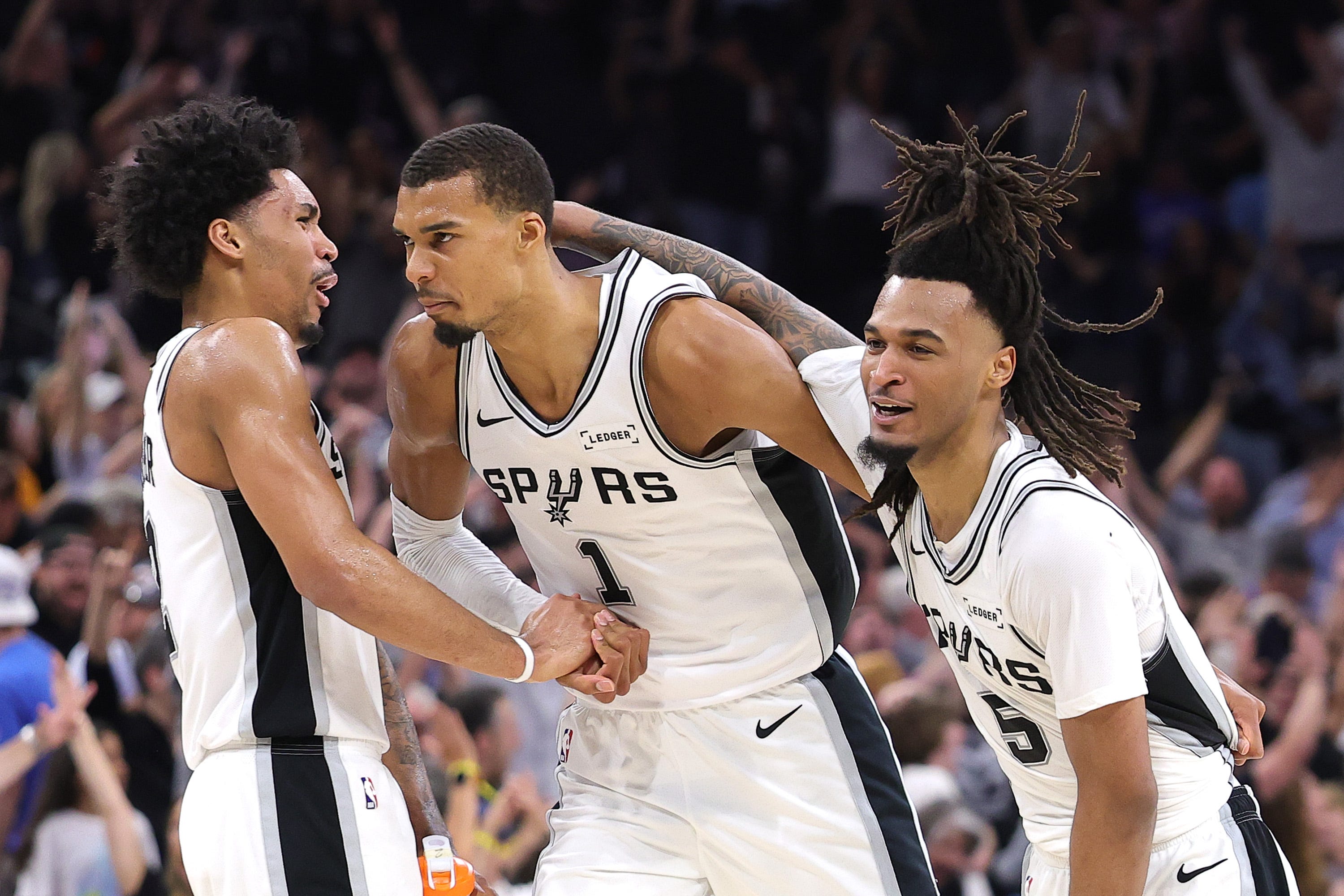
If there was any doubt, Saturday night’s Game 7 made it obvious that this year’s Western Conference Finals was one of those series — the stakes were extraordinarily high, a number of the league’s main characters left their marks, and no team ever felt like it established true control.
The Spurs and Thunder had been on a crash course for a long time. Oklahoma City has occupied the role of “best positioned team in the NBA” since 2022 at least, but the Spurs’ lottery luck vaulted them into the same tier of short-term and long-term contention. Both teams sit in roughly the same age window, ranked #1 and #2 in record and simple rating system, and have consistently held the top two spots in our Future of the Franchise rankings. As of a few months ago, there honestly wasn’t much deliberation at the top end of FotF; the Spurs were clearly #2 ahead of the rest of the league, but the Thunder were clearly #1. This series obviously calls that into question.
There’s not a lot of love lost between the two franchises either. The matchup doesn’t carry the pedigree of a Lakers-Celtics, but both teams have loyal, dedicated hometown fanbases and a real claim to being the model for a modern basketball franchise. Those past matchups were notable for the depth of talent they featured and the narratives around those teams. The Thunder were young, loud, and stupidly athletic; the Spurs were the dynasty in its long, graceful decline, buying time with system and pedigree.
The newest iteration of the Thunder-Spurs rivalry has only had the first of what should be many future playoff series, so while we don’t know exactly how this story will go, the historical parallels are easy to see. The emergence of young players during the series, like Dylan Harper and Jared McCain, forced both teams to make heavy adjustments. The Thunder aren’t much older, but they played the part of the battle-tested veterans. The Spurs, whose three best players in this series were in their third, second, and first seasons, didn’t blink, answering every punch with a swift counter.
How did we get here?
That lack of experience was certainly one of the bigger storylines during this series, and it’s even more dramatic than I had previously assumed. The Spurs aren’t just young and inexperienced for a Finals team: by most measures, they’re one of the most inexperienced teams to ever make the playoffs. For reference, the closest historical analog is the 2012-13 Warriors, who fell in the second round to the Tim Duncan-led Spurs.
There is the question of how they’re overcoming this disadvantage. Empirically, playoff experience does matter, but perhaps its effects can be more dramatic for certain types of teams. The Spurs have been particularly resistant to some of the typical issues that beset younger teams in the playoffs, like suffering from long scoring droughts or struggling to make consistent rotations. Instead, their overall play has actually improved — over a sample of 18 games in the playoffs, they’ve maintained a net rating of +11.0, a decent improvement over their +8.4 mark in the regular season.
Now, I do recognize that I’m several paragraphs into an article about the Spurs and I haven’t mentioned Victor Wembanyama. Part of that is the point — this run has been a team achievement in a way that's easy to miss when one of the players is Wemby. But it's hard to overstate just how unprecedented he is, both in his on-court playstyle and his accolades at such a young age. Wemby is, to put it plainly, complete madness to watch. It’s not just the step-through dunks from inside the free-throw line, or the pull-up threes over other seven-footers. It’s the poise he shows in anchoring team defense, and the growth he’s shown in setting up a very organized offense this season — both genuinely rare for someone at his developmental stage.
When I wrote my debut byline about Wembanyama back in October, I postured about whether he could make the MVP leap, which felt like a longshot in the moment. While he didn’t take home the award this year, he has certainly placed himself in the “best player in the world” argument, if not already grabbed the title outright. Wemby belongs to a rare class of rim protectors and can outright take over the offensive end at times.
Somehow, Wemby’s defense has gone up a notch in the playoffs — he has the best rim deterrence on/off of any player ever with at least 500 minutes in the playoffs — and the Thunder had to resort to some interesting strategies to keep him away from their drivers.
Wemby hasn't had to carry it alone, though. The other Spurs went 12-6 in games without him this year and have also stepped up big time. I was worried Stephon Castle’s looseness with the ball might be too much to overcome after Game 2, but he didn’t let it hamper his aggression, which proved to be the correct gamble as the series played out. It will probably be a bigger deal in future seasons, but there’s something to be said about how he was able to find other ways to impact the game as the series carried along.
The Spurs’ X Factor is likely their youngest player, Dylan Harper, who looks like he’ll be one of the best guards in the league very soon. He’s already creating at historic levels near the rim. Some of the greatest point guards of all-time have had similar (indeed, often slightly worse) profiles to Harper at the same age, and most of them never had his high defensive floor. Harper was already one of the highest volume self-creators at the rim this regular season, with the only hole being his inability to draw fouls consistently. In the playoffs, his free throw attempts per 100 possessions nearly doubled, which is incredibly rare for a rookie guard. (They don’t typically get a generous whistle.) If this continues to progress, he could return All-NBA level value while still on his rookie deal.
Harper’s ability to push in transition and in the half-court gives San Antonio an additional release valve, and it showed against Oklahoma City — in multiple games this series, the Spurs went to Harper as a creator at the end of the shot clock. At the end of Game 7, Harper launched an absolute bomb over SGA, which quieted the Thunder crowd.
It reminded me a little of a young James Harden in 2012, before most had pegged him as a guy who would command the attention of an entire defense. I don’t think Harper is there just yet, but I keep coming back to the fact that the Spurs are getting this from a rookie who isn’t even their best young player. If there’s a team that could show a lack of experience doesn’t mean a lack of poise, it’s this one.
Do the Spurs have an answer for point-KAT?
Plenty of people seem to think the Western Conference Finals already settled who’s winning the title. I don’t exactly buy it, and underrating the Knicks feels backwards. We almost never see playoff runs this dominant. New York chopped up a decently tough schedule, and it’s a signature of that dominance that their opponents look like roadkill in the rearview mirror.
As Nate wrote on Sunday, the Knicks have KAT-ified their offense since their early struggles against Atlanta. I’ve actually long wondered whether KAT’s ideal role is exactly this — less a usage-sink secondary scorer, more an oversized creator running the offense through his passing, like an oversized attacking midfielder in soccer, a Ruud Gullit of sorts.1
Towns is driving the ball at similar rates to the regular season, but it’s clear that he’s found a better cadence and angles in the playoffs: his finishing percentage on drives and his passing percentage have gone up 6 percent. This isn’t the first time wingifying a big man has had good results — in 2023-24, Joel Embiid transitioned more from baseline post-ups to face-up elbow actions, which made him one of the best passing bigs in the NBA almost immediately. It’s possible that KAT’s involvement in the offense unlocks a dimension for the Knicks that the Spurs aren’t entirely prepared for.
As a result of KAT’s self-creation jump (and his floor spacing), Wemby will likely be assigned to Josh Hart to avoid pulling him out of the paint too often, which puts pressure on the Spurs’ forward depth. Wemby’s rim presence helps, but Carter Bryant, Devin Vassell, and even Castle will have to spend sizable stretches on Towns, and avoiding foul trouble becomes a very tangible goal if they want to keep KAT from leaving a mark on this series.
Still, this isn’t a complete positive for the Knicks. KAT has often struggled with body control, and the threat of Wemby roaming will make it hard for him to find the same angles to the basket he’s enjoyed over the last two series. It’s possible the series swings the Spurs’ way as a result of Towns getting into his own foul trouble. We can sort of reliably expect KAT will have at least one of those games — he was the worst big man in the NBA this year when it came to offensive fouls, and a matchup that forces him to put the ball on the deck against smaller players is exactly where he gets into trouble, picking up cheap charges and player-control fouls that send him to the bench. If the Knicks can’t play Towns as much in the second or third quarter, the Spurs will try to bury them in defensive stops.
The variability of these matchups makes it hard to know what version of the Knicks the Spurs will have to face. During the regular season, the Knicks had a tendency to break down offensively at times, usually as a result of poor communication or bad process. The playoffs have featured less of that, but they also involved back-to-back rounds of pretty weak guard defenders (Donovan Mitchell, Tyrese Maxey, James Harden). Brunson may have a harder time trying to create against the Spurs guards and wings, as they contain a bit more length.
On the offensive end, the Spurs will have to do with less Wemby self-creation away from the basket. If I’m correct, the Knicks will have OG Anunoby on Wemby, in hopes that OG’s relatively low center of gravity will make it hard for him to create much on post-ups away from the basket. Luckily for the Spurs’ guards, there are real weak spots for them to attack in the Knicks’ rotation. If they can force Brunson on Harper or Castle, they’ll be in cruise control. Of course, the Knicks’ wing stoppers will make it hard to get that match up very consistently, but on the margins this feels like an area to exploit.
I’d expect that the Spurs will try to take advantage of lobs for Wemby, and their transition offense will be in full effect against Brunson and Towns, but I’m still not totally convinced that this is a great series for either team. The Spurs seem like a tougher matchup for New York than Oklahoma City (with their injuries) would have been, but there are real levers that New York can pull to stretch San Antonio thin.
If I had to estimate, this series goes six or seven, and I’d lean San Antonio. Obviously, a lot will be made of the Spurs’ inexperience if they lose, but I’d push back on that framing in advance. The Knicks don’t need San Antonio to play down to its age to win this series; these are two genuinely good teams, and in their current form New York might simply be the better one. For the Spurs, the youth that looked like a liability back in May has been the whole story of this run, and I don’t see the Garden being the thing that finally cracks them. Still, the mechanisms are there for New York to turn this into a war of attrition, and I wouldn’t be surprised if they walk away with the trophy.
This sort of soccer deep-cut is why it was nice to have Joseph working with me on PELE. -NS
This was a better argument for the Knicks than Nate's piece.
I ran the same experiment with this post as with Nate Silver's bull case for the Knicks. This required AI, I had trouble picking any relevant opinion about the Spurs chances--lots of details, many not involving both teams, only qualitative directional information and often not even that, and frequently immediately undercut with a "but".
Like the Knicks piece, there's no base rate here and the points are all over the map. Wembanyama as the best player in the world who has taken it up a notch--that's a point if you're trying to push the Spurs up from 70%. But that's adjacent to most inexperienced team ever which is something to push below 30%.
The best I can distill from this is it started out to argue for the Spurs at below the betting market consensus, then talked itself down to well below what Nate Silver concluded for the Knicks bull case. If this is the bull case, it reads like a defense lawyer starting out "my client is guiltier than you think," and going down from there, only pulling up at the last minute to concede, "well, he's slightly more likely to be innocent than guilty."
Anyway, here was Claude's analysis of what the post way trying to convey:
Spurs beat the consensus #1 (Thunder) in Game 7, "calls Future of the Franchise into question" — the resume opener, most bullish beat — ~58%
"one of the most inexperienced teams ever," "experience does matter" — fade — ~48%
net rating +11.0 in playoffs vs +8.4 regular season — ~55%
Wemby "best player in the world," record playoff rim deterrence; 12-6 without him; Harper rising — strongest cluster — ~58%
"I don't exactly buy it… underrating the Knicks feels backwards" — author's own thumb on the scale, for the Knicks — ~50%
"almost never see runs this dominant," opponents "roadkill" — ~46%
KAT unlocks "a dimension the Spurs aren't entirely prepared for"; forward-depth/foul-trouble worries — ~46%
KAT body control / league-worst offensive fouls / Wemby roaming — back to ~52%
Knicks beat weak guard defenders, Brunson vs Spurs length — ~54%
"not totally convinced this is a great series for either team" — 50%
closing "lean San Antonio," but "NY might simply be the better one," "wouldn't be surprised if they walk away with the trophy" — ~52%