

Should Democrats panic about Platner?
Maine polls have a recent history of underrating Susan Collins and other Republicans.

This is going to be a sports-heavy week at Silver Bulletin. No apologies for that, with both the NBA Finals and the World Cup set to start soon. You can find the first part of our NBA Finals preview here on the Knicks. And I think we’re within 48 hours of being ready to publish our World Cup forecasts. (In the meantime, you can find our underlying PELE ratings here.) I’m not much of a hard-sell guy, but we do hope that Silver Bulletin will provide a lot of value over the rest of the year between the sports models and, of course, the midterms.
Let’s see if we can get away with a quickish politics post, though. Like Matt Yglesias, I have some thoughts on recent developments in the Maine U.S. Senate race, and I figure they belong here rather than on X.
The state of play in Maine
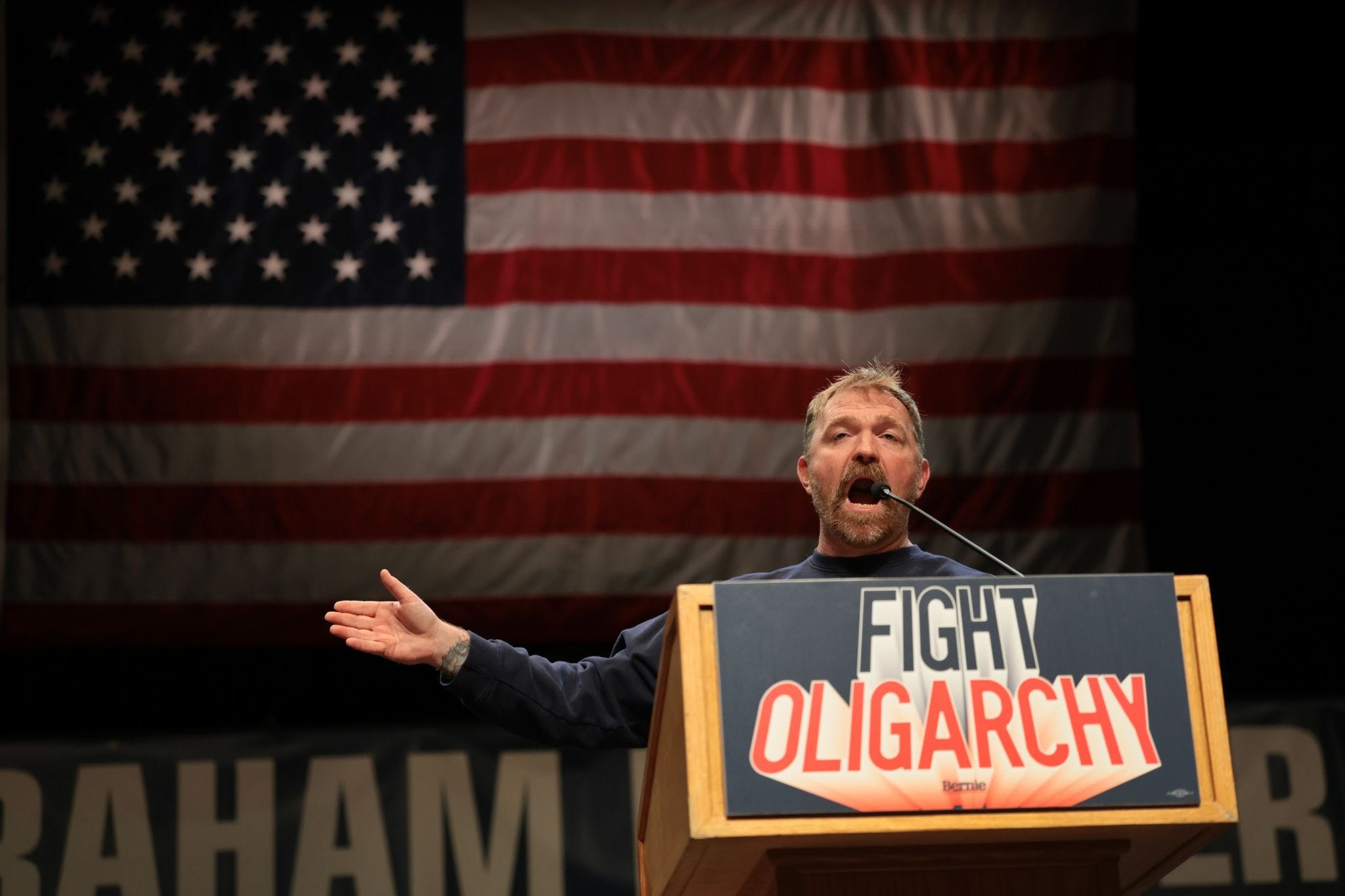
When we last checked in on the Maine race, Graham Platner, the populist oysterman who probably needs no further introduction at this point, had seemingly vanquished Governor Janet Mills in the Democratic Senate primary, with Mills suspending her campaign. The primary is set for next Tuesday, June 9. Over the weekend, however, the Wall Street Journal reported that Platner’s wife, Amy Gertner, had flagged sexually explicit texts sent by Platner to a number of women on the messaging platform Kik as being a potential concern for the campaign.
The story is very messy. Platner hasn’t denied the existence of the sexts, but a senior Platner strategist, Morris Katz, reportedly threatened Genevieve McDonald, Platner’s former political director who quit the campaign in October, for speaking with the press. Rather than retracting her claims as Katz demanded, McDonald instead went on the record with them. Katz responded by making an apparent reference to McDonald as an “incompetent, opportunistic” operative who valued “vengeance over decency.”
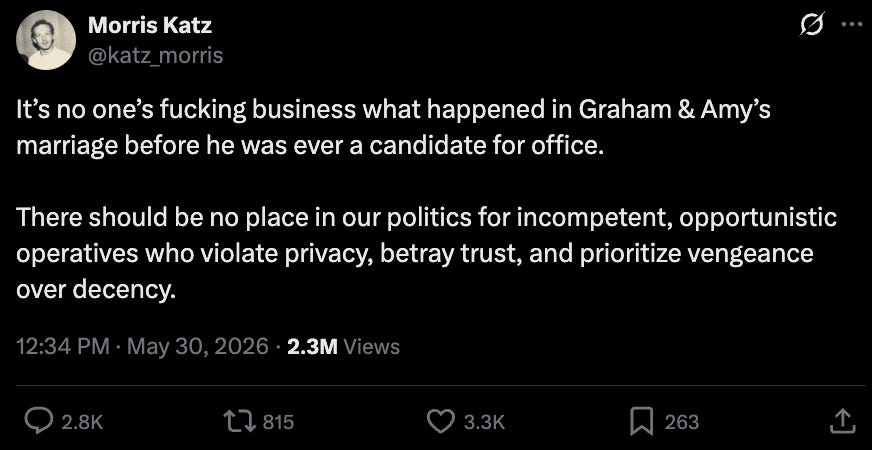
I’ll be diplomatic and say Katz doesn’t sound like a very nice guy. While I personally don’t care much about a candidate’s personal conduct, so long as it doesn’t impact his performance in office, it’s up to the voters of Maine to decide what exactly is their “fucking business” and what isn’t.
In Maine, the line between the personal and the political can be blurry
No Maine voter, from Kennebunkport to Presque Isle, presumably cares very much about whether Morris Katz is a jerk. But they might have concerns about Platner. So far, Platner has shown an arguably Trump-like resilience to a series of scandals, including a tattoo of the Totenkopf, a Nazi symbol, which Platner got while serving in the Marines in 2007 and had covered up last year.
If voters don’t care about a Nazi tattoo, why would they care about some sexts? Every couple, certainly, has their own boundaries for what is and isn’t acceptable in a relationship and even whether fidelity is expected at all. Gertner, for what it’s worth, has been supportive of her husband. (She has also been paid almost $30,000 by Platner’s campaign.)
However, Platner has spun his story as a redemption arc: that the tattoo and a series of inflammatory Reddit posts were youthful, sometimes drunken, indiscretions. That the sexts were relatively recent calls that narrative into question.
And look, all of us have probably had friends who engaged in infidelity or other indiscretions. Just speaking for myself, I’m a fairly tolerant person — human beings are human beings — but these can yield some tough judgment calls. Maybe you see someone as an occasional “drinking buddy” you don’t want to get too close to; I don’t think there’s anything inherently wrong with that. But if there’s a cluster of bad behavior and no trajectory toward improvement, you may conclude that someone is too toxic or narcissistic to be worth your goodwill. You might also feel betrayed if you thought someone had earned your trust and they turn out to be chronically manipulative.
It’s hard to know how all of this translates when you’re evaluating a candidate for office rather than one to get some beers with. And I know I’m psychoanalyzing. Maine, however (where I’ve spent quite a lot of time) is a state where personal relationships matter and the boundary between the personal and the political isn’t always so clear. The fact that Platner is “relatable” undoubtedly accounted for some of his appeal.
Yglesias pointed out other flaws with Platner, such as his tendency to burn bridges with the Democratic establishment, a risky strategy in a state where he might need every vote. I’m less sure about that, actually. Part of Platner’s appeal, I think, is that he doesn’t come across as a partisan in a state that’s famously nonpartisan, having elected plenty of Democrats, Republicans and independents to office.
You can’t necessarily trust the polling in Maine
Still, Platner has had something of a halo around him because his polling has held up well. He had large leads over Mills before she suspended her campaign and typically led by mid-to-high single digits in matchups against Susan Collins.
These polling leads have scrambled some of the usual intra-Democratic arguments around Platner. Despite being on the left, he’s very unpopular on Bluesky, for instance, while he’s been supported by more “electability” focused types who usually prefer more moderate candidates.
But here’s the thing. It’s a little early to crown Platner with Trump-like Teflon abilities. Platner hasn’t been elected to anything yet, and Maine’s not a state where you should make too many assumptions based on the polls.
In 2020, the last time she was on the ballot, Collins trailed former State Rep. Sara Gideon in almost every poll, but wound up beating Gideon by 8.6 points, making for one of the largest polling errors in our extensive polling database. One could argue that 2020 was an unusual circumstance. Perhaps because of COVID-related behaviors, polls badly overestimated Democrats that year, with Joe Biden just barely holding on to win the key Electoral College states. There was also an important late-breaking development in the race: Collins voted against Amy Coney Barrett, perhaps earning back some moderate cred, and most of the polling predated this.
Maine has also gotten meaningfully bluer as recent transplants to the state have been overwhelmingly from Democratic-leaning voting groups. It voted for Hillary Clinton by just 3 points in 2016, but Kamala Harris by 7 points last year. One other difference: in 2020, ticket-splitting voters in Maine might have assumed that Collins could serve as a check on a newly elected Democratic president in Biden. This time, they know they’re getting two more years of Trump.
However, the tendency for polls to overrate Democrats in Maine has been fairly persistent. Since 2014, in Maine races with two or more polls in the final three weeks, Republicans have beaten their polls by about 4 points on average.
There wasn’t much consistent bias prior to 2014, though Collins substantially outperformed her polls in 2008, even as Barack Obama won the state overwhelmingly. She underperformed her polls in 2002 but still booked a 17-point win.
Maybe none of this matters. Based on Democrats’ substantial lead on the generic ballot plus Maine’s increasingly blue lean, our current benchmark for the state is D +14.6. In other words, you’d expect a “generic” Democrat in the state to beat a “generic” Republican by double digits.
Is Platner such a bad candidate — or is Collins such a good one — that she can overcome that?
Well, there’s precedent. Interestingly enough, in 2020, our model actually pegged Maine as a toss-up rather than buying into Gideon’s polling lead. There are several reasons for that, but the basic story is that the model defaulted more toward “fundamentals” because polling in the state was sparse. And so Collins’s history of winning by landslide margins, and to a lesser extent her bipartisan voting record in Congress (candidates who more often defy their party in Congress tend to overperform electorally) caused it to hedge substantially.
We’ve since tweaked our model to be less sensitive to “candidate quality” factors of any kind and more keyed to raw partisanship, such as expressed by that D +14.6 statewide benchmark. Still, the fundamentals matter some, and they’ll work against Platner in the model. The model will regard Platner’s lack of electoral experience as a problem, and we’ve found that prominent scandals can subtract several points from a candidate’s vote share even in an era when ticket-splitting has become less common.
Furthermore, Maine tends to march to its own drummer. Demographically and politically, Maine is among the biggest outliers and the least correlated with other states, which in the model’s logic tends to make outcomes there highly uncertain. You can’t infer as much from the national picture there as you would in a state like Pennsylvania.
While I suppose I’d still bet on Platner, I’m very curious what the model will say. And I’d note that we absolutely can’t be certain that there aren’t further skeletons in Platner’s closet. Some of the women who received the sexual texts might speak out. (Most users of Kik are much younger than Platner.)
There’s no particular reason for Collins to have leaned into her opposition research file while the Democratic primary is technically still unresolved. And Katz’s defensiveness and the departures of McDonald and other staffers aren’t a great sign either.
So it would take a somewhat unlikely parlay — but, yes, it’s at least plausible that Democrats will have a strong night in November but will blow the race in Maine.
Mills would at least be a lower-variance bet, and that’s probably what you want in a blue state in a blue year. She reminded voters today that she’s still on the ballot. It’s probably too late, with early voting already having been in place for several weeks, though Platner would have until mid-July to withdraw and be replaced by a candidate of the state Democratic Party’s choosing.
To me, the biggest indictment of the Democrats here is that the only serious alternative to Platner is 78 years old with high name recognition and relatively low popularity in the state. Like Matt Iglesias mentions in his post, it shows a massive failure in candidate recruitment. I get that Maine is a smaller state than Georgia, but if the Democrats had an alternative candidate in Maine even close to Warnock or Ossoff's level of political skill, that person would be a no brainer.
First "sexting" is not a real clear description of Platner's behavior or issue. But I think G McDonald was simply wrong to dump crap on Platner . I don't know the details but I understand that Platner's wife told McDonald about some of the early marriage issues with Platner "in confidence". Some people love betraying friends. Vengeful, angry behavior. It is also not clear why McDonald left Platner's campaign staff last October. Another unknown. It's beyond me to judge since I don't understand what are the basic facts and motivations of people.