


I have a feeling we’ll all be pretty tired of the Maine Senate race by the time we get to November. But for now, I still have a bunch of thoughts about it. Speaking of which, you can find the video from my Substack Live with Galen Druke above. We spent the first 20 minutes or so talking about the Knicks — yes, I went to Game 3 — before moving on to Maine then closed with some lightning-round topics like California and the World Cup. (Which starts tomorrow, by the way! You can find our World Cup predictions here.)
We had this conversation yesterday afternoon before the results were known1, but Graham Platner is now the Democratic nominee for U.S. Senate. With 90 percent of the vote counted, he has 72 percent compared to 19 percent for former Governor Janet Mills — who suspended her campaign in April but made some half-hearted efforts recently to remind voters that she was still on the ballot — and 9 percent for other candidates. That Platner share has been falling slightly as more Election Day votes are counted — early voting began before Platner’s latest series of scandals — but I’d expect it winds up north of 70 percent. Turnout was decent: we just passed 200,000 votes counted, exceeding the 163,000 ballots cast in the Democratic Senate primary in 2020.

I’m not quite sure how to evaluate that performance relative to “expectations”, and I’ve never loved playing the expectations game. For what it’s worth this result was quite close to what prediction markets were expecting at the start of the day. “Platner won by 50 points on high turnout!” is one way to frame it; “30 percent of Democrats protested Platner despite his essentially running uncontested” is another.2
Meanwhile, prediction markets have Democrats’ chances of winning the general election in Maine rebounding after a sharp drop following Platner’s sexting scandal.
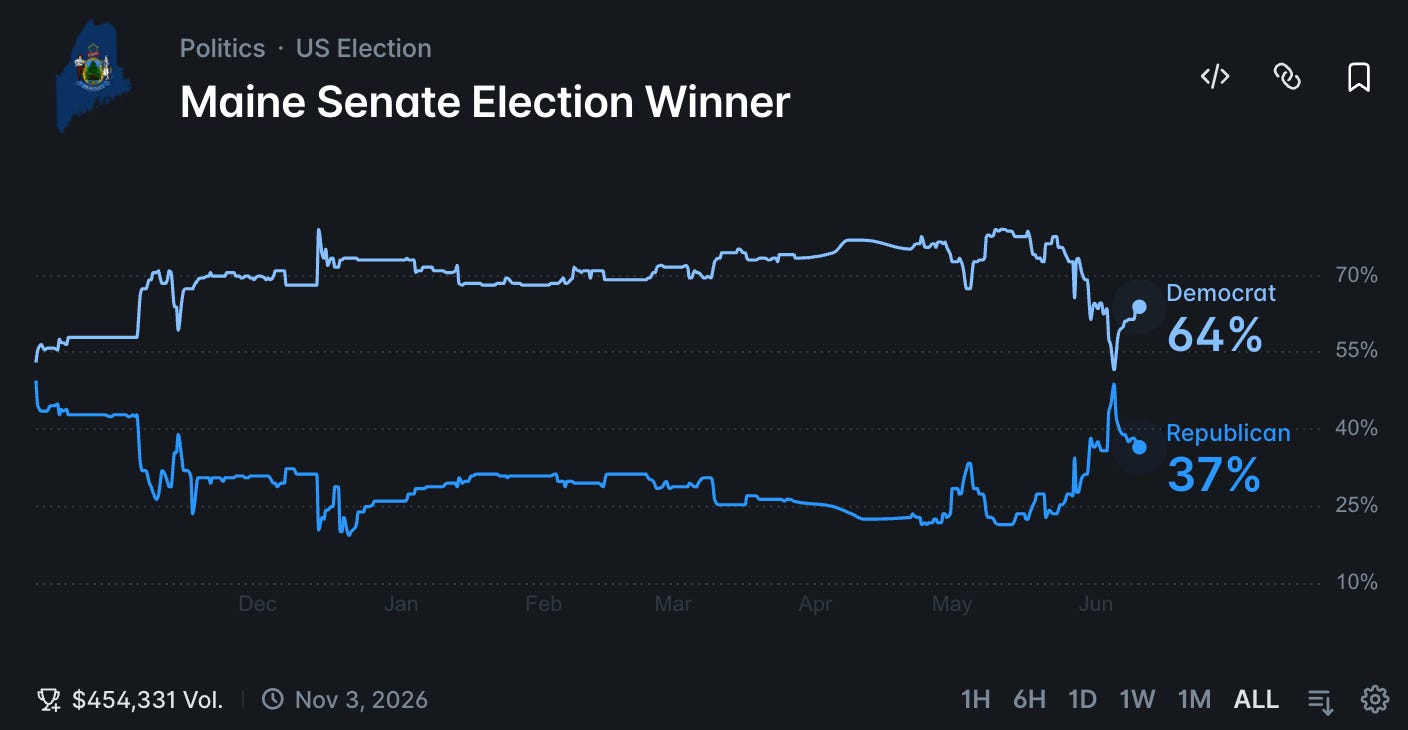
This isn’t a particularly easy race to forecast. Maine is an unusual state that often isn’t correlated well with national trends. Indeed, it has become somewhat bluer recently, defying the pattern of rural white voters becoming redder. But it has a recent history of lowballing Republicans in polling — and particularly Susan Collins, Platner’s opponent.
Platner is an unusual candidate; it goes without saying, between the lack of elected experience and the scandals — but it’s also easy to see why he strikes some voters as genuinely charismatic and a break from the norm. You could argue that Collins is unusual too, just by virtue of being basically the only surviving blue-state Republican Senator in the Trump Era.
Polls suggest that the sexting scandal has made a dent in Platner’s numbers, however. In three polls since the latest scandal, he leads by an average of 2 points, versus 7 points beforehand. That includes a Platner internal poll — campaign internals typically exaggerate their candidate’s standing by about 4 points of vote margin — although, for that matter, it also includes a Collins internal.3


