

War isn't what it once was
Past precedents are less useful than you'd think when predicting a war's political impact. But Iran still poses downside risks for Trump.


This weekend, as I’m sure you’re aware, the United States launched a series of airstrikes on Iran, including one that killed Ayatollah Ali Khamenei. Iran has retaliated by attacking the UAE and other Gulf States that have comparatively friendly relationships with the U.S.
So the United States is at war with Iran. I try to be precise with our language at Silver Bulletin, but you’d think it would be safe to say this, right?
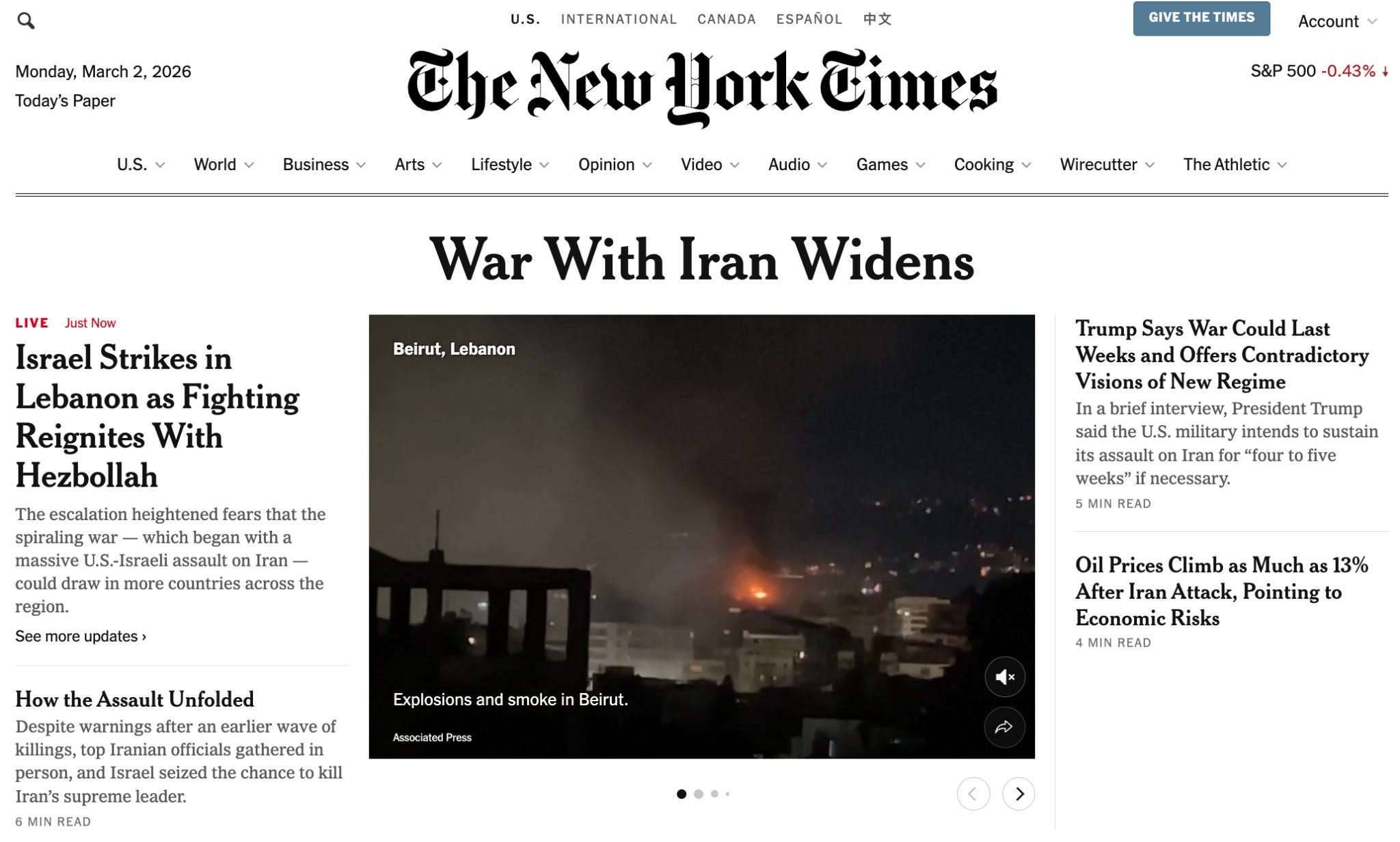
Well, at Wikipedia, the entry for “2026 Iran–United States war” redirects to “2026 Israeli–United States strikes on Iran”. As much as I value it as a resource, Wikipedia’s politics can be complicated these days. So let’s turn to the mainstream media. The New York Times banner headline when I started drafting this story1 was literally “War With Iran Widens”:
Just a few minutes after I started writing, however, the Times’s headline changed to “Mideast Conflict Widens Across Multiple Fronts”:
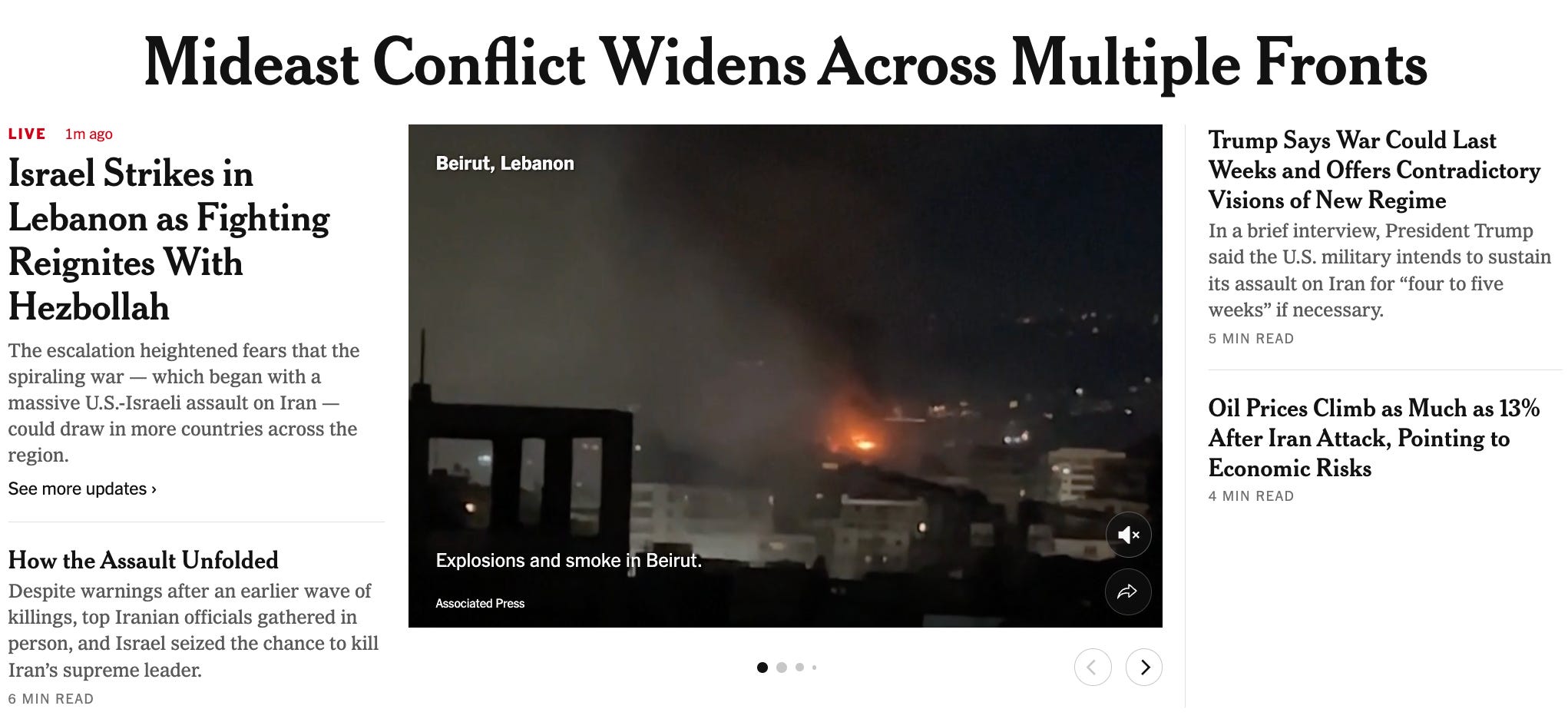
Personally, I’m going to stick with “war”, especially with the conflict escalating and Trump saying that the strikes will continue for at least several weeks.
This pedantic aside isn’t really intended as media criticism, however, nor as any sort of comment on foreign policy. Instead, my scope is narrower. Public opinion is one of Silver Bulletin’s main beats, and I’m sure readers have questions about the downstream effects of Iran on American domestic politics (even if it’s not the most important part of the story).
However, the fact that there’s a debate about how to even describe what’s happening in Iran illustrates how war is changing, and there can be dangers in making sloppy extrapolations from the past.
The traditional model: Rally-around-the-flag, then quagmire and backlash
I first officially got into the business of covering politics in 2008, a time when the Iraq War was massively unpopular and was instrumental to Barack Obama’s victories in both the primary (Hillary Clinton had voted for the war) and the general election.2 At that point, the relevant data set for the effect of wars on American politics was comprised of 4 or 5 (depending on how you count) post-WW2 conflicts: Korea, Vietnam, the 1990-91 Gulf War (a.k.a. Operation Desert Storm) and the wars in Iraq and Afghanistan, sometimes lumped together under the “War on Terror”. The conventional wisdom was something like this:
The war will initially be popular, producing patriotic feelings and boosting the president’s popularity: the so-called rally-around-the-flag effect.
However, unless it is resolved quickly (as was only the case in the Gulf War from among these examples), it will eventually become a quagmire, and the president’s popularity will suffer after extended deployments and deaths of American troops.
Of course, this conceals several differences between these conflicts. As wars are increasingly fought with airpower rather than on the ground — and now with drones, and even AI — there’s no longer the necessity for a draft, as there was for Vietnam and Korea. All of these wars have been destructive: counting civilians and foreign soldiers, there were at least several hundred thousand deaths from the War on Terror, and possibly something closer to 900,000. But less of the destruction has been visited upon American troops.
U.S. military deaths were an order of magnitude lower in Afghanistan and Iraq than in Vietnam and Korea.3 They’ve been an order of magnitude lower still in what the military officially calls Operation Inherent Resolve, basically our war against ISIS in Iraq, Syria and Libya. No American soldiers were killed in the January raid of Venezuela, which resulted in the capture of President Nicolas Maduro. In the Iran conflict, 4 U.S. troops have been killed so far as of this writing.
The new conventional wisdom: nothing matters?
So the emerging conventional wisdom (see January’s newsletter on Venezuela for more on this) is that American voters are increasingly indifferent about wars — until and unless there are attacks on American soil, large numbers of casualties among American troops, or a draft.
None of those things were remotely likely as a result of Venezuela. But while I’m not going to speculate about what could spin up from Iran, there are obviously more risks. It’s a much bigger country in the most politically volatile part of the world. This time, the U.S./Israeli operations are far more than a “surgical strike”, like the strikes on Iranian nuclear sites last June. Trump wants regime change, and Khamenei is dead.
Still, you might think the increasing efficiency of war these days might encourage American presidents to engage in more of it. In the 1997 satire Wag the Dog, emblematic of the conventional wisdom at the time, the president hired a Hollywood producer to stage a war with Albania to distract the media and the public after he was caught flirting with a girl scout. All of this was literally fake news — there was no actual war, just footage produced on Hollywood sound stages. But if there’s less practical and political fallout from war these days, why not try the real thing to get the same effect?
However, it’s also not clear there’s any political upside from doing this. The rally-around-the-flag effect has largely disappeared. In our approval rating tracking, there’s been no obvious benefit or harm to Trump from the previous major foreign policy events of his second term, including Venezuela or the previous strike against Iranian nuclear facilities. Even if these efforts were apparently successful, the public is perhaps appropriately cynical after one too many premature declarations of “mission accomplished”.
3 reasons why Iran might be different
We deliberately don’t do a lot of posts on “issue polling” at Silver Bulletin. While high-level attitudes are worth looking at, there’s something of a cottage industry at other Substacks of cherry-picking issue polling that suits the author and/or his audience’s priors. Almost all of this polling tends to presume more knowledge from voters than they actually have4, the question wording can be leading, and it otherwise often misses the forest for the trees. For what it’s worth, the polling so far on the Iran strikes is mediocre at best for Trump. But the polling on Venezuela also started out poorly for Trump before improving, and it’s not clear that it ultimately had much political impact in any direction.
There are, however, three factors, above and beyond the possibility of escalation, that make the situation with Iran higher stakes, with risks that are mostly to the downside for Trump.
Iran is a much bigger oil producer than Venezuela, by a factor of approximately 5x, and conflict in the Middle East could also disrupt shipping routes or oil production in other countries. Crude oil prices spiked when markets opened today, and while the U.S. is now more self-sufficient (indeed we’re now the world’s largest oil producer), the impact could be passed along in the form of higher gas prices to the American consumer.
The war is being conducted jointly with Israel. I’m trying to say this without getting myself into trouble. But you might have noticed that Israel is a complicated issue in American politics, sometimes creating horseshoe-type coalitions while creating a lot of intraparty tension for both Democrats and Republicans.
Finally, because the conflict is in the Middle East, and because it’s liable to persist for at least a few weeks, it’s more likely to remind voters of Iraq and Afghanistan. Most voters probably will indeed see this as a war, not a “strike” or “intervention” the order of Libya in 2011 or an “incursion” or “raid” like on Venezuela in January. And that represents backtracking from some of the themes Trump emphasized in both of his winning campaigns; part of his success in 2016 came from repudiating George W. Bush’s position on Iraq. While it’s undoubtedly true that a large share of Trump’s base will remain loyal to him, one can imagine a type of swing voter who is bothered by what seem like broken promises.
In his first term, there were a lot of critiques one might make of Trump. But normies could at least claim that, as much as the libs were freaking out, he kept a good economy running until COVID hit, and kept the United States out of trouble abroad. Perceptions of the economy are much worse than during Trump’s first term, however, and while markets rebounded today after opening lower, the public tends to react negatively to any sort of additional uncertainty or volatility. And even if an Iraq-style quagmire is less likely and Trump is probably canny enough not to commit a large number of ground troops, it’s not clear who was asking for this exactly. The base case is that Iran will fade into the background, as Venezuela did. But there’s a distinct whiff of lame duck in this sort of foreign adventurism.
At about 5:45 a.m. New York time.
Although the financial crisis was probably more important than Iraq by the time of the general election.
The difference in the number of troops wounded is somewhat less because battlefield medicine has improved and helped to save more soldiers.
Partly because “high-information” voters tend have higher response rates to polls.
Just to comment on #2, as a Jew Khamenei wanted me, my family, my relatives, and any other Jews dead or unacceptably subjugated. This is in addition to the internal human rights violations and killing of Iranians who dared to dissent.
I think this is why across the spectrum, except in the far left and right wing as you mention, politicians are saying something along the lines of “Khamenei was evil and Iran can’t have a nuke but we don’t want a forever war and maybe Trump should consult Congress.” In other words, no objection on a moral basis, just a cost and procedural basis
Risk 1 is huge, Inflation declines have primarily been driven by gas price declines.