

Trump approval just hit the 30s. Can his numbers get any lower?
$4 gas is a big problem for Trump. But broken campaign promises and series of self-inflicted wounds are eroding support even among Trump’s base.


The last time I did a check-in on President Trump’s popularity in November, I noted that the decline in his approval ratings had been remarkably linear. There have been peaks and valleys, sure, which you can correlate with particular news events. But the recovery after every bounce-back has been incomplete, leaving some permanent damage behind.
So what’s happened since then? Well, let’s just go ahead and update that chart.
Obviously, the trend is still down. To be fair, his numbers were relatively flat between November and March.1 But Trump just hit a new low in our tracking. For the first time in his second term, Trump’s approval rating in our average is (just barely) below 40 percent at 39.7. And his net approval rating is -17.4, also a new low. The recent decline has been pretty steep: about 5 points of net approval over the past several weeks.
From a political standpoint, the most important events since November are probably the killing of two American citizens by border agents in Minneapolis in January, and then, of course, the Iran War, which began on Feb. 28.2 The effect of Minneapolis on Trump’s topline numbers is more debatable. Trump’s ratings have declined on immigration, and the government’s conduct in Minneapolis was deeply unpopular with swing voters. Immigration and “border security” remain just about the only issues where Trump’s ratings remain close to breakeven, however.
Iran has had a much clearer impact. So far, though, it’s probably less about the war itself than about the impact on gas prices, which are now at about $4 nationally, having risen by more than a dollar over the past month.
It’s still the economy, stupid
The start of the war did not produce a traditional rally-around-the-flag effect, but it also didn’t seem to immediately hurt Trump’s topline numbers. We’ve started publishing an Iran poll tracker, and it finds that net approval for the war is -15.3. So it’s unpopular, notably unlike other recent conflicts that began with more public support, but no more unpopular than Trump himself.
It was, however, about a week into the war when markets started to freak out over the likelihood of a prolonged disruption to oil shipments in the Persian Gulf. Here is the effect on prices at the pump:
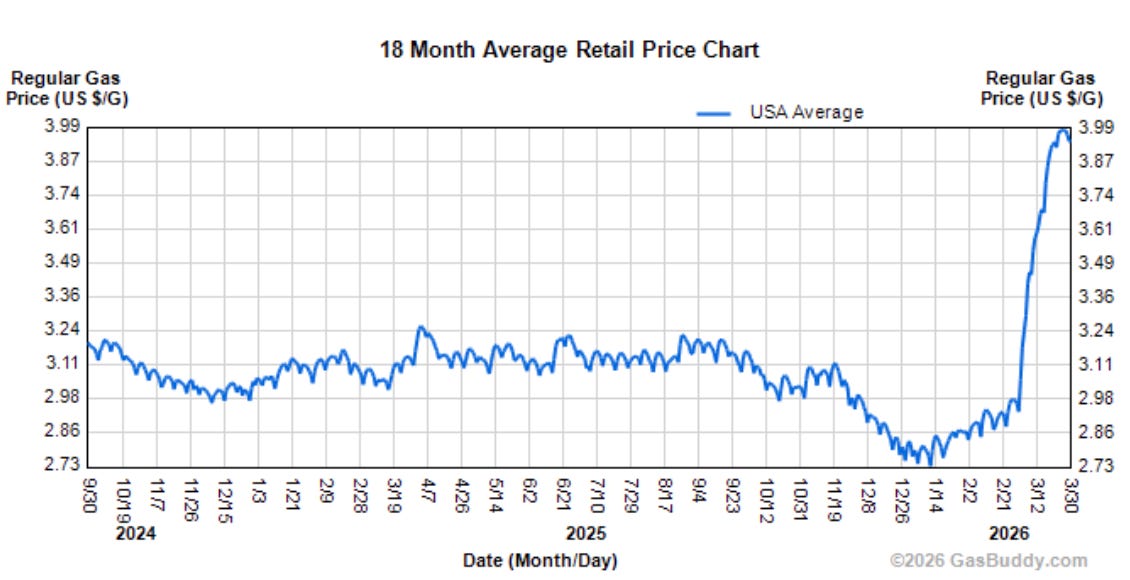
Gas prices are likely to a sore point for a president who won an election largely on inflation. In 2024, 40 percent of voters in the exit poll said that “high prices for gas, groceries and other goods” was the single most important factor deciding their vote, and they broke 2:1 for Trump. It would be hard to pick a more visible indicator of affordability.3
Although there’s also the stock market. With its ubiquity on TV tickers, it’s closer to underrated than overrated as a measure of overall “vibes”. If you’re checking your 401K (and more Americans are than usual this time of year because it’s tax season), you’ll find that your wealth has declined by a chunk.
We saw some similar effects during the government shutdown. As Democrats struggled to craft the right message, Trump’s numbers actually improved during the early days of the shutdown. But they began to decline right when the White House threatened people’s SNAP benefits. As much as political discourse on social media can be centered on abstract, “post-material”, “culture war” issues, these debates occur mostly among people who are already strong partisans and who aren’t likely to have their overall opinion about Trump changed much in either direction. It’s when people’s pocketbooks are affected or their daily lives are disrupted that broader public opinion tends to change.
Trump will bounce back, right? Well, that’s not so clear.
So far, however poor, Trump’s approval ratings remain within the range of other recent presidencies. Biden bottomed out at a -20.5 on July 4, 2024 (after his debate with Trump but before he dropped out). Trump’s first-term low was -20.8 on Aug. 6, 2017; he also hit a -19.1 a week or two after the events of January 6, 2021. Even Obama had some rough stretches, hitting his all-time low of -13.2 on Nov. 18, 2013.
There’s no reason to doubt that the extreme political polarization puts a cap on a modern president’s approval ceiling — and probably also raises his floor. And yet, when I look back on that chart of Trump’s numbers, here’s what I’m struck by: so many of these political wounds have been self-inflicted.
In fact, you could argue that he’s actually been lucky not to have more problems. There haven’t been a lot of natural disasters during Trump 2.0, or major wars (like Ukraine or Gaza) breaking out that Trump didn’t start himself. The biggest economic shocks have also been Trump-caused: the tariffs last year, and now the oil shock. Meanwhile, he’s benefited from the boom in AI investment that has helped to keep tech stocks afloat, without which we might be in full-on bear market.