


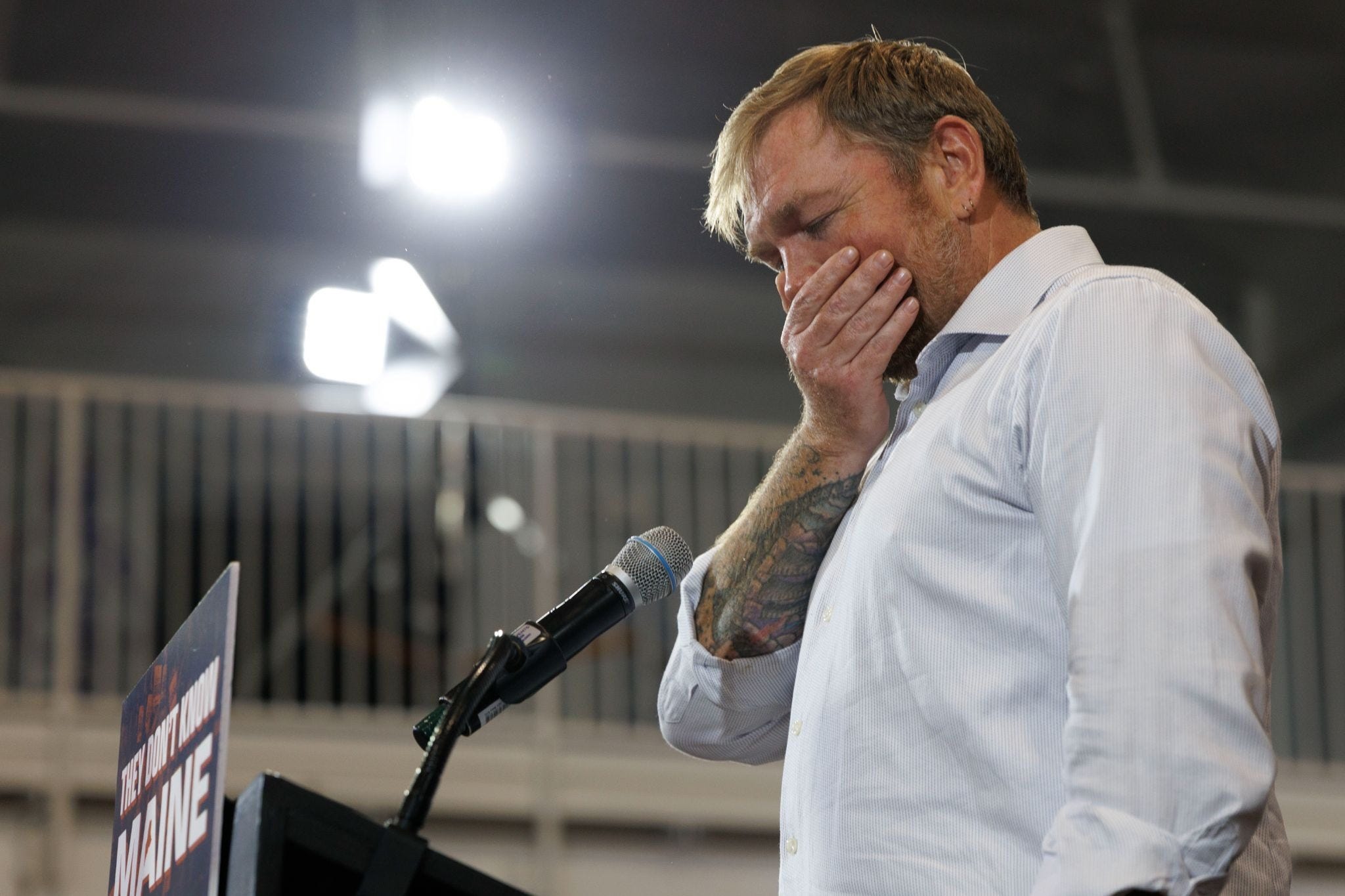
Graham Platner, the Democratic nominee for U.S. Senate in Maine, was accused today of sexual assault in a story reported by Politico.
The allegation has to be taken seriously: the accuser identified herself by name and, according to Politico, provided corroborating materials, including communications about the assault with her therapist and with a friend before Platner became a major political figure. The woman had previously referred more obliquely to “reckless” and “unsettling” behavior by Platner in a New York Times story published last month.
Having worked in major newsrooms before, including the New York Times and ABC News, I can tell you that these stories are heavily “lawyered.” A high-prestige news outlet is unlikely to publish such allegations unless it believes they are well-supported. And Platner is plausibly litigious. In June, Platner referred to a claim by a reporter on Fox News that he was a “pathological liar” as “false and defamatory” and brought up the Dominion Voting Systems lawsuit against Fox, which was settled for almost $800 million after Fox personalities falsely implied that the 2020 election had been rigged.
Platner, nevertheless, has denied the allegations — “any accusation of nonconsensual behavior is categorically false,” he said in a video he posted today. But he also said he was taking time to “reflect on the best path forward” for his campaign and the best way to defeat Susan Collins. Much of the video was phrased in the past tense.
Traders at prediction markets think it is very likely that Platner will drop out. As of Monday evening, they give Platner just a 3 percent chance of being the next U.S. Senator from Maine. After Collins, at 37 percent, the next-most-likely election winner is Troy Jackson, at 34 percent. (Jackson, a progressive Democrat, came in third in Maine’s recent gubernatorial primary.) Under Maine law, Platner has until next Monday (July 13) at 5 p.m. to withdraw from the race. The Maine Democratic Party would then have two weeks (until July 27) to replace him with a new nominee.
Interestingly, Democrats’ chances of winning the Maine Senate race actually improved on the news because traders think another Democrat would have a better chance against Collins.
Indeed, in our previous newsletter about Platner, we noted that he had lost altitude in polls after a series of sexting allegations surfaced in late May. Ahead of Collins by an average of 6 points before those allegations, he’s led by just 1 point since then, in a state where polls have frequently underestimated Collins and other Republicans. There’s been no particular sign of a rebound; in fact, two of the three most recent polls showed Platner trailing Collins.
It’s not exactly rocket science to suggest that Platner would be an underdog if he remained in the race. The sexting allegations were much less severe, but damaged his margin against Collins by 5 points. And now he has no more lead to spare.
The left should want nothing to do with Platner
So what are the takeaways here? The left has been on a good run in Democratic primaries lately, having ousted two incumbents in New York and one in Colorado with current or former DSA candidates. I owe you a newsletter on that; it was actually set to publish tomorrow before this latest news in Maine.
But who are the three most successful left-wing politicians in America? I’d argue they are pretty clearly Bernie Sanders, Zohran Mamdani and Alexandria Ocasio-Cortez.
What do they have in common? They might have significant ideological baggage in a swing district. In a series of New York Times polls of key Senate races last week, 53 percent of voters said that the Democratic Party was too far to the left, as compared to just 8 percent who said it was too far to the right. Twitter and Bluesky aren’t real life. But that’s not really a problem in New York City or Vermont.
And what Bernie, Zohran and AOC conspicuously don’t have is a whole lot of personal baggage. Mamdani, in particular, cultivates a clean-cut image by constantly wearing a suit and cheering for the local sports teams.
You can say there’s a double-standard for candidates on the left. In my view, their success in recent primaries is both fairly predictable and arguably something the Democratic establishment “deserves”. As early as April of last year, Galen Druke and I both wanted to take Alexandria Ocasio-Cortez #1 in our Democratic primary “draft”, meaning we thought she was more likely to be chosen than someone like Gavin Newsom.
But even if Democratic voters are shifting to the left, that only goes partway to explaining the success of the DSA challengers. Democrats want candidates who are “fighters”, whether that means fighting Trump, fighting billionaires, or whatever else.
There’s no reason, though, for that to be attached to a long series of personal scandals that have nothing to do with a candidate’s position on the political spectrum.
And to be fair, some prominent voices on the left conspicuously aren’t circling the wagons around Platner. Hasan Piker today called the allegations “reliable” and said it was “curtains” for Platner’s campaign. The Nation called for Platner to be replaced.
I’d note here the left, at least in this case, has been quicker to revise its views when faced with “candidate quality” problems than the Democratic establishment has sometimes been in the past — and quicker than Republicans have been, certainly.
Why I became a Platner skeptic
After many years of covering politics, I think voters tend to have some instincts for which candidates they feel are “authentic”. We’ve covered Platner a lot, and at first I took a position of detached irony toward him. He’s from Sullivan, Maine, the tiny town where I spent many summers at my grandma’s house. He’s certainly not lacking for a swaggering charm. And his polls against both Janet Mills and Collins held up fairly well when the story was “just” about his Nazi-themed tattoo and his Reddit posts.
Part of why I grew skeptical of Platner after the sexting allegations is that I thought it called his redemption arc — that his decision in 2007 to get the tattoo had been a silly drunken mistake, for example — into question. It’s highly implausible that Platner didn’t become aware of the symbolism of the tattoo at some point before having it removed last year, and there are numerous accounts that contradict his story.
Platner’s campaign also took a highly aggressive posture toward Genevieve McDonald, Platner’s former political director, who left his campaign in October. Given that the sexting allegations were far less serious than a sexual assault claim, it was reasonable to ask whether they reacted in this way because they knew there were more serious allegations that might come to light.
There are other critiques that one can make of Platner also. He grew up with a fair amount of privilege. He was recruited by consultants and activists who saw him in a video shot by a local ecological conservation organization.
Few of us are boy scouts. At some point, though, you pass a threshold where someone’s story doesn’t add up.
I could get cute here and cite something involving reading poker “tells”. Generally you’re not looking for any one sure-fire sign — someone rapidly blinking their eyes, for instance — so much as a cluster of behaviors that are collectively more powerful than any one indicator individually.
But although poker players have more experience in precisely quantifying this, it’s actually a very natural human instinct and one that probably becomes better with experience. You might excuse a “problematic” element in someone’s personality, or two. But most of you have probably also had a moment where you learned that you were wrong to give the benefit of the doubt to a friend or coworker. “Fool me twice, shame on me” has always been one of the wiser proverbs.
Plus, political parties have to think probabilistically, too. Maybe it’s all a series of extremely unfortunate misunderstandings and coincidences. Democrats aren’t in a court of law, however, where they have to prove allegations beyond a reasonable doubt.
Should he remain on the ballot, Platner will be a burden for Democrats’ ability to win a majority this November. Progressives will probably want Jackson to replace him, while the establishment might make one last pitch for Mills. But that’s what the argument should be about, not trying to rehabilitate his campaign once more.
Thrilled for the country that he’s out of the race. Nazi tattoos should be nowhere near the levers of power.
Okay I’m here ready to eat my hat. I commented last time saying there’s no way he drops out so why even write about the possibility, and now it sure seems feasible.
My bad, sir. I missed lunch.