

Are England the New York Knicks?
Another team just ended a half-century curse by becoming more than the sum of its parts. England's always had the talent — can it finally do the same?

Be sure to check out our World Cup forecast page. We’ll also publish a little look-ahead to the knockout round, posted late tonight or tomorrow morning, once the group stage is finished.
And I know we’ve been sports-heavy lately — there are a couple of politics stories queued up for early next week, though. We’re not apologizing too much, given that this is the first World Cup in the U.S. in 32 years! -NS
The phrase “it’s coming home” has, over the years, taken on a hint of irony for English football fans. After all, it’s been six decades since England last won a major international trophy — a drought that rivals just about any in sports.
But this year has been pretty good for ending trophy droughts: Arsenal won their first Premier League in twenty-two years — the first since their famous Invincibles season — and the Knicks snapped a 53-year wait, beating the Spurs for their first NBA title since 1973.
On the surface, the English national football team is a lot like the Knicks: both believe they’re the rightful “home” of their respective sports, both ran into juggernauts in the late 1990s and early aughts, both suffered through bad management in the early 2010s, and both still have some of the most passionate fans — maybe too passionate — in the world. By now the relationship between English fans and their team borders on tragic, each tournament following the same script: a wave of genuine belief, then the familiar blow — a penalty shootout or quarterfinal collapse.
Despite their trophy drought, England remains a hotbed for producing world-class players.1 After they laid waste to Luka Modric and Croatia in the second half of their opening game, it was easy to see the type of performances their squad is capable of. Still, while England certainly has the talent to succeed this year, far more goes into winning the World Cup than having the best players.
Why did England’s Golden Generation fail?
A lack of talent has never been the real issue for England. In fact, too much of it may have been the root of their underachievement in the 2000s. During the 2000s, the English talent wave — nicknamed its country’s Golden Generation — was deep at every position.
They boasted two monstrous attackers in Michael Owen and Wayne Rooney. Owen won the Ballon d’or in 2001 at only 22 years old, while Rooney is recognized as one of England’s finest-ever talents, starring for Manchester United teams that dominated the Premier League. Their backline had no holes either: Rio Ferdinand is widely considered one of the best defenders of his generation, Ashley Cole and Gary Neville flanked the left and right back positions, respectively, and John Terry filled in the final spot. Their midfield was perhaps their deepest position: Joe Cole, Paul Scholes, Steven Gerrard, Frank Lampard, and their captain, David Beckham, competed for scrace available spots in the center, often leaving an odd man out.

England’s Golden Generation was something of a cultural phenomenon at the height of tabloid culture, with the footballers’ relationships being some of the most discussed news stories in mid-2000s Britain, peaking around the 2006 World Cup in Germany. It wasn't without reason: the English squad boasted some of the most recognizable footballers on the planet, but their partners — or as British media coined them, “WAGs” — were famous in their own right. Household names like Victoria Beckham and Cheryl Cole made their partners into news fixtures as much as any goal or trophy did.
These relationships were engines of financial success. David Beckham was a wildly good footballer at the peak of his powers, yes, but the commercial value of his brand proved to be far more valuable to clubs looking to build viewership. At the time of the 2006 World Cup, Beckham was playing for Real Madrid as one of their Galacticos, but was already considering offers to play in the MLS as part of a plan to build the global fame of the league.
Despite the stardom, the Golden Generation didn’t produce a single trophy, never making it further than the quarterfinals in any of the major tournaments during the 2000s.
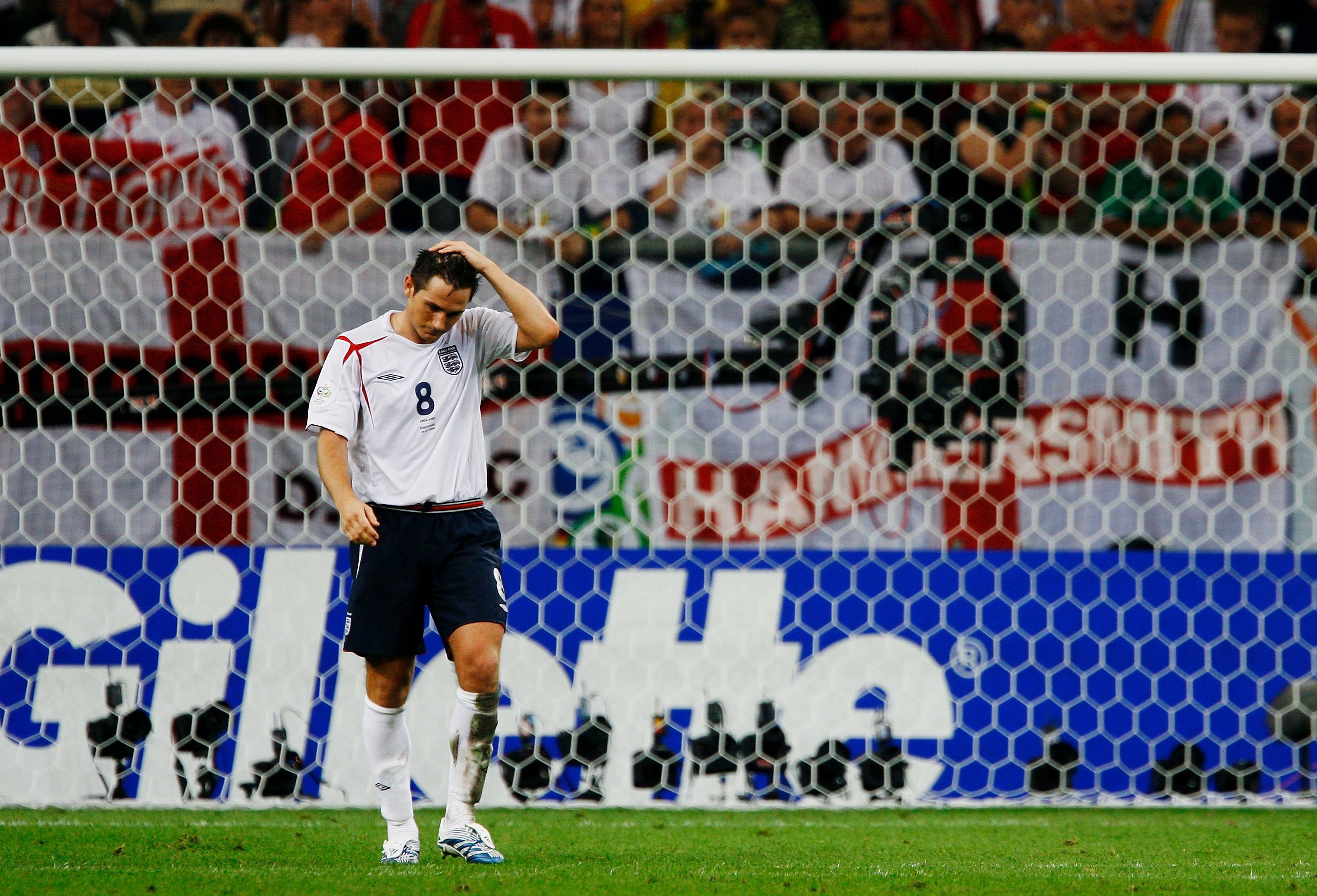
Of course, there are some boring reasons behind England’s underachievement in major tournaments. For one, there was quite a lot of bad luck involved. England had a longstanding “penalty curse.” Across a decade of major tournaments, they were repeatedly undone from the spot: Euro 96 against Germany, a 1998 World Cup last-16 tie against Argentina, Euro 2004 against Portugal, and the 2006 World Cup quarterfinal against Portugal again. England also faced major injuries during some of these tournaments: Michael Owen famously tore his ACL during the 2006 World Cup, and Wayne Rooney struggled with metatarsal injuries after breaking the bone in the lead-up to that same tournament.
Even then, not reaching even one semifinal for almost a full decade can’t be explained only by bad luck. England had its fair share of poor performances, highlighted by poor chemistry between their squad and rigid tactical formations that didn’t showcase their best players.
Manager Sven-Goran Eriksson employed a 4-4-2, which put Gerrard and Lampard — both gifted attacking midfielders — at odds with one another. The fundamental issue was that the 4-4-2 asks its two central midfielders to split duties, with one sitting back to provide defensive cover while the other roams forward to create. Gerrard and Lampard were both creators, by temperament and by the role they played at club level. When both pushed forward, as they tended to do, they vacated the space in front of the back four and left England exposed through the middle on transition. When one held back, England no longer retained the midfield advantage it had on paper.
England could have employed defensive midfielder Owen Hargreaves in a more prominent role, but he often didn’t get the call to start. English management had trouble leaving a world-class player like Lampard, Gerrard, or Scholes on the bench, and Hargreaves was often derided as England’s lesser midfielding talent. Hargreaves turned out to be one of the few bright spots in an otherwise underwhelming 2006 campaign, proving the media wrong, though it didn’t rescue England's tournament.
Some of England's misfortune, too, was simply a matter of being one superteam among many in a crowded era. In 2002, the Brazilians featured Ronaldo, Ronaldinho, and Rivaldo, and beat England in the quarterfinals before winning the tournament in dominant fashion. In 2006, the Italian side that won the tournament featured world-class players up and down the pitch, from Gianluigi Buffon in goal to Ballon d’Or winner Fabio Cannavaro in defense and Andrea Pirlo pulling the strings in midfield. England’s trouble against a strong Portuguese side in 2004 and 2006 shouldn’t be excused, but Portugal wasn’t exactly an underdog. After all, they started Luis Figo, Deco, and a young Cristiano Ronaldo in a devastating attacking trio that would have troubled any good team.
Even in their better moments, England never achieved a year-end #1 PELE ranking, and only ever peaked at year-end #4 during Beckham’s run as team captain. Moreover, the dominance of countries like Spain highlighted England’s tactical rigidity. During the 2008 Euros, Spain ran a more typical 4-4-2 formation, but by 2010, they had started to focus more on possession as the main lever of control, treating the ball itself as the most valuable thing on the pitch and building everything else around keeping it.
Under Luis Aragones and then Vicente del Bosque, Spain moved from a system of football nicknamed la furia — “Spanish fury,” an identity built on physicality and aggression — to one known as tiki-taka, a possession-obsessed style defined by short passing and constant movement. In the 2012 Euros final, for example, Spain lined up without a recognized striker at all, deploying the midfielder Cesc Fabregas as a false nine ahead of a side built around Xavi, Busquets, Xabi Alonso, Iniesta, and David Silva in a now-famous 4-6-0 formation. This stylistic evolution underpinned Spanish play during a period in which many other footballing powers struggled to get the most out of their talent.
Of course, you can't blame England for not pushing the boundaries of football any more than you can blame early 2000s NBA teams for not shooting enough threes. Innovation involves risk-taking, and the number of chances you have to win an international trophy with a Golden Generation of players is few and far between.
Can England bring it home this time?
The modern England side has at least somewhat internalized the lesson the Golden Generation never could. Under new manager Thomas Tuchel, who took charge at the start of 2025, the team has a clear division of labor in midfield, and a willingness to leave big names at home when they don't fit.
The 2026 iteration had some huge omissions — Phil Foden, Trent Alexander-Arnold, and Cole Palmer all missed out after mediocre club seasons —and some in the press have called it the most shocking English squad in almost thirty years.

These decisive moves have paid off for England thus far. Despite a draw against Ghana in their last match, they’ve enjoyed a stellar run of play going into this World Cup. They won all eight qualifiers without conceding a single goal, and outplayed familiar foe Croatia in their opening match.
Kane, unlike the Golden Generation players, is a bit underrated considering his consistency over the last decade or so. Most serious football analysts consider him the most complete striker in the world, even if fans don’t always give him his respect: he’s England’s all-time leading scorer and has maintained form in both the Premier League and the Bundesliga.
When Kane first burst onto the scene in Tottenham, he was considered more of a poacher — reliable, yes, but not a player that England could anchor a counterattack around. By 2021, Kane had started to use his attacking potential to draw defenders and create space for fellow Tottenham left-winger Son Heung-Min, which led to a devastating number of goal-combinations.
This expanded framework for the #9 role has become one of the most devastating aspects of Kane’s game. During his 2017-18 season with Tottenham, Kane operated as a penalty-box striker, but he’s gradually moved away from poaching to a deep-lying creator role, playing closer to the halfway line. Despite many predicting Kane would have a steep decline in older age, he’s effectively tripled his creative output, creating more for his teammates.

Kane isn’t necessarily unique in this transformation. Lionel Messi transformed from a right-winger to a deep-lying playmaker later in his career, going from a devastating one-on-one dribbler during his early years at Barcelona to a game built on vision and weight of pass. It’s the appropriate way to transition your game from being dependent on athletic tools to something more stable: intelligence and positioning.
The shift has steadied Kane as one of the world’s best players— there are arguments he is outright the best, though I won’t go too far — but England should be wary of an overreliance on him. So far, Tuchel has been keen to make use of Kane’s all-around offensive versatility, but their dependence on him could put them in tight spots as they go deeper into the knockout rounds.
He’s produced nearly a third of the team’s goals and xG across the last four tournaments, but when he struggles to break down the opposition’s backline, they can be left vulnerable to tight games that get decided by small margins. In England's match against Ghana, for example, Kane said he couldn't find much space because he was effectively man-marked by Thomas Partey, denying him the room to drop deep and arrive late in the box. England dominated possession (79 percent) and outshot Ghana 19-2, but were essentially neutralized because there wasn’t a second reliable attacker for Kane to create space for.
Nonetheless, Kane isn’t the only world-class talent on their roster. England’s most pivotal player might be Arsenal midfielder Declan Rice, widely regarded as one of the most complete players in football. Rice’s transformation from playing the destroyer role to becoming a more versatile box-to-box attacker catapulted Arsenal to the Premier League title and a Champions League final. The unlock came when Arsenal signed Spanish holding midfielder Martín Zubimendi in 2025. With Zubimendi anchoring the base of midfield in a double pivot, Arteta was free to push Rice into a more advanced role, releasing him from the pure shielding duties that had defined his West Ham years. Rice topped Arsenal’s rankings for both chances created and possession won, and even with 27 of his 63 key passes coming from set pieces, he still finished joint-second on the team for chances created in open play while remaining their primary ball-winner.

Tuchel has kept him in that role thus far, pushing him relatively far above the halfway line in England’s first two matches. If Rice’s presence can aid England’s attack and relieve some pressure off Kane and fellow midfielder Jude Bellingham, England looks to be extremely powerful in this tournament.
So will England bring it home this year? They have a good chance — our model gives them the fifth best odds in the field — but it might be worth tempering the optimism. For one, England will need to win today against Panama. They’ve already clinched a spot in the knockouts, but finishing second could mean playing either one of Portugal or Colombia in the round of 32. Both teams are good enough to send England home. There’s a world in which they could play a very tricky combination of opponents in sequence: Portugal, Spain, Belgium and France — and winning out would require both some luck and tactical brilliance. Conversely, a win today could put them on the other side of the bracket, where they would play DR Congo or Senegal in the first round. Senegal is the better team, but is probably England’s preferred matchup, given their defensive limitations thus far.
Either way, World Cup title or not, England’s tactical innovations are suggestive of a side that has gotten over its tendency to favor star players over the overall healthiness of their team. Much of winning a World Cup is luck, but after 60 years, a team built to give itself the best possible chance is about all you can ask for.
When viewing the chart above, based on PELE ratings, note that PELE begins to incorporate player market value data beginning in 2005. So England starts to get more credit for its talent starting then, talent that it has not always lived up to.
This piece poses a good question but never tries to answers it.
Start with the framing devices. The WAGs of a past England team is tabloid click-bait. The Knicks analogy is thin, and it isn't even right about the Knicks. Their stretch of real dysfunction came after the early 2010s, when they were actually making the playoffs and won a series in 2013; the wilderness years ran roughly 2014 to 2020.
The "passionate, maybe too passionate" fanbase point doesn't hold either — I had Knicks season tickets for years, and in ordinary seasons the building was mostly knowledgeable, not-overly-partisan basketball fans; the loud, emotionally invested crowd the article imagines only showed up in good years and the playoffs, and a lot of those are celebrity and success chasers, not die-hards. That's close to the opposite of the self-flagellating, every-tournament-is-trauma England support the piece is reaching for.
More to the point, a single franchise in a closed 30-team league has almost nothing in common with a national side that draws on an entire country and competes against the whole planet. The two "droughts" aren't the same kind of object, which makes the analogy decorative rather than illuminating.
"A drought that rivals just about any in sports" is parody. Eight nations have ever won a men's World Cup, out of 211 FIFA members. For almost everyone, the "drought" runs unbroken back to 1930. England is one of the few countries that has won at all — that's the top 4% of football history, not a uniquely cursed category. The interesting question isn't "why the drought," it's "how often should even a top-five side expect to convert, given the variance of a seven-game knockout?"
The article dings England for a rigid 4-4-2, then praises a Spain side for the same lineup in 2008 — when it won the Euros. Outcome-based reasoning. The shape didn't fail England; Spain didn't win due to a formation; it won because it had Xavi, Iniesta, and Busquets and a plan for using them.
What's left is a tour of Kane and Rice that arrives, after a long detour, at what everyone already knew: England is good, not favored, probably won't win — fifth-best odds.
The headline asked whether this England is different. Answering that would mean engaging with how talent actually translates into tournament outcomes, what the model's probability implies versus the market, and what Tuchel's omissions are really worth. That column would have been worth reading.
I think it is challenging to say that it has been six decades since England last won a trophy of note. It is certainly true of the men’s team, but the England women won the European championships in 2022, then successfully defended their title at the next championships 2025. In the interim, they made it to the women’s World Cup final, where they lost 1-0 to Spain. Indeed, it has been the strong success of the women’s national team that has heaped even more pressure on the men.