

The World Cup champion will be one of the greatest teams ever
Spain is chasing a historic streak. Argentina is chasing back-to-back titles. Whoever wins Sunday will join the highest tier in international soccer history.


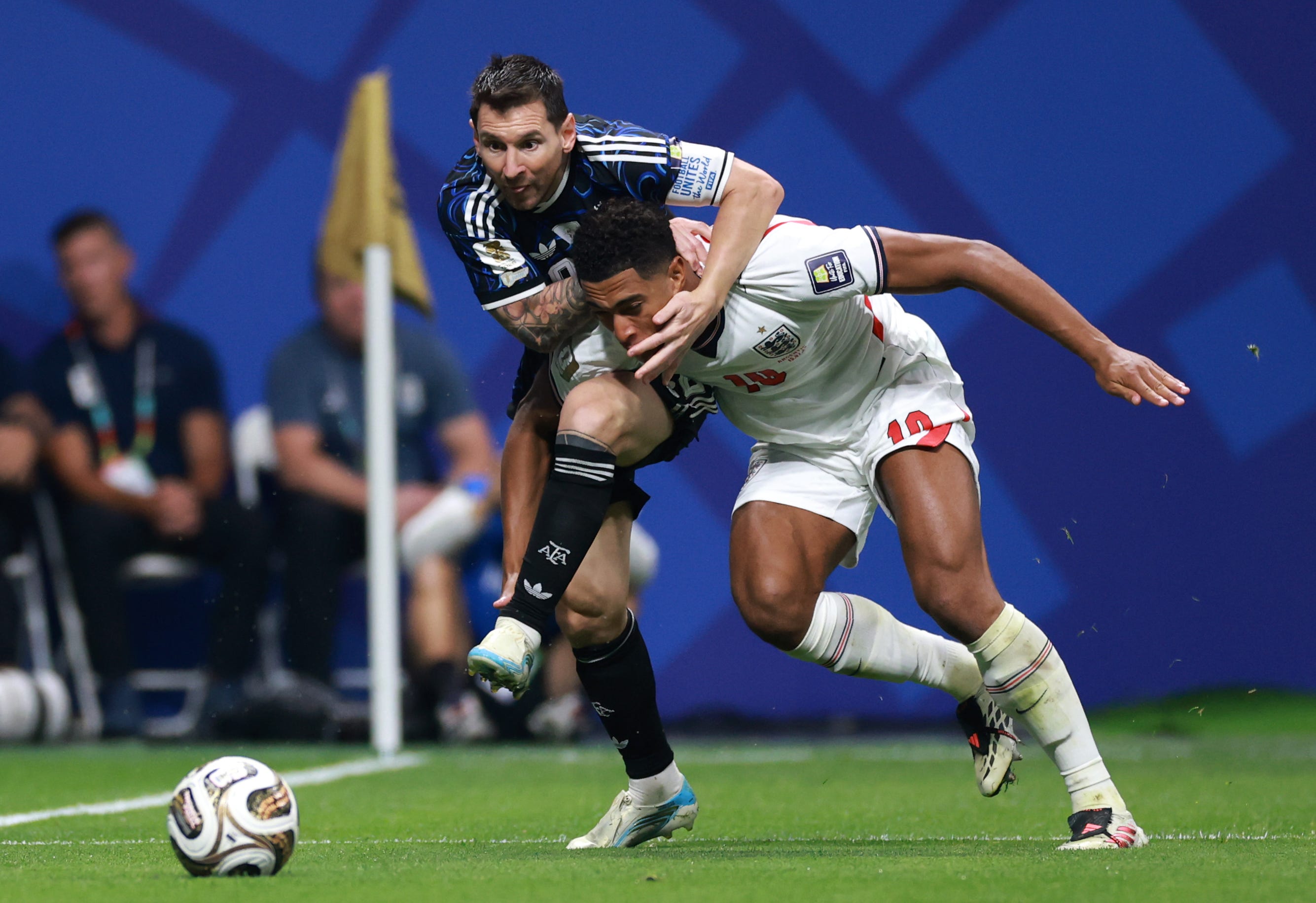
We’re probably not the only ones feeling sad about the end of the World Cup. Through 102 matches, the quality has been elite, with stars from Messi to Mbappé to Haaland having turned in A+ performances even relative to unreasonable expectations. With certain notable exceptions — England after taking the lead against Argentina on Wednesday — the play has been creative, daring and offensive-minded, and the 2.91 goals per match scored so far in the tournament is the highest since 1970. The finale is at 3 p.m. on Sunday in New Jersey, when Spain and Argentina will play one another in the World Cup for the first time since 1978.
Argentina and Spain were our co-favorites at the start of the tournament — a slight deviation from the conventional wisdom, which had France and Spain as co-favorites instead and Argentina a tier behind. So we’ll admit to feeling pleased with how the results have gone from a PELE/predictions standpoint.
But there was nothing inevitable about this outcome. In the knockout round, Argentina’s game-clinching goals have come, respectively, in the 111th, 93rd, 112th and 92nd minutes. Argentina and Spain might even have met in the R32 and not in the final if one of them had finished second in their group while the other won theirs.
We can’t promise you a great final. Historical World Cup finals have included some duds, in fact — a fair number of choppy, defensive stalemates, as well as a handful of blowouts. What we can guarantee, however, is that whoever wins will be able to stake a claim for being among the greatest World Cup champions ever. A Spain win by any means other than on penalties would leave them with the highest PELE rating of any World Cup champion immediately after the World Cup. Argentina, meanwhile, would be the first repeat champion since Brazil in 1958 and 1962, a less competitive era when only three knockout wins were required instead of five to claim the championship.
Their stories are different, however. Argentina has been remarkably persistent. Their case is about the cumulative success of Messi in his late 30s, winning not only back-to-back World Cups but also the Copa America in between. The better comparison for Argentina might not be to the 1958/1962 back-to-back Brazilian champions, but rather the more veteran 1970 Brazil squad. Still, there are veterans — Pelé, who might have won the Golden Ball if the award had existed then, was 29 in 1970 — and then there’s Messi, who is 39. Apologies to our non-American audience, but the best comparison we can think of is to that other type of footballer: Tom Brady.
Spain, meanwhile, is a team on the rise. You could say they’re “peaking at the right moment”, but as one of the youngest teams in the tournament, and with the World Cup set to be co-hosted in Spain in 2030, they could be set up for a dynasty. If Spain wins1 on Sunday, it would set an all-time record with 38 consecutive international matches without a defeat.2
Spain crashed out after winning their first World Cup title in 2010 and their second straight European Championship in 2012. They were eliminated in the group stage of the 2014 World Cup in Brazil, and the R16 in both 2018 and 2022, in both cases on penalties. Their combined record in those years: 3 wins, 3 losses and 5 draws3, more suitable for Los Estados Unidos than a team that had just broken through to become only the eighth nation to win the World Cup.
But Spain has been building momentum pretty much ever since, with a perfect record in World Cup qualifying, seven wins in seven matches at the 2024 European Championship, and a run to the 2025 UEFA Nations League final, which they lost only on penalties.
You can find our official prediction on the World Cup landing page — spoiler alert, it’s close. I hope you’ll pardon the cliché, but this really is about as close as you’ll get to the irresistible force against the immovable object. So let’s talk more about the matchup, and how we got here.
Argentina is still king of the hill
PELE, like other variations on Elo ratings, pretty much takes the view that the best team is the best team until proven otherwise. Which isn’t exactly a controversial premise, we realize. But Argentina, which had the 2nd-highest PELE rating entering the 2022 tournament in Qatar, finished with the #1 ranking after defeating France on penalties in the final.4 You’d assume they’d at least be considered one of the favorites unless there was an obvious decline in performance.
But even as perhaps one of the most popular teams in the world, Argentina wasn’t given particularly much credit by betting markets, starting the tournament with only about 10 percent odds5 of winning: about half the chance that PELE calculated for them.
There was basically nothing in Argentina’s record since winning in 2022 that warranted such a bearish view. Their record isn’t as pristine as Spain’s. But it’s very good: in 46 matches since Qatar, they have 39 wins, 4 losses and 3 draws.6 They won Copa America and lapped the field in South American qualifying, where clean sweeps are basically impossible because of the large number of qualifying matches (18), many of which are in challenging road environments like Brazil and Ecuador. Their worst result since the last World Cup was a 2-0 loss to Uruguay at home in qualifying, but that was almost three years ago.
Technically speaking, match results aren’t the only factor in PELE. There’s also a slow process of mean-reversion applied in between matches, based primarily on the Transfermarkt value of the players on the roster and secondarily on team age, region (South America = presumptively good), the size of the country’s economy and its soccer legacy. Argentina does just fine by those measures. While they don’t have the player depth of France or England or Spain, they did rank 7th in the world in aggregate market value heading into the tournament in the way that we calculate it7 (ironically, without giving much credit to Messi8). And Argentina is a big country in what has historically been the most overperforming football region in the world.
Our diagnosis after our extensive work on PELE, making lots of comparisons between team records and player valuations in forecasting future games, is basically that prediction markets place too much emphasis on raw talent and not enough on team results. It’s a bit counterintuitive because international football teams don’t play all that many meaningful matches. We expected to discover something like a 50/50 blend of team results and priors was optimal for predicting future performance, but the “right” ratio is more along the lines of 75/25, with the bulk of the weight going to match results and the priors having a more gentle, long-term effect.
This may be because the idea that a team is just the sum of its player components is dubious. World Cup teams don’t have the same opportunities to optimize their talent that club teams do. While France or England might be better than Spain or Argentina given a few dozen games to refine their tactics, they were outstrategized in the semifinals.
But haven’t Argentina’s results in this World Cup been a little bit sketchy, with Messi constantly pulling rabbits out of his hat?