

The DSA sweet spot: highly educated, downwardly mobile
Education and economic security are usually correlated. But where the relationship breaks down is fertile territory for the new left.

Now that the World Cup is over, we’re fully focused on getting the midterm forecast up and running as soon as possible. I’m going to be honest that between publishing a ton of stories over the past two months, highly competitive primaries, redistricting, and various other distractions, this has taken a little longer than we were hoping for. So we’re going to err on the side of publishing less for the next couple of weeks until the model is ready to go.
However, one benefit of working on the model is that there are usually some fun spin-offs from the various data that we collect for it. For instance, in calculating the state-by-state correlations used by the model, we rely on voter-level microdata from the Cooperative Election Study, a large-sample online survey conducted every year or two. We’ve aggregated responses to the CES in each year it was conducted during the “Trump Era” — from 2016 through last year — into a dataset of more than 400,000 voters.
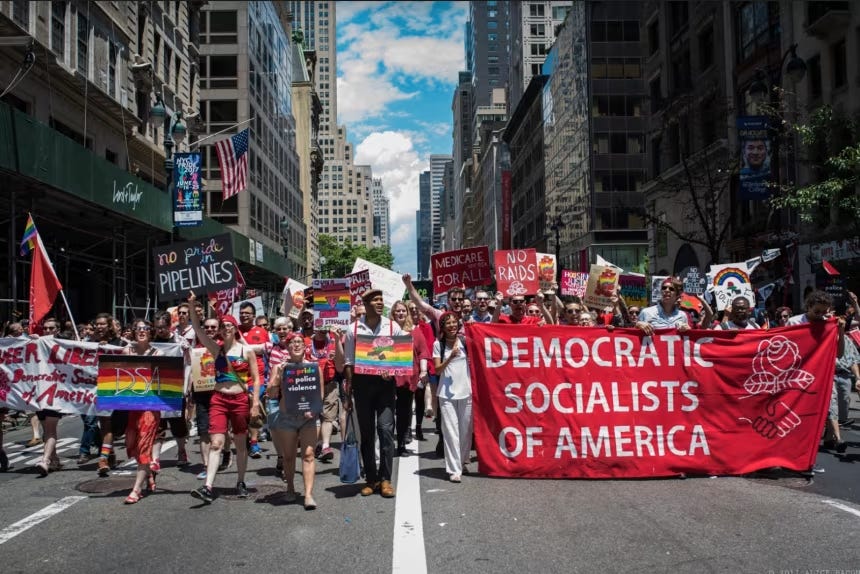
That gives us high-fidelity data for capturing voting trends among smaller subgroups that usually get lost in the shuffle. Today I’m going to focus on one such group: voters with high educational attainment but low to middle incomes. Because income and education are positively correlated, there aren’t all that many of these voters. I’d argue, though, that they’re vital to understanding emerging trends within Democratic politics, and particularly the rise of the Democratic Socialists of America (DSA).
The DSA occupies the high-education, lower-income corner of the electorate
As a result of contentious Democratic primaries in Michigan, Maine, and New York, I’ve been reading a lot of conversation about the role that class plays in voting patterns in the United States. In these primaries, candidates like Graham Platner and Abdul El-Sayed who are associated with democratic socialism often claim to have the mandate of the working class. But in practice, their strengths tend to be with college-educated voters. Even before his scandals, Platner wasn’t particularly doing better among voters without college degrees than previous (losing) Democratic nominees in Maine. El-Sayed has relatively weak support from Black voters in polls, meanwhile.
But does that make them hypocrites? For what it’s worth, they certainly both have interesting backstories. Platner didn’t graduate from college, but came from a fairly privileged background. I don’t think it would be unfair to classify him as “downwardly mobile.” El-Sayed is in some ways the polar opposite: a first-generation American who went to a good public school in suburban Detroit and is obviously a high-achieving person.
The larger point, though, is that I think we ought to be careful about conflating class with educational attainment. Apologies for the cliché, but class in America reflects a tapestry of race, educational attainment, and income/economic privilege — and even that doesn’t capture everything.
I’m reminded here of Peter Turchin’s elite overproduction hypothesis. It basically argues that America is producing “too many” college graduates relative to the number of high-prestige, well-paying jobs available to them. People who wind up in this situation often carry heavy student loan burdens or other sorts of debt. Even if their material situation is objectively “just fine,” it’s rarely great. They’re gloomy about their own financial prospects, and feel aggrieved about the state of the country. Their class status is ambiguous: privileged in some senses, but they’re part of the “have-nots” in other meaningful ways.
What would be ideal here, to get closer to the notion of class, is if we had data on voters’ family backgrounds. Did they grow up rich or poor? Were their parents white-collar or blue-collar? Did they go to a private high school? Unfortunately, you’ll rarely, if ever, see this sort of question in political surveys, even ones as comprehensive as the CES.
Still, we can get a fair amount of texture by running through various permutations of income, educational attainment and race, all of which are available in the CES. I’ll look at who these voters preferred1 in the 2016 through 2024 presidential elections.2 Putting race aside just for a second, I’ve classified voters into four groups based on educational attainment, cross-hatched with five groups based on their self-reported household incomes.3
Based on this grid, what is the most Democratic voting group in America? It’s voters with postgraduate degrees but lower-to-middle household incomes of $30K to $60K per year.
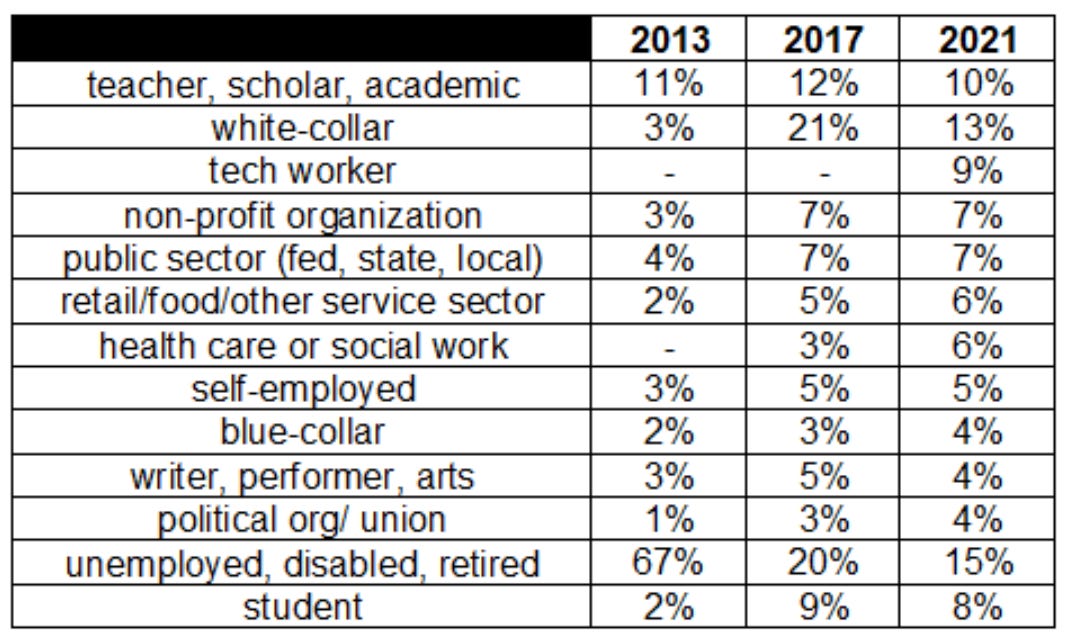
This is very much also the sweet spot for the DSA. In the group’s most recent member survey in 2021, 80 percent of members aged 25 or older had bachelor’s degrees, but 45 percent had household incomes below $60,000 per year.
This is unusual, because education and income are usually substantially positively correlated. In the composite CES data, only 19 percent of Americans with bachelor’s degrees or higher had household incomes of $60K or below. The DSA rate is around twice that.4 These voters aren’t necessarily “blue collar” in the sense of working with their hands. But that doesn’t mean they’re privileged. Common occupations among DSA members include teachers, non-profit workers, social workers, and public sector employees.
By contrast, who are the most Republican voters in the country? It’s not necessarily voters with a lot of “economic anxiety”. Rather, it’s the precise opposite corner from the DSA: high-earners who didn’t attend college. About 60 percent of voters with a high school education or less, but whose households earned incomes of $60,000 or above, preferred Trump to the various Democratic presidential candidates. (You can probably think of various stereotypical professions here too: small business owners, independent contractors, real estate developers, used-car dealers, etc.)
Could this just be some weird composite artifact of race? In the DSA’s 2021 survey, 85 percent of members reported their race as white5, which certainly isn’t representative of the country or the Democratic Party overall. But in the broader CES data, we find that the patterns mostly hold once you disaggregate by race. Let’s speed-run through the various major groups. Here is the CES data on voting by income and educational attainment among white voters alone.
Among whites, there’s particularly strong stratification in political preferences by educational attainment, with incomes making less difference. Still, there is some very mild “U-shapedness” — i.e., both the poorest and the richest whites are more blue than middle-income ones. The most Democratic group among all white voters is the same one as in the aggregate data: voters with graduate degrees making between $30K and $60K per year.
Next, the same numbers among Black voters:
While it’s true that Black voters are not a monolith, their preferences are notably more uniform than for whites — and mostly very blue. But what’s the most Democratic Black voting group? You guessed it — Black voters with graduate degrees earning $30K to $60K per year. In fact, with 95 percent of voters who meet this description voting for Democrats, it’s probably the most D subgroup in the entire voter universe.
How about among Hispanics?
This chart hits a bit differently. Among Hispanic voters, voting is considerably less correlated with educational attainment than among whites. However, Hispanic voters earning higher incomes are considerably more Republican than lower-earning ones. Hispanic-Americans (and Asian-Americans) have high rates of small business formation. As I’ve argued in the past, Democrats may be doing a poor job of appealing to entrepreneurially-minded Americans — and DSA-type messages may be particularly unappealing to them.
Still, it’s basically the same pattern again. The top-right corner of Hispanic voters (high education, low-to-middle income) is blue. The bottom-left one (high income, less education) is much more purple.
High-education, lower-income voters are cultural libs, too
Another complication with candidates like Platner and El-Sayed is that much of their messaging isn’t focused on bread-and-butter economic issues. Instead, like other Democratic factions, democratic socialists can believe in the “omnicause”. Apart from Medicare for All, the signature issue of El-Sayed’s campaign is Gaza, with a huge amount of his campaign communications focused on the extensive spending by AIPAC and affiliated groups in support of his opponent, Haley Stevens. Meanwhile, in his message announcing he was formally withdrawing from the campaign, Platner signed off with a series of cultural signifiers — “F*ck ICE.6 Free Palestine. Up the Hearts” — the latter a reference to Portland, Maine’s professional soccer team.
That’s not to say the DSA wouldn’t be better off in the long run if it were more agnostic on cultural issues. Even Bernie Sanders once had relatively moderate stances on immigration and guns. Even Zohran Mamdani has backtracked from his more left-wing positions on issues like policing.
But politicians who truly have some long-term vision are rare. Most of them are trying to play the ball where it lies. The fairway consists of college-educated, mostly younger, mostly white progressives who are disillusioned by their economic opportunities and/or with the direction of the Democratic Party. We could get into the sociology behind this, but this is a group that typically uses “post-material” cultural issues as their rallying points.
In addition to asking voters about their presidential preference, the CES also asks voters to rate their ideology on a scale from 1 (“very liberal”) to 5 (“very conservative”). “Very liberal” wasn’t a very common response: only around 10 percent of the electorate. But which voters were most likely to check the “very liberal” box?
You’re probably getting the hang of this by now: it’s voters with graduate degrees making between $30K and $60K a year. Some 21 percent of those voters say they’re “very liberal”, about twice the population average.
As I discussed last week, voters who describe themselves as very or extremely liberal tend to place more emphasis on cultural issues — particularly gay rights, trans rights, the environment, race relations and Israel/Palestine — as compared to other voters. They’re only about average or even a little below-average in how much they prioritize things like health care and jobs, by contrast.
So what Platner and El-Sayed are doing might be smart politics, particularly in El-Sayed’s case given Michigan’s relatively high number of Arab-American voters.
Noah Smith recently argued that the “socialist left” and the “woke left” should be regarded as separate political movements. But I’m not so sure that’s true. This data helps to explain the relationship. Messages like “Fuck ICE” and “Free Palestine” are catnip for college-educated liberal Democrats of all kinds. Culturally left-wing but economically comfortable Democrats are probably more likely to join other Democratic factions like the #Resistance. Culturally left-wing but more “economically anxious” ones are potential targets for more anti-establishment factions like the DSA, by contrast.
DSA members aren’t necessarily struggling to pay the bills, nor are most of them traditionally “blue-collar”. But they’re likely to be genuinely upset about their station in life as well as how things are going with the country. Without wanting to psychoanalyze too much, it can be appealing to anxious-feeling voters of all political persuasions to feel as though they’re part of some greater, more altruistic struggle against corrupt elites or injustice. The DSA is betting they’ll stick around for the socialism — but the culture wars are often what get them in the door.
Either the candidate they actually voted for or the candidate they said they intended to vote for, depending on the CES wave in which they participated.
Voters who supported third-party candidates or did not vote are excluded.
All data in these tables is weighted based on the CES’s recommended weights.
I’m hedging my language slightly here because the 45 percent of DSA members who reported incomes of $60,000 or below is among all members, not just those with college degrees. However, since the very large majority of DSA members had bachelor’s degrees, it shouldn’t be too far off.
Although, the DSA survey allowed respondents to select multiple races; some of the 85 percent checked other boxes, too.
I’m quoting Platner’s letter verbatim. Here at Silver Bulletin we’re proud to use swear words without asterisks!
I think this is absolutely spot on and has huge implications for the Democratic Party.
I also think another powerful element driving DSA support is the wild amount of money in big coastal cities like NYC, LA, Boston, San Francisco, etc. The PERCEPTION of being "downwardly mobile" and/or economically insecure even among relatively high earning households should not be overlooked.
Take a hypothetical married couple with 1 or 2 kids living in my solidly Commie Corridor brownstone Brooklyn neighborhood. Lets say you have a NYC public school teach with a masters and 8 or 9 years of experience making around $100K and a not-for-profit executive with 10-12 years of experience making around $140K. That household is not rich, but they certainly aren't poor and really aren't middle class either. In fact they're earning fully 3X what the median Brooklyn household earns and are likely in the top 20% of households in the borough. Forget about what they are earning compared to an actual middle class household in Wisconsin or whatever.
And yet at $240K a year they likely can't afford more than a 1BR apartment in Ft. Greene. Factor in the cost of childcare and they likely feel like they are barely scraping by. Forget about taking the kiddies to Europe or buying a weekend home. And they see 20 something kids in finance renting $5,000 a month apartments.
They're prime Millennials who did everything right...they were high achieving teenagers, went to great colleges, got masters degrees, colored inside the lines their entire lives, they play by all the rules. They're attuned to every sort of fashionable well educated cultural virtue signaling. They bring their NPR totes to shop at the farmers market (happily paying a 20% premium), still wear COVID masks on the subway and seem to genuinely enjoy composting. That at least in my corner of Brooklyn is the typical DSA voter.
Thank you for using swear words without asterisks. The idea that intelligent, educated commentary should never include vulgarity is, frankly, fucking ridiculous.