



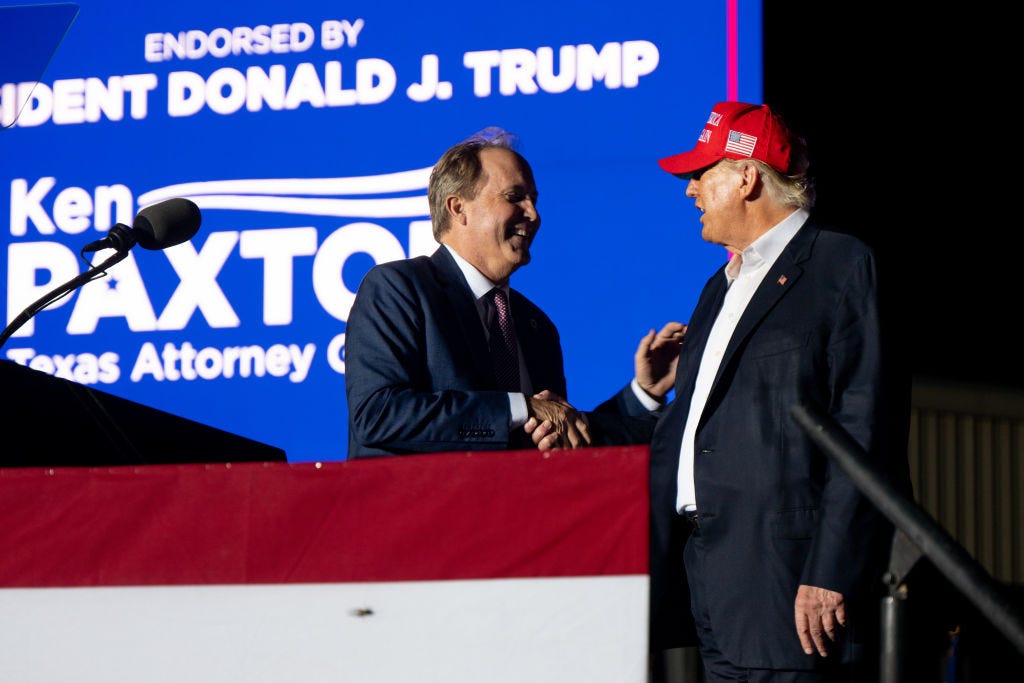
UPDATE: Ken Paxton beat John Cornyn by 28 points (!) in the Texas runoff, a margin that looks straight out of the Knicks’ demolition of the Cleveland Cavaliers.
In all seriousness, it’s quite momentous to see an incumbent senator lose by this wide a margin, and it tells you everything you need to know about Trump’s continuing stranglehold on the GOP.
I’ll probably have some additional quick thoughts for you on the race tomorrow (Thursday). In the meantime, this analysis from Eli and me over the weekend should provide a pretty good preview of the general election in Texas. I haven’t changed any of the text below as a Paxton win is the outcome we were expecting (though maybe not by quite so large a margin).
Two other quick things to also alert you to:
The World Series of Poker started yesterday — I’m out here in Vegas for a week or so — so I’ve updated my annual guide with several sections of new material.
And as we’re getting toward the end of the month, SBSQ needs to publish soon also. You can submit your questions in the comments to SBSQ #31. -NS 5/27/26
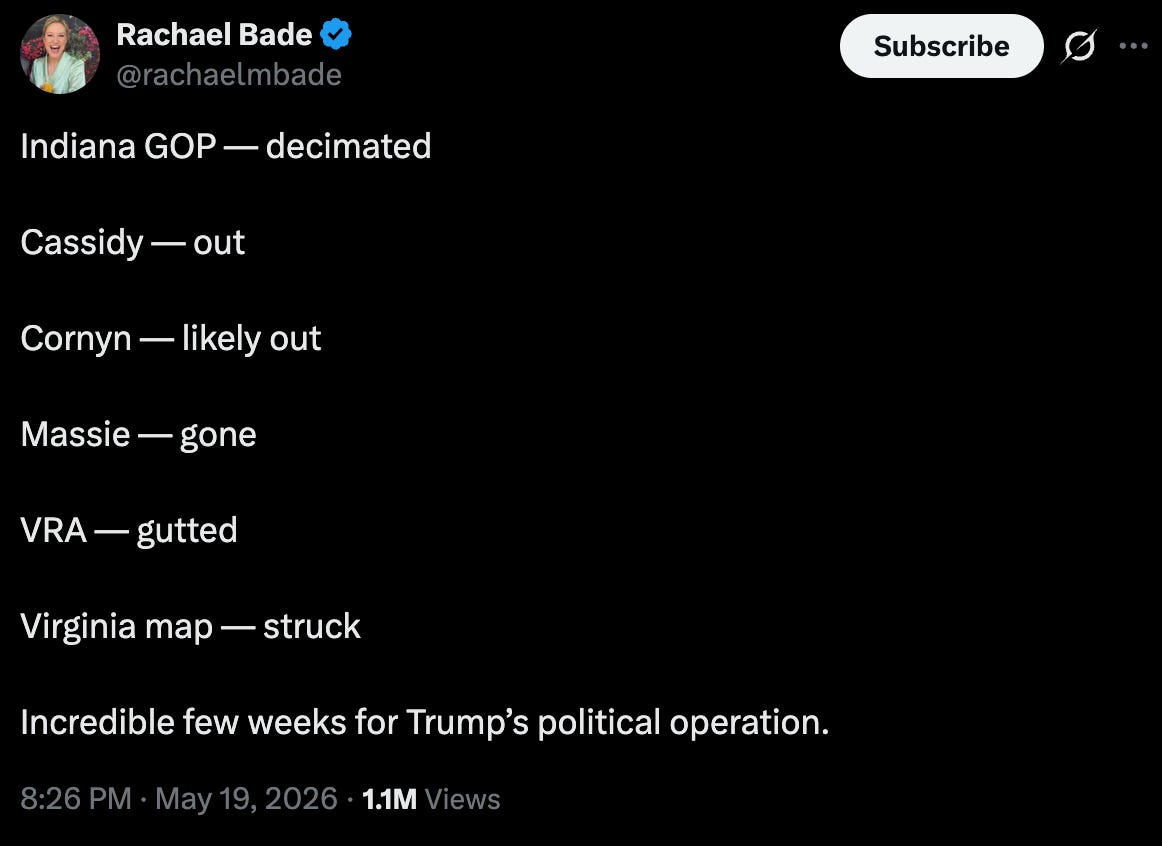
From a certain vantage point, you can argue that May has been an “incredible few weeks for Trump’s political operation,” as the journalist Rachel Bade recently did. Bade cited redistricting wins for Republicans in Virginia and at the Supreme Court, and the ousting of a series of Trump-skeptical Republican incumbents — like Bill Cassidy of Louisiana and Thomas Massie of Kentucky — in Republican primaries this month.
Trump may add another notch to his belt on Tuesday in Texas, when Republicans will go to the polls in the runoff of the U.S. Senate primary between incumbent John Cornyn and state attorney general Ken Paxton, whom Trump just endorsed.
But rest assured, readers: this is not our perspective here at Silver Bulletin. Here’s a good rule of thumb to understand why: if Nancy Pelosi somehow did a Freaky Friday-style body swap with Trump, would she have handled this Texas endorsement any differently?
Last time we wrote about the Republican Senate race in Texas, Cornyn was trailing the scandal-plagued Paxton in primary polls. We said the one thing that would give Cornyn a shot at frontrunner status was an endorsement from Trump. Instead, in a move reminiscent of the New York Times’s co-endorsement of Amy Klobuchar and Elizabeth Warren in the 2020 Democratic primaries1, Trump endorsed all three Republican candidates. You could call that a nice gesture — and an understandable one because Trump featured prominently on all of their campaign websites. But it of course defeated the entire purpose of an endorsement as an informative signal.
Cornyn outperformed his polls even without Trump’s help and narrowly won a plurality of votes in the primary. But that wasn’t enough to avoid a runoff. So Republicans were staring down the barrel of nearly three more months of an already nasty race between Paxton and Cornyn before they could pivot to the general. To make matters worse, Jasmine Crockett — Republicans’ preferred candidate — lost the Democratic primary to James Talarico.
Let’s remind you of the stakes here. Democrats need to pick up four seats to flip the Senate in November. The comparatively easy pickups are in Maine, where the state’s increasingly blue lean might be enough to overcome both Susan Collins’s track record and Graham Platner’s controversial past, and in North Carolina, a purple-ish state which prediction markets say is more likely than not to turn blue thanks to a strong Democratic nominee in former governor Roy Cooper.
After that, things get harder. Democrats have fighting chances elsewhere, but are no better than a toss-up in any other contest. And one more pickup is not enough: they have to win at least two seats on top of Maine and North Carolina. Putting Texas in play would make for a lot more winning combinations.
So something had to be done, as Republicans were fully aware. Trump jumped into action with the promise of a quick endorsement of one of the two primary survivors and strong encouragement that the non-endorsee should drop out:
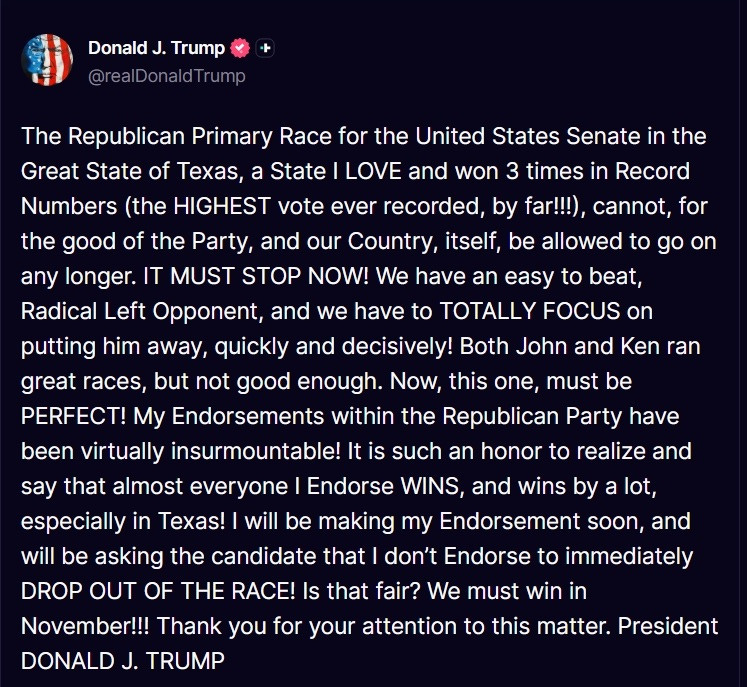
Although that Truth Social post played its cards close to the vest, reporting at the time indicated that Trump was leaning toward endorsing Cornyn. We don’t say this too often about Trump, but tactically, that seemed like a good call. Cornyn is probably the better general election candidate, and not just because he’s the incumbent.
So what happened? Whether out of frustration that his plan to back Cornyn leaked or because of his usual instincts to improvise, Trump’s speedy endorsement never materialized. The March 17 deadline for one of the two candidates to remove their name from the ballot came and went, and after maneuvering from both sides, it looked like Trump might not endorse anyone. “The impact of him staying out of the race, I think, has been unfortunate because now we’ve spent tens and tens of millions of dollars in a competitive US Senate seat in Texas that could’ve otherwise be used for competitive House seats … against Democrats in the fall,” Texas Republican House member Nathaniel Moran told CNN.
But on Tuesday, Trump finally did endorse Paxton, whom he called a “true MAGA Warrior.” Paxton had already been a slight favorite in prediction markets, but his chances shot up from 60 percent to 95 percent following the news.
Anyone surprised by the flip-flop between Cornyn and Paxton either hasn’t been paying attention to Trump’s previous endorsements or is too plugged in to Beltway inside baseball. The most basic take here is that Trump seems to have questionable taste in candidates. Just like with Herschel Walker in 2022, he chose the loyal but scandal-plagued over the safe “establishment” option.
Is Texas truly a toss-up?
In previous cycles, these Trump-backed candidates have seriously underperformed. And Trump’s endorsement of Paxton comes at a time when Trump’s political standing is probably at its all-time low: he’s at a net -19.3 in our approval rating tracker, the worst rating for any president at this point in a nonconsecutive term.2
To level-set here: the Texas general election contest is the proverbial case of a rock meeting a hard place. It’s a very red state, having repeatedly defied Democrats’ wishes to “Turn Texas Blue”. It’s the kind of place that has survived blue waves, like in 2018, when Ted Cruz was just far enough ashore to beat Beto O’Rourke by 2.7 points.