

America used to be exceptionally patriotic. Now we're below average.
Most Americans still love their country, but patriotism is in sharp decline.


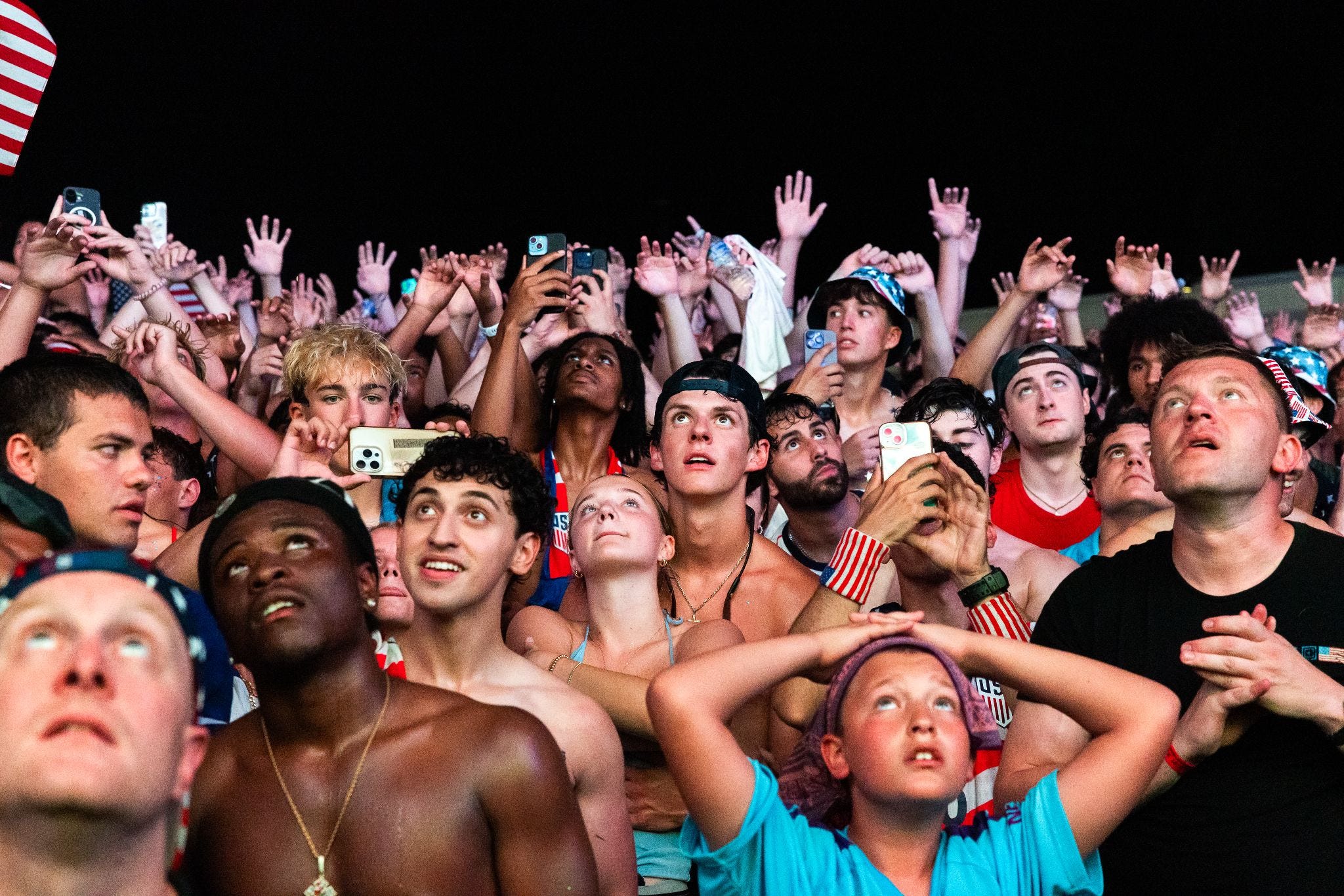
I’m going to admit to feeling a swell of patriotic pride after the U.S. beat Bosnia-Herzegovina 2-0 on Wednesday.1 Maybe it was a protective reaction after the bullshit red card the referee gave Folarin Balogun. Or maybe it was the juxtaposition of everyone singing along to “Country Roads”2 in the middle of Silicon Valley, not necessarily considered the most patriotic place in America.3
So congratulations to the United States on its 250th birthday, which the country will celebrate tomorrow. It’s really quite an accomplishment if you’ve spent any time studying the rise and decline of empires. And I hope you’ll have a fun and restful July 4 weekend, readers. I very much don’t want to rain on the parade. I’m also relatively optimistic about the future of the country. I’m a big defender of the complicated national project we’ve undertaken over the past two-and-a-half centuries. I love the United States, and I’m pretty sure I’ll be here for the rest of my life.
However, an increasing number of Americans don’t agree with me, to a degree that I found frankly surprising. We assigned this story to Eli in our weekly planning meeting, and I expected the data to show that, while American patriotism had declined, it remained relatively high as compared to the rest of the world. Some informative content that was a little on the lighter side, if we’re being frank.
But that isn’t the case. Compared to most countries, we’re now a little below average in patriotism.
So I just wanted to let you know where we’re coming from. Our goal here at Silver Bulletin is to evaluate public opinion for what it is, not to reflect our personal views every time we analyze the polls. (And even if we don’t necessarily agree, we understand why an increasing number of Americans feel ambivalent about the United States.) I thought this was a better way to approach the occasion than a hot take from yours truly. –Nate Silver
What the polls say about patriotism
By Eli McKown-Dawson
“It was a grand day for the Bicentennial parade in the nation’s capital today, and it was a grand parade celebrating the diversity that is America.” That’s how The New York Times described America’s bicentennial celebration in 1976. The parade drew 500,000 people and featured Johnny Cash as the Grand Marshal. Our 200th anniversary also included a Grand Parade of Sailing Ships in NYC and a tour of the country by Queen Elizabeth II. When Gallup asked Americans in June of that year how much we had “succeeded over these 200 years in achieving the ideals for which this country was founded,” 77 percent answered either a great deal or a fair amount.
The vibes aren’t anywhere near that good for our semiquincentennial. The Great American State Fair has had problems with power outages and crowd sizes — and the celebration in general has a decidedly partisan flavor. Many of this year’s events are being put on by Freedom 250, a Trump-backed public-private partnership.4 The president also promised to “make a really long speech” before the fireworks begin in DC.
Being mad about the Great American State Fair is something we’d be tempted to characterize as “very online” behavior. But increasing skepticism about the United States isn’t just an online sentiment. In 2004, Gallup found that 69 percent of U.S. adults were “extremely proud” to be an American. The fourth wave of the World Values Survey (WVS) also ended that year and showed that a similar 71 percent of Americans were “very proud” to be American. Fast forward to 2026, and just 33 percent of adults are extremely proud to be American, according to Gallup, while the latest WVS wave showed an only slightly higher 46 percent in 2022.
To be fair, as Natalie Jackson pointed out earlier this week, the Gallup write-up only focused on the “very” or “extremely” proud categories. Some 75 percent of U.S. adults are at least “moderately” proud to be American, according to its data, a figure in line with other polls from YouGov and Fox News. Anti-American sentiment isn’t likely to be a winning argument, even in Democratic primaries, let alone in general elections.
How American pride compares to the rest of the world
Still, there has been a real decline in patriotism that I don’t think we should discount. Historically, American pride was somewhat exceptional when compared to other countries, so much so that the American tourist who slaps an American flag on everything is a common trope. Have smaller countries — particularly those in Latin America, the Middle East, and parts of Asia — always topped the patriotism charts? Absolutely. In the latest WVS wave, 97 percent of Jordanians were “very proud” or “quite proud” of their nationality, while 92 percent of Venezuelans and Colombians felt the same.
But we used to hang with that crowd. In the first WVS wave, concluded in 1984, 95 percent of Americans were very or quite proud of their nationality. That figure was higher than the average share in Latin America (83 percent) and much higher than the European average of 77 percent. Throughout the late 20th century, the U.S. was a patriotic outlier compared to other large developed nations and our peers in Western Europe. Just 19 percent of Germans and 32 percent of French people were very proud of their nationality in the 1993 WVS wave, compared to 74 percent of Americans.
Fast forward to 2022, and “just” 78 percent of Americans were very proud or quite proud of their nationality; that’s a 17-point drop since the 1980s and lower than the 2022 European average of 81 percent. People in Asia, Latin America, Africa, and the Middle East are hovering closer to 90 percent pride, on average. While other regions’ national pride has held steady or increased, ours has fallen.5
It isn’t just the smaller countries either, which arguably have more national cohesion. Let’s pare down the WVS dataset to countries that have populations of at least 100 million or that are OECD members. We’ll create a “pride-o-meter” score for each country from 0 to 100 based on the four categories of responses.
You have to scroll down to the third page to find the United States. We’re 34th out of 45 qualifying countries. Americans are now no more proud of their country than Brits.6
Yes, patriotism is becoming more partisan
That decline in pride has happened across the board, but it’s been most pronounced among Democrats, particularly since Trump entered the political scene. To level-set, majorities of Republicans (96 percent), independents (59 percent), and Democrats (58 percent) are still proud to be Americans, according to YouGov. But when it comes to more intensive national pride, Democrats are nowhere near where they used to be.
During George W. Bush’s second term, an average of 58 percent of Democrats were extremely proud to be American according to Gallup, as was an identical share of independents — though Republicans were higher. The rough parity between Democrats and independents lasted through Barack Obama’s second term, but the share of extremely proud Democrats fell to an average of 30 percent during Trump’s first term and was just 14 percent in the most recent Gallup poll.
Although Republicans are generally more patriotic, their opinions can shift based on who occupies 1600 Pennsylvania Avenue too. The share of Republicans extremely proud to be American fell from 79 percent on average during Bush’s second term to 60 percent during Biden’s term. What happened after Trump retook office? It jumped right back up to 74 percent.
But did Democrats’ numbers bounce back under President Biden after Trump’s first term? Nope. They held steady at 30 percent. Some of this is probably attributable to changing attitudes about the nation’s founding and subsequent history that accompanied the Black Lives Matter movement.
Still, Trump seems to be the bigger story here, and perhaps even caused a permanent shift in attitudes. Echelon Insights recently polled Americans about “conditional patriotism” and found that 49 percent of Democrats agreed with the statement “how patriotic I feel depends on who is in power and current government policies.” The figure for Republicans was 18 percent.
Perhaps it’s rational that our pride advantage over other nations has evaporated. We’re still the world’s largest economy, but we’re not as clearly dominant across the board as we were in the ‘80s and ‘90s. The growth in American life expectancy has stagnated. And the U.S. is no longer as democratic as it once was, according to various democracy indices, even if we’d debate the notion that the country has passed some tipping point.
Still, a shared belief in the American project once served as a hedge against the “alternate domination of one faction over another, sharpened by the spirit of revenge,” as Washington put it. These days, even the joint gold medals by the U.S. men’s and women’s hockey teams at the Milan Olympics devolved into some indecipherable partisan argument.
Maybe if we win the World Cup? It’s not likely, granted. But at this point, a return to America being a profoundly patriotic country is probably a long shot too.
I was lucky enough to attend the match. I had a meeting in Silicon Valley the next day. You think I wasn’t going to go?
More formally, “Take Me Home, Country Roads.” It’s a great song, and although it might seem conservative-coded, John Denver was very much a lib.
But maybe that’s the wrong conception. Silicon Valley is still the American frontier in many ways, and it attracts a lot of immigrants from all around the world. And frontier spirit is a very American characteristic.
To be clear, I’m not bashing Freedom 250. In fact, I’m morbidly excited about their Patriot Games, an athletic competition between one male and one female high school student from each state that you have to imagine was dreamed up by a huge Hunger Games fan.
The WVS also shows a drop in Canadian pride, albeit a smaller one, between 1984 and 2022. But more recent polls show that trend reversing now that Trump is back in office.
Although we still have bipartisan national pride over air conditioning.
I'm 78 and thus remember our 200th Birthday in 1976 very well when I was 28. The overall tone of the country was radically different then, and not because all was perfect.
Nixon had resigned in disgrace just two years earlier, and the US final exit from Vietnam had ended with the debacle of helicopters pulling the last troops off our Embassy roof just one year earlier.
AND YET almost everyone was joyous, with celebrations in every city and state.
Not so today. I blame both the MSM AND our education system, who emphasize every fault of America while minimizing all of the ENORMOUS positives of our great country.
I can’t do much to change the median or mode, but BY GOD I will do what I can to change the mean. (And that’s with full acknowledgment of our failings. Even with those failings, our potential is IMMENSE.)