


It’s safe to say that this has been a weird NFL season.
Before the year began, Vegas odds posited what were essentially six Super Bowl co-favorites: in alphabetical order, the Bills, Chiefs, Eagles, Lions, Packers and Ravens. Let’s throw in the Commanders here too, since they had the next-best odds and played for the NFC Championship last season.
Of those seven teams, only three even made the playoffs. And only one, the Eagles, is hosting a playoff game this weekend.
True, the standings might have been upended if a few balls had bounced differently. The Chiefs were 1-9 (!) in games decided by seven points or fewer after having been 10-0 (!!) in those games last season. Conversely, the Broncos were 1-6 in such games last season — but 9-2 this year. And that’s before getting into untimely injuries.
ELWAY, the new NFL model that we launched early in the season, didn’t necessarily have a lot of hot takes that bucked the consensus — but it wasn’t a great year for the consensus. Nevertheless, we think ELWAY can offer some real insight on the postseason. By being plugged into QBERT, it recognizes how much of a difference Drake Maye has made for the Patriots, for instance. It can account for the impact of injuries — a big deal in the case of the 49ers, Chargers and Packers — and has more detailed calculations than other systems about the effects of weather, home-field advantage and rest.
And because ELWAY ratings change iteratively over the course of the season, it can weigh preseason expectations — which still matter in a sport where the season is just 17 games long — against who’s coming into the playoffs hot. So here’s how each playoff team’s ELWAY rating has evolved over the course of the year:
(For a more detailed version with non-playoff teams included, see the ELWAY landing page.)
ELWAY started out the year skeptical of the Jaguars, but it has since considerably revised its view of Trevor Lawrence and the rest of the team. The Seahawks and Patriots basically kept looking better and better over the course of the season — and that had been true for the Rams too, until they scuffled a bit in the final few weeks.
Other teams, like the Eagles and Bills, are basically what ELWAY thought they were, though it’s more bearish on both teams than other systems. Speaking of the Bears, ELWAY still stubbornly insists they’re a slightly below-average team, which reflects a combination of lingering preseason skepticism and a defense that gave up 6.0 yards per play, tied for third-worst in the league.
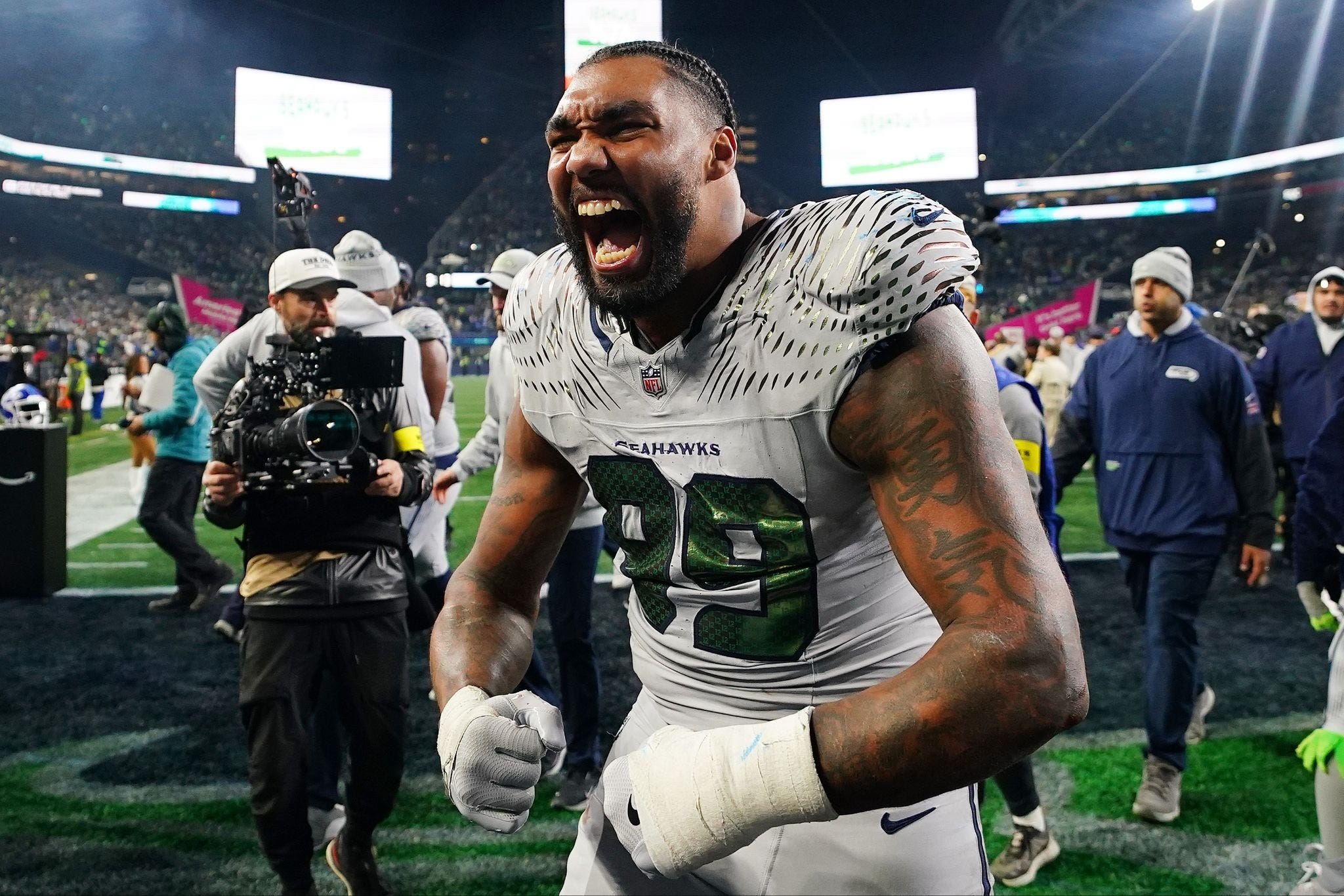
But to answer the question in the headline, who is the Super Bowl frontrunner? (There’s no “favorite” per se since every team’s chances are well below 50 percent.) Well, the photo gives it away: it’s Seattle. But I have a lot more detail for you on how all of this works, with a capsule summary considering the strengths and weaknesses for every remaining team.
The version of the team ratings you see in that pretty chart above doesn’t account for quarterback and injury adjustments, whereas ELWAY’s simulations do. So let’s take at those. Non-QB injuries are often neglected by casual fans, but they go a long way in differentiating positive and negative surprises.
The way ELWAY works, basically every team gets points marked off for injuries. (Our model also accounts for mid-season trades, which can have either a positive or negative impact.) But it’s the relative impact that matters. In the table, the injury/trade adjustment is tantamount to a point spread: the Seahawks project to be only 0.5 points per game worse than if they’d had their entire preseason roster healthy. Other positive surprises like year like the Broncos and Jaguars are also notably healthy.
For the Packers and Chargers, however, injuries take about 4 points off their rating per game. Usually, a team like that is going to struggle to make the playoffs at all: look what happened to the Lions. The 49ers are also coming into the playoffs in poor shape.
One more chart before we roll through the teams. I’ll admit this one is a little busy, but it gets at something critical in a 17-game regular season: the role of skill versus luck.
The Bears had a +22 turnover differential this season, which is highly impressive given that teams are much stingier about turning the ball over than they once were. (The New York Jets literally didn’t have a defensive interception this year.) There is, however, a large body of research suggesting that turnovers are mostly a matter of luck, especially on the defensive side of the ball. Efficiency data — things like yards scored and allowed per play, completions and first downs — tends to have more predictive power. Sacks are a more persistent indicator than turnovers, too.
Four of the 14 playoff teams actually allowed more yards per play than they realized themselves, whereas the Seahawks’ differential was the best in the league. ELWAY’s formulas for calculating all this stuff are somewhat more complex than what I’ve shown above — but the chart gets the basic idea across. An advantage built from a positive turnover differential may be a house of cards.
OK, then, let’s run through the 14 teams who are lucky enough to still be playing football, listed in ascending order of their ELWAY Super Bowl odds.