

The Bucks traded Giannis too late
The deal is "ehh, fine" for both Miami and Milwaukee. But Giannis to Boston would have had a seismic effect on the league.

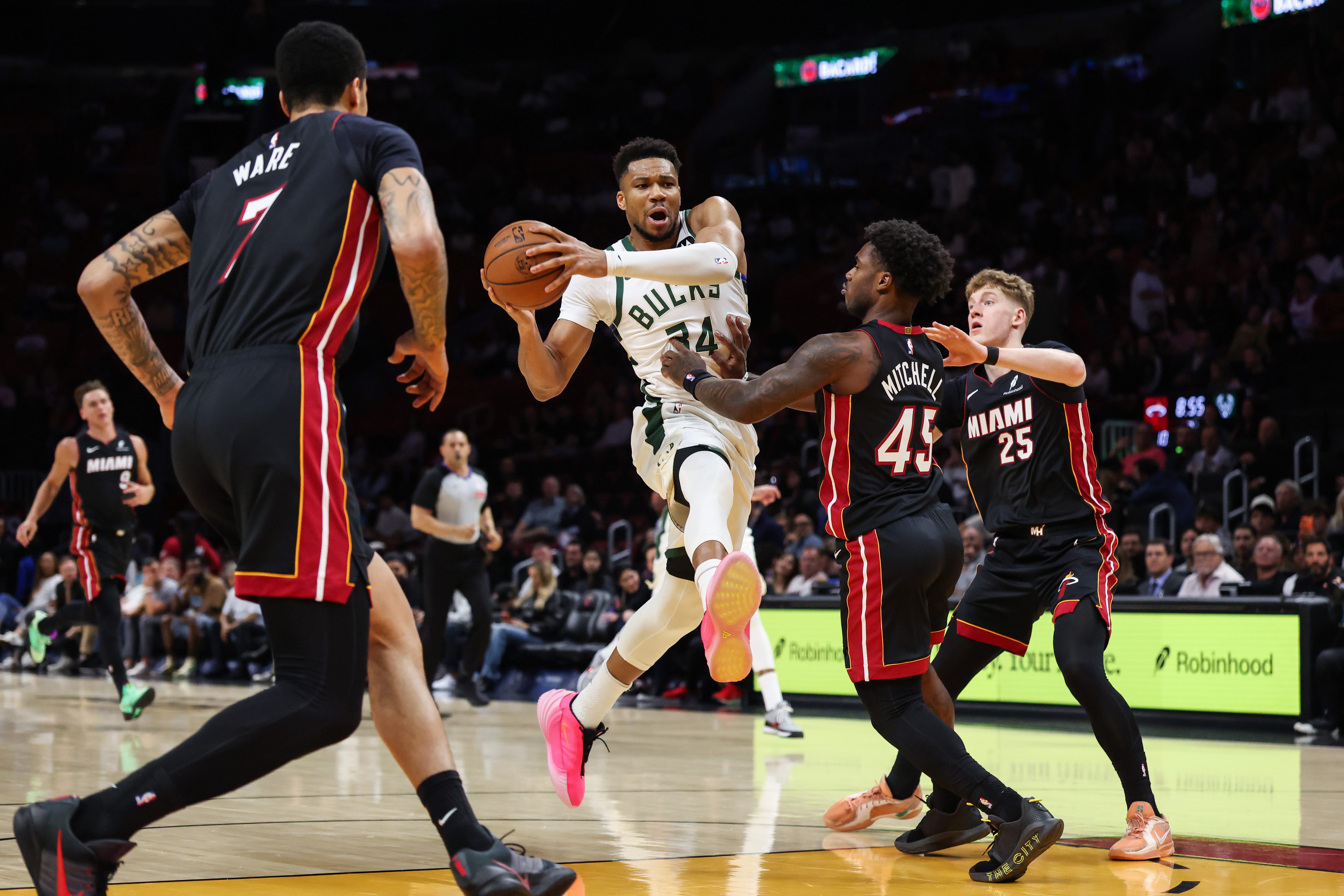
After years of build-up, the Giannis Antetokounmpo trade saga drew to a close Monday night, with the Bucks’ franchise legend heading to Miami. Per various reports, Milwaukee spent the afternoon weighing two offers: a Celtics package fronted by some variation of Jaylen Brown and draft capital, and the Heat bid that ultimately won out.
They ended up shipping Antetokounmpo and Bobby Portis for Tyler Herro, Kel’el Ware, Jaime Jaquez Jr., Kasparas Jakucionis, three first-round picks, a pick swap, and a second-rounder. Jon Horst and the rest of the front office chose flexibility over a win-now star, taking a stockpile of capital to build the next era of Bucks basketball around upcoming talent rather than an established veteran.
There are more than a few angles to discuss here. But the trade also feels like an anticlimax, as Giannis’s star has dimmed from consensus top-3 player to a guy who might need to be paired with another star or an outstanding core of complementary players to compete for a title.
Milwaukee fumbled a golden opportunity
It’d be hard not to feel a little disappointed if you’re a Bucks fan. None of the players they received have real All-NBA upside, and the pick they acquired in this year’s draft landed outside the top ten, leaving them with one of the draft’s more polarizing players in Nate Ament. They did pick up Miami’s 2031 and 2033 first-rounders, which could become valuable assets down the line, especially with the league’s new lottery system.
Trading players when they can fetch the most value is optimal portfolio management — though “selling high” is difficult for any number of reasons. Still, the Bucks getting cold feet more than a few times over the last few years has cost them some potential assets. For what it’s worth, despite my own projection that Giannis would regress, he looked very good in the half-season that he played this year — but not quite good enough for his value as an asset to catch up to his age and injury concerns.
While not everyone inherently trusts the advanced stats, Giannis’ defensive EPM tracks with consensus opinion here. He won Defensive Player of the Year in 2020, also his best season according to EPM. But he hasn’t made an All-Defensive team since 2022. The pattern is typical of aging players, who sometimes hide the decline with less effort on the defensive end while maintaining the same “box score stats”. It’s not much of a decline on a per-minute basis, though, and any player with Giannis’s geometry is going to be severely disruptive at the rim. The question is availability.
Giannis is also on the last year of an expiring contract with a player option — he’ll almost certainly opt out and fetch more money — which gave him leverage on his trade destination. According to reports, he narrowed his own preferences down to Boston, Miami, and strangely, Minnesota (which wound up having other ideas up its sleeve.) None of those teams could put together the world-beating packages you would expect for a top five player in the league.
Still, the absence of asset-rich teams like the Spurs, Rockets and Thunder from the conversation should be noted. If the mock trades from a year ago were anything close to Giannis’ true value in the moment, the Bucks missed out on a chance to land a real cornerstone. Most of the Bucks’ conversations stayed behind closed doors, so the rumored packages deserve a healthy dose of scrutiny. Still, if there was a deal on the table headlined by a genuine young building block, like Stephon Castle, plus the usual draft capital, it would exceed what they ended up with this year.
Or there was another possibility: the Mavericks reportedly offered Luka Doncic for Giannis. Perhaps that rumor was a bit of ass-covering for Nico Harrison, whose process in trading Luka to the Lakers was secretive. But let’s say they made that trade. It’s possible Luka wouldn’t have wanted to stick in Milwaukee long-term. They’d still have held his Bird rights and been able to offer the most years and money of any team, so he’d likely have been in a sign-and-trade of some sort. Could they have fetched a better package for him than they just received from the Heat? Both Luka and Giannis have injury concerns and fit issues with teams not specifically designed around them, but Luka is four years younger, and is probably the better asset as of this moment both in theory and in practice.
By now some of our Wisconsin readers — there are 2,763 of you — are probably itching to change the subject. Forget about what the Bucks should have done. What happens now? Well, the trade package isn’t so bad. As I mentioned, the Heat attached their 2031 and 2033 first rounders, which are more valuable under the new lottery system (teams can no longer just win enough games to avoid conceding a good pick), and the young talent they received is enough to be tentatively excited about. They retain Ryan Rollins, who made a sneaky run at the Most Improved Player award last season, and Kel’el Ware is an intriguing player who was buried on the Heat’s bench for unclear reasons.
Granted, if you're a Bucks fan, supporting a team that's openly rebuilding without control of its own future first-round picks might feel a little strange. There are ways out of it, but they'll take a kind of patience you may not be used to. The last time the Bucks missed the playoffs for two seasons in a row was actually before Giannis got drafted. Barring any further moves, it’s likely that streak is broken this upcoming season.
Miami gets the better of Boston again — or did they?
After their many playoff battles, it was only fitting that Miami foiled Boston’s plans to retake control of the Eastern Conference. It’s hard to say, though, that either team is in a significantly better place after the trade had settled.
On the surface, Miami’s roster doesn’t suggest championship contention. The pairing of Bam and Giannis is fine, on both ends, but the rest of Miami’s roster has been stripped down to its bones. They can try to resign Norman Powell on a cheaper deal — it looks unlikely at the moment — and fill in the rest of their roster with minimum contracts, but does that team compete with the Knicks, Celtics, Pistons, or even the Pacers1 next season?
I’m inclined to say no, but that doesn’t mean that they overpaid. Some of my favorite pieces to write at Silver Bulletin are our semi-annual Future of the Franchise rankings, particularly because they help us frame transactions in terms of championship equity. Does Giannis give the Heat enough championship equity to justify mortgaging their future? It’s certainly possible. Something I’ve learned to not underrate is the value of short-term championship equity.
The Heat could lose in the playoffs next season, but all they really need is one or two strong runs over the next four years, barring major injuries to Giannis or Bam. And the league’s Collective Bargaining Agreement is on their side here: the hardest thing to acquire in today’s NBA is a cornerstone, not the role players around one. It’s more or less impossible to sign your way to a top-five player, while rotation pieces, by contrast, are a renewable resource — minimums, the mid-level, veterans chasing a ring all present affordable options.
The bull case for Miami doesn’t rest on this roster beating New York next May. It’s that they’ve already cleared the highest hurdle and the CBA makes everything downstream of that much cheaper to solve for a front office in a desirable market that tends to make strong moves on the margin.
Still, the clock is ticking. “Barring injuries” is not something to just gloss over — after all, it was baked into Giannis’ trade value. The trade reminds me a bit of the Kevin Garnett sweepstakes in 2007 — the Celtics traded a lot of their middling depth for the aging superstar and ended up winning a championship, with Garnett playing 71 games for the terrific 2008 team. By 2009, Garnett was already dealing with major knee injuries that would speed up his decline. If the “Big Three” hadn’t won a ring together, would the trade be considered as much of a win? Still, that’s somewhere in the vicinity of a favorable precedent for this deal.
Of course, Giannis has proven to be more durable in form than Garnett was at the same age, but he hasn’t finished a season truly healthy since 2022. This isn’t very surprising for a player over the age of thirty.
Heat fans might have to adjust their expectations. This team probably isn’t going to compete for the #1 seed even if they have decent health next season.
Still, it’s worth noting that the Heat often outplay the sum of their parts. With Erik Spoelstra on their bench, and a group of scrappy veterans, it’s not impossible they can make some noise next year, even if they don’t end up winning the championship. If you’re a Heat fan, that would obviously be a better outcome than the play-in disappointments of the last few years.
The Jaylen Brown sweepstakes begin?
Even if the Giannis trade makes the Heat competitive again, the rest of the league should be breathing a collective sigh of relief that the Celtics couldn't pull off their attempted heist of the Bucks. I know Jaylen Brown just made an All-NBA team, but swapping him and Giannis for only two additional picks would have been highway robbery.
Had the trade gone through, the Eastern Conference landscape would have shifted drastically in favor of the Celtics, especially given the depth they have to surround a star like Giannis. Luckily for the rest of the league, the Celtics are now in a somewhat weird spot — Brown can’t be happy that Boston so openly tried to offload him after a career year, and it looks like they’ll be taking calls for him.
I don’t love to speculate on future transactions, but I’d be surprised if he’s still on Boston’s roster to start next season. The market for Brown is sort of ambiguous at the moment, though. It seems like Milwaukee’s biggest concern in trading for him was a worry that he would demand a trade elsewhere, not that he wasn’t an appropriate talent return, so there may be interest around the league.
If Brown really does have a top fifteen trade value, like Bill Simmons ranked him back in February, then the offers should be steep. Depending on the front office making the trade, it seems plausible he could be valued at a very high price, even if most of the advanced metrics consider him as a solid starter at best. Brown had a career year, sure, but inflated per-game numbers without a matching jump in the advanced metrics is about as clean a sell-high window as you’ll find.
Why is Brown not liked by impact metrics? Well, he’s a fine scorer on high volume, but his passing doesn’t match his overall offensive load while he averages more turnovers than you would expect for someone of his archetype. Even with his scoring getting directionally better, there are clear ceilings on what he can do in a lead role. On defense, he has the reputation as a two-way player but has regressed into more of a one-way, efficient-but-not-super-efficient shot creator. Of course, trade value and impact metrics can differ. Shot creators are scarce in the NBA, especially after Brown demonstrated he could carry a high usage rate. Ultimately, I would expect Brown to be moved for at least a credible package of capital — at least two firsts and/or a younger player with upside — even if his impact estimate doesn’t justify it.
The Timberwolves just made the best move of the summer so far
The Giannis trade dominated the news cycle, but a few moves flew under the radar this week, most of all the Timberwolves’ offloading of Julius Randle. The trade was made to open up financial flexibility for an Ayo Dosunmu extension — a pretty large overpay in my opinion — but left room for further moves. It was rumored that the Timberwolves tried to trade for Derrick White, but were turned down shortly before the Giannis negotiations hit their peak.
As it turns out, those further moves came fast. With rumblings about Anthony Edwards’ reported unhappiness clearly weighing on the front office, Minnesota pulled the trigger on the real blockbuster: LaMelo Ball (plus Josh Green) for Naz Reid, a 2033 unprotected first, three first-round swaps, and a bundle of seconds. As a LaMelo Ball fan (although I can admit he has some flaws, both as a player and an off-court personality), I think this is an very solid gamble for the Wolves — and a case where it pays to be long volatility given the high bar established by the Spurs and Thunder in the West.
It’s a weird move for Charlotte. LaMelo is the engine of their offense, and the Hornets were one of the best teams in the league over the second half of the season, but perhaps they have doubts about his injury history or his place as a franchise cornerstone.
Still, the return isn’t amazing when compared to LaMelo’s overall impact2. It’s not certain that any of those swaps would convey — the Hornets are probably going to be worse than the Timberwolves for a while — and Naz Reid is a fine player, but nowhere close to LaMelo as a ceiling raiser. The bet is mostly that either LaMelo will be injured or Anthony Edwards demands a trade, which would let one of those swaps actually land in the lottery. I feel this isn’t a basketball bet so much as a bet against Minnesota’s stability, which could be plus-EV in terms of pure championship equity (assuming LaMelo can’t recreate his past season elsewhere) but additional years of struggle for a franchise that last made the playoffs a decade ago.
The rest of the league is still reacting to this past season’s playoffs, which appear to have created something of an arm’s-race as teams adjust to the talent level now required to compete for a championship.3 Most front offices haven’t fully tipped their hand yet, but the Giannis and LaMelo deals suggest that more dominoes will fall in the coming weeks, and that the order in both conferences could look fairly different by the time they do.
The editor of this story, Nate, does not necessarily endorse Joseph’s optimistic take about the Pacers.
He’s seventh in the league in expected EPM.
Nate jumping in with a spare Knicks-centric thought here. The lesson of these playoffs is a bit weird given that, on the one hand, the Spurs and Thunder are setting an incredibly high bar — but on the other hand, the Knicks’ model of having B+ talent but A+ chemistry could be a tempting path for some teams too. The Knicks’ rebuild took years to come together and careful planning, though — rather than through panic because the status quo wasn’t working. —NS
Spot on piece. As I’ve mentioned previously here, I’m as big a C’s fan as there is - have been going back to the late Cousy days. JB is a fine player, but he should never, ever be mentioned among the league’s elite. The Celtics will move him eventually because it will be extremely hard for them to win with him and JT in max slots, particularly with JT coming off the Achilles, which if nothing else will result in fewer minutes. As for Milwaukee, easy for me to say, but after giving the title team a year to defend, they should have pivoted by moving Jrue and Middleton or Lopez, restocking the assets account. Giannis would have been pissed, but they could have explained that they wanted him to have a title shot for the entirety of his career, not one or two years.
Other than the collective bargaining agreement paragraph—which is clear and useful—I found this a frustrating post that can't decide if the glass is half-full or half-empty.
The headline claim, that the Bucks failed to sell high, is immediately undercut by the post's own caveats: the "prices" here are strategically leaked quotes, not fills. The asset is enormous and indivisible, the market is thin, and most of those rumored packages were floated by teams and agents with a reason to move the market—the author even flags the Luka offer as possible ass-covering for Harrison, then turns around and marks Giannis to exactly that kind of rumor. You can't sell high into a bid you were never going to be able to hit. Scoring the Bucks against a quote nobody could transact on is hindsight dressed as portfolio discipline.
Then, a few sections later, the opposite error: Jaylen Brown is "about as clean a sell-high window as you'll find"—immediately contradicted by the claim that his trade value can exceed his impact metrics because shot creation is scarce. Those can't both carry weight. The sell-high call needs the box score to be a mirage the market will overpay for; the scarcity hedge needs it not to be. The author commits to both answers in adjacent paragraphs.
The LaMelo Ball section is backwards—Minnesota is short vol in the deal, not long. They sold a put on their own performance to Charlotte via the swaps and the unprotected 2033 pick. They may well increase their expected wins, but the protection they gave away pays off worst in exactly the state where they'd most want their own picks back: the swaps convey precisely when Edwards bolts or LaMelo breaks down or the season otherwise craters. That's not diversifying variance, it's stacking it. The "long volatility" position here belongs to Charlotte.
Finally, the Garnett section is outcome-based analysis in an otherwise process-oriented column. It's a sample of one—selected on the fact that it won, which is the very reasoning the author flags as suspect one sentence later—and it highlights that fact. Where's the analysis of the aging-star-for-depth deals that cratered?