


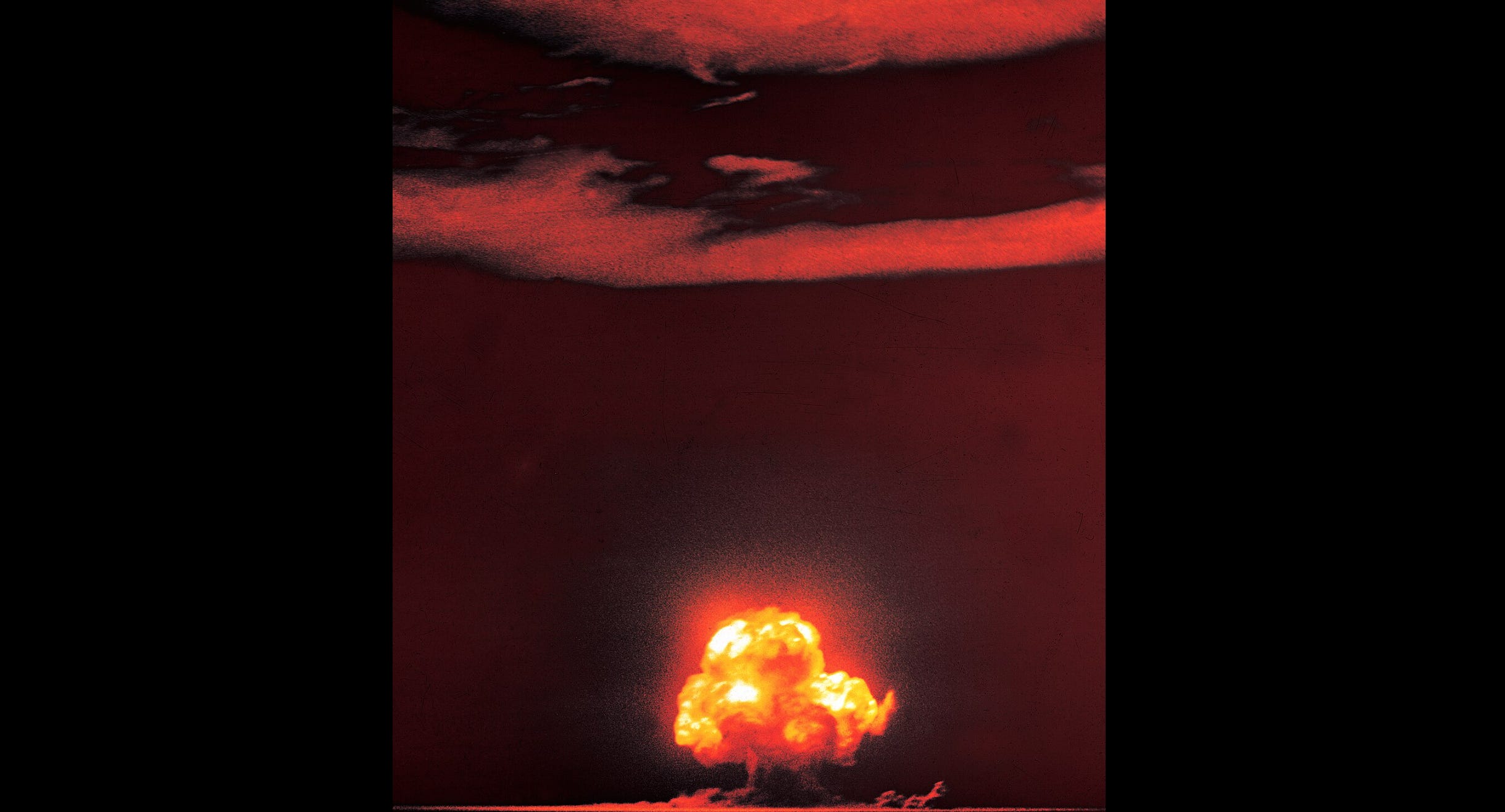
I’m not super eager to talk about military strategy as opposed to the political implications of the war with Iran. But as someone with some expertise in strategy and game theory generally, I suppose I’d like to make a quick point here.
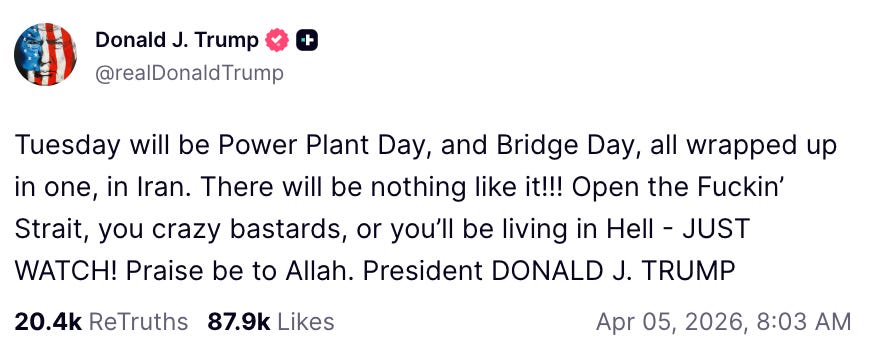
Over the past few days, President Trump had been making some extremely escalatory threats toward Iran. On Easter Sunday at 8 a.m., he wrote the following on Truth Social:
And then on Tuesday morning, Trump doubled down, claiming that “a whole civilization will die tonight” if Iran didn’t make some effort to reopen the Strait of Hormuz by 8 p.m. last night:
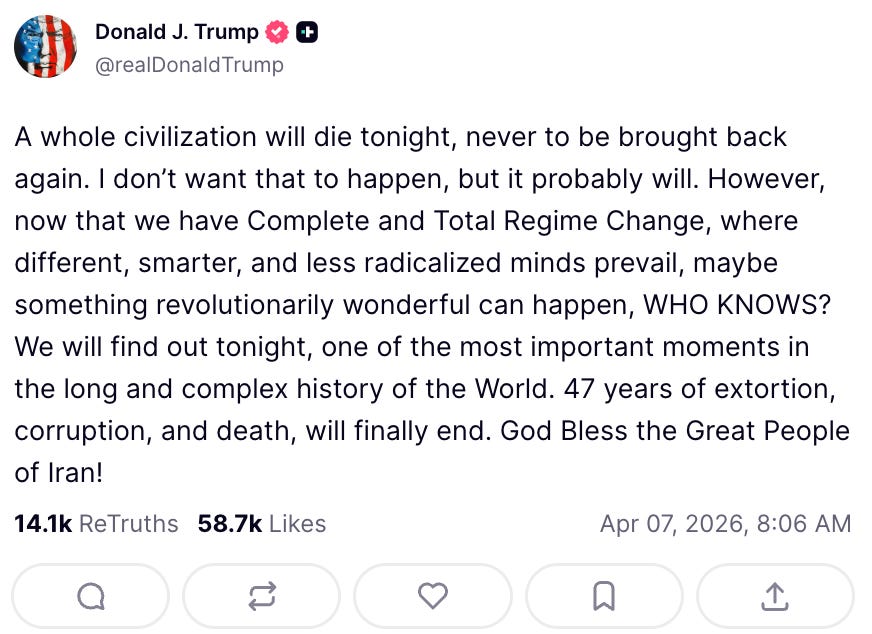
I didn’t want to put this idea out into the ether with a glib tweet or something until we got through last night, but this was, in my view, a not-so-thinly veiled nuclear threat. It was a little bit ambiguous, but nuclear threats usually are. And it wasn’t exactly that subtle. I mean, Trump literally said “a whole civilization will die tonight” and that this was “one of the most important moments in the long and complex history of the World”. Whether it was a credible threat was another matter. But I clearly wasn’t the only one who was thinking about the potentially existential stakes. Here was Garrett Graff, from the appropriately named newsletter Doomsday Scenario:
Is the chance that tomorrow at 8 pm ET Donald Trump launches nuclear weapons against Iran zero? Definitely not — and, regardless of whether that’s a one-tenth-of-one-percent chance or two percent or eight percent, anything more than zero is too high. I’d personally put the chance that Donald Trump uses a nuclear weapon against Iran at some point in the three percent range — which is a stunningly high number, given the history of nuclear weapons and the presidency.
I have no idea whether Graff’s estimate of a 3 percent chance of a nuclear strike against Iran was in the right ballpark or even how you’d go about calibrating such a forecast. But I don’t think Graff’s take was “alarmist”. There were really three scenarios: 1) Iran would back down; 2) Iran wouldn’t back down, but Trump would chicken out anyway; 3) Iran wouldn’t back down, and Trump would follow through on his threat.
I’m not sure whether we just experienced Scenario #1 or Scenario #2. But even if we had wound up in Scenario #3, a massive assault through conventional weapons was probably more likely than the literal nuclear option. And maybe if Trump had ordered a nuclear attack — or even something short of that — people in the chain of command would have regarded it as an unlawful order, refused to carry it out, and we’d be in some sort of constitutional crisis.
Even though we have pulled back from the brink — a two-week ceasefire was announced 90 minutes before the deadline — nuclear escalation had entered the realm of the thinkable, and that’s bad enough. I’ll tell you this much: I wasn’t eager to make plans last night.
I have a lot of respect for the intelligence and integrity of people who work in the military (not one of my more lib-coded characteristics). But Pete Hegseth has been firing senior commanders. He’s notoriously erratic and unqualified to lead the Department of Defense.
You shouldn’t feel too relieved
Sometimes, there’s an element of “heads I win, tails you lose” in media coverage of President Trump. He makes some sort of threat that every reasonable person thinks is a bad idea, and then he backs down. So he’ll be (appropriately) criticized if he follows through, but also criticized for chickening out.
Usually, it’s OK to feel some sense of relief when the worst consequences are avoided.
My point is this: I don’t think this is one of those times when you should feel particularly relieved. In fact, I think it’s pretty fucking irresponsible to either celebrate Trump’s strategic genius or troll him for TACO’ing.
Yes, a ceasefire is much, much, much better than the alternatives. No, I don’t know how long it will hold. Nor do I know how much Trump backed down as compared to Iran.
But this certainly isn’t some sort of 13-dimensional genius move. It reflects an unchecked Commander-in-Chief who was erratic on his best days, who is 79 years old, who was boxed into a corner, who has sycophantic advisors who are mostly too afraid to challenge him, and who once bragged that he could maintain approval from his base even if he murdered someone.
States with nuclear weapons have the ability to make a lot of bluffs. The expected value of a 3 percent chance of an infinitely bad outcome is still negative infinity. That’s why many countries, including, of course, Iran, have pursued the bomb.
And it probably does help Trump in some ways that he could be plausibly considered an irrational actor under “Madman Theory”, the term popularized by Richard Nixon. I doubt that a President Romney or President Haley or President Biden or President Harris or President Ocasio-Cortez would have used the same rhetoric, but if they had, it would have read differently.
There were, however, various ways this could have gone very badly, or still could go very badly the next time the “game” is played, and inevitably will go badly if we repeat the scenario often enough:
Even if he wasn’t eager to launch a nuclear attack, Trump could feel like he’d be humiliated or would lose credibility if he didn’t follow through. And having a reputation for chickening out might make those impulses worse.
Iran could have concluded the threat was empty — with the same overconfidence I’m seeing elsewhere tonight — when it wasn’t.
Even if Iran took the threat somewhat seriously, we don’t have a lot of evidence on how real human beings behave in scenarios like these. But there’s a pretty rich literature on how humans react very negatively to coercion and ultimatums and often seek revenge. Iran is also a literally decapitated regime — it’s not clear exactly who’s in charge — and might figure it didn’t have a hell of a lot to lose. And who knows about any political or religious motivations.
Even if nobody wanted further escalation, there’s inherently some risk in the fog of war. (See also: Thomas Schelling’s “Threat That Leaves Something To Chance”.) Some American sub-commander could have gotten his signals crossed, misinterpreted an order, or gone YOLO. Iran could have launched some sort of preemptive attack against American interests or against Israel (also a nuclear-armed state), and somebody might have panicked.
I’m not in the mood to get cute about this, so I’ll save the requisite poker analogy for the footnotes.1 But you don’t need to be some sort of game theory maven to appreciate that the small chance of a catastrophic outcome can outweigh the overwhelmingly likely but less than 100 percent chance of a trivial gain. And you need to understand that there can be some dangerous self-reinforcement from making “plays” like this because they almost always work. If you’re tempted to show the bluff and sit there with a smug smile on your face — “haha, suckers!” — that’s even worse because people will take you less seriously the next time around.
You do not want to play this game repeatedly. Nuclear weapons haven’t been around that long, and since Nagasaki, the world has been closer to the brink of nuclear weapons being used in combat than most people realize.
Suppose it’s the first hand of the World Series of Poker Main Event. You’re the first player to act against 8 opponents. Everyone paid their $10K entry fee and has 60000 chips. There’s 500 in the pot from the blinds. You go all-in with one of the worst hands in poker, seven-deuce offsuit.
Most opponents will (correctly) play very tightly against you in this spot; say, they’ll only call you with pocket aces or pocket kings. The chances of one of your eight opponents waking up with one of these hands is only about 8 percent. So 92 percent of the time, your all-in gets through and you win 500 chips. Hooray! However, the other 8 percent of the time, you’re in deep shit and will usually lose your 60000. Roughly, the way this works is: 92 percent of the time, you win 500, but 7 percent of the time you lose 60000. (And 1 percent of the time you go all-in, your opponent calls with AA or KK, but you get really lucky and beat him and win 60K instead.) The expected value of this play roughly -3000 chips. It’s a terrible, horrible, no-good move even though you win more than 90 percent of the time.
Even if they back down today, will this will encourage or discourage the Iranians from building their own bomb? I suspect that they'll try harder than ever to build their "pillar of fire" and if that doesn't work, they'll buy one from North Korea and park it in a van near the White House
Even in this piece, Nate manages to flaunt his caricaturized view of the left by suggesting that respect for our military is incompatible with liberal views. It is an unwillingness to sacrifice resources and lives recklessly; to ignore international norms and treaties; or to overspend on defense at the expense of fiscal discipline and/or investing in programs with higher marginal value that typifies modern liberalism. Maybe it's a throwaway comment, but it betrays the increasingly reductive, contemptuous view of "the Left" that renders much of Nate's work so seemingly out of touch with actual progressive views.