

Did Las Vegas get too greedy?
There's not a recession or a pandemic, but visitors are down almost 8 percent this year. What's going wrong?

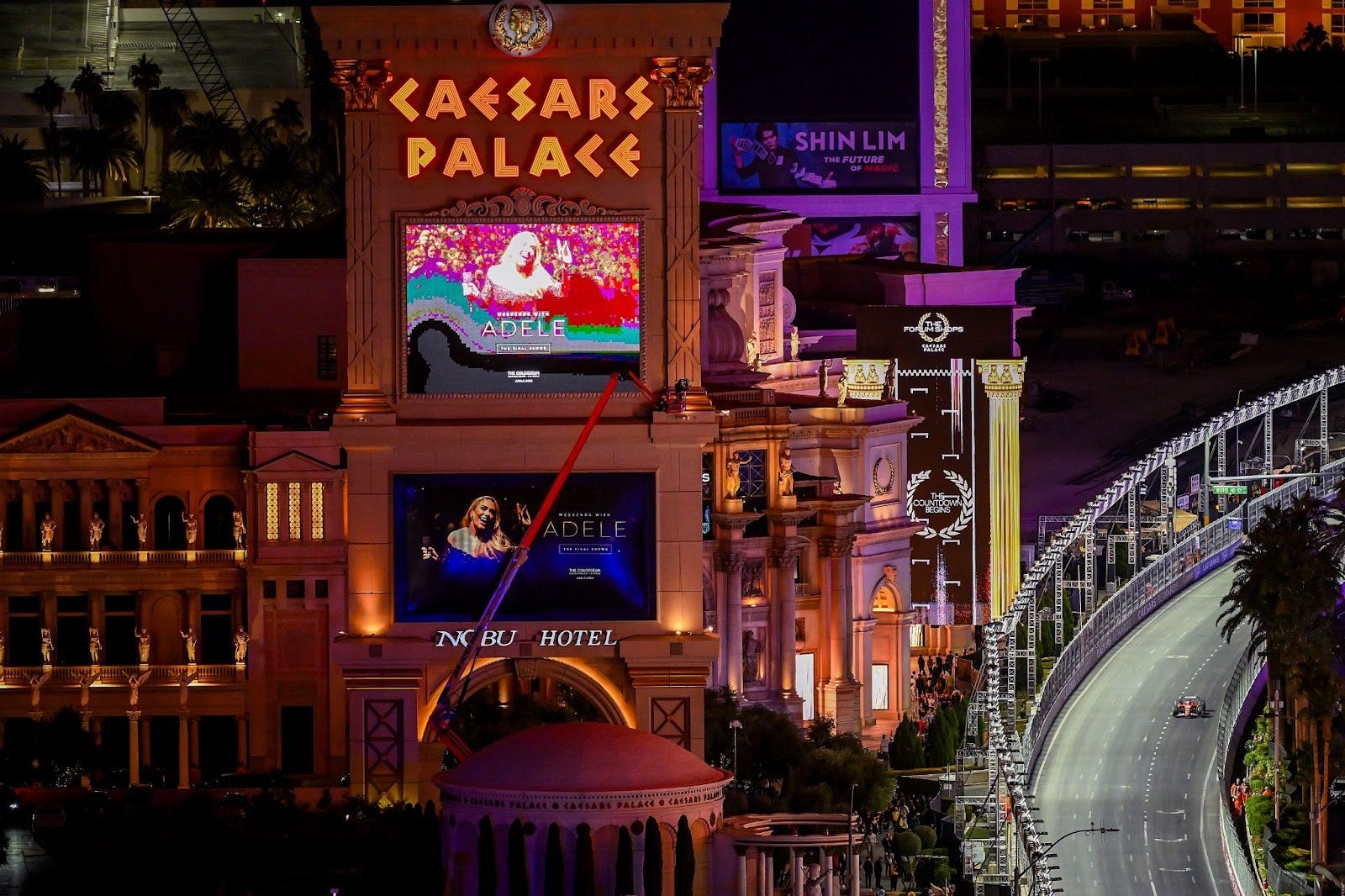
Las Vegas is capitalism in its most naked, sometimes exploitative form. I really like the city: off the Strip, it resembles other growing, diverse Sunbelt metros like Raleigh, Houston and Nashville, full of fantastic strip-mall restaurants and middle-class housing. But it also serves as a laboratory for economic experimentation.
And because state regulators obsessively track the gambling industry’s performance — tourism reflects more than a third of Nevada’s economy — Vegas is a surprisingly data-rich environment. So, for instance, we might ask questions like these: How much additional profit can you squeeze out of your customers before they rebel? Even if you’re doing it in ways that initially might be hard for them to notice?
A slump in tourism this year suggests that Vegas may have passed its saturation point. Once a town of penny slots and cheap buffets, Vegas no longer feels like a good value to middle-class consumers.
This is, I’ll admit, not precisely a contrarian theory. Complaints about how Vegas has become a bad bargain often pop into my “For You” feed. Nonetheless, I knew something was off when I booked hotels for my annual World Series of Poker trip late this spring. What constitutes “cheap” is a matter of perspective. But I know the Las Vegas Strip hotels and their typical price points extremely well. (There’s even a Las Vegas Strip hotel guide in a past SBSQ.) Everything was priced down a tier: rooms that would typically go for $269 a night were priced at $189, rooms that would cost $189 went for $109, and anything under that was basically being given away for free if you had any sort of casino status.
Despite these discounted prices, in June and July — the main months for the WSOP — visitor volumes fell by 11.3 percent and 12.0 percent, respectively, as compared to the same months in 2024, according to data from the city’s Convention and Visitors Authority. The year on the whole hadn’t been quite as bad, with tourism down 7.6 percent for the first ten months of the year as compared to January-October 2024. Still, the numbers are on pace to reflect the biggest year-over-year drop in tourist arrivals on record — except for the COVID year in 2020. The decline in revenues projects to be even steeper because the average daily room rate is off by 5.2 percent from last year, or roughly 8 percent after inflation.
“Gaming” revenues (the industry’s euphemism for “gambling”) have been sturdier: they’re up 1.1 percent year-over-year before inflation or down 1.6 percent after factoring it in. Still, this isn’t a particularly robust trend. It is primarily due to two categories: baccarat and mobile sports betting.
Baccarat revenues were up 18.4 percent in the 12 months ending in October 2025 as compared to three years earlier and adjusted for inflation. (From this point forward, all figures in this newsletter are inflation-adjusted unless stated otherwise.) But craps are down 8.2 percent, roulette is off 12.7 percent, and blackjack — the traditional choice of price-sensitive gamblers because of its relatively low variance and narrow house edge — has fallen by 16.4 percent.
What’s different about baccarat? Out of the “big four” table games (along with craps, blackjack and roulette), it’s the province of high-rollers: stereotypically often wealthy VIPs from Asia. So far this year1, the average baccarat table is generating $353,000 in revenues, as compared with $56,000 for blackjack, $95,000 for roulette and $129,000 for craps. So the high end of the customer pyramid is doing fine, while more and more blackjack tables sit empty.
Why the decline? Well, there are several factors. Vegas relies on good vibes, and consumer confidence has slumped. Reticence among some foreign visitors to travel to the U.S. hasn’t helped either. There’s been a particular decline from Canada, which was targeted by Trump’s tariff regime, although our friends from the north constitute only about 3 percent of overall tourist arrivals in Vegas.
It’s also plausible that we’ve shifted into a secular decline in interest in gambling. Almost certainly not as compared to the long term — the entire economy is becoming more “casino-ized”. But relative to the sugar high of the post-COVID return to normalcy, when consumers had unusually high cash on hand and a pent-up desire for “revenge travel”, perhaps we’ve reached a new, more risk-averse steady state. GLP-1s like Ozempic may even be a factor; in some studies, they reduce the urge to eat, drink and gamble — basically every indulgence that Sin City relies upon.
And Las Vegas is not merely banking on maintaining its current numbers but continuing to grow. The Singapore-mall-like Resorts World, which opened in 2021 on the north end of the Strip and where I stayed last month for a North American Poker Tour event, has persistently been in financial trouble. Fontainebleau opened a stone’s throw away in 2023 after years of delays, offering a bounty of good restaurants like a clone of LA’s Mother Wolf, but the casino floors there often sit conspicuously empty. And a new Hard Rock Guitar Hotel at the former site of The Mirage is set to open in 2027. If it’s anything like the version in Hollywood, Florida, perhaps the most opulent casino in the United States outside of Las Vegas, it will be counting on raucous crowds to pay back its $5 billion+ construction cost. But even if they come, they may cannibalize customers from other Strip resorts.
Are customers sensitive to worsening odds?
So, Luke Winkie’s terrific account of Vegas’s slump in Slate last month — a must-read for anybody interested in this subject — rang true to me. I was in Vegas particularly often between summer 2021 and summer 2023 while I was doing the bulk of research2 for my book. It was an invigorating feeling: Vegas rising from the ashes after the pandemic had literally shut down the Strip for several months. There were one or two occasions when passenger traffic at some of the chokepoints on the Strip was so dense that I was worried about what might happen in the event of some sort of emergency.
As Winkie writes, Vegas is hardly some ghost town. Living in Manhattan, I’m used to extreme human density, and the Strip is one of the few places in the United States that can rival it. Even with a modest decline in tourists, it’s still impressively busy. Still, the decline hits harder for workers like street performers and tour guides who target pedestrians and middle-class customers.
Winkie’s thesis is basically that the middle-class consumer is increasingly squeezed by both higher prices for rooms and amenities and worse odds at the table. He points out, for instance, the increasing number of triple-zero roulette wheels, which raise the house edge on every spin from 5.3 percent to 7.7 percent. Furthermore, the large majority of blackjack tables on the Strip now pay out 6:5 rather than 3:2 on blackjack. This change increases the house edge from just 0.4 percent (assuming otherwise favorable rules and that the player plays perfect basic strategy — most people don’t) to 1.8 percent.
Slot machines have also grown stingier. For On the Edge, I spoke with Gary Loveman, a Harvard Business School economist who somewhat improbably became the CEO of Caesars Entertainment. Loveman had bragged to me about how his customers were barely able to differentiate tight slots from loose ones:
Loveman was in an elevator going up to his room at the Harrah’s in Las Vegas when he heard a group of tourists from Atlantic City complaining. “They’re saying, Jesus, we can’t win anything on the slots here in Las Vegas. These slots are so tight, I can’t believe it. I wish I was back in Atlantic City.” Loveman knew better. At the time, Vegas slots were relatively generous, with a hold percentage of around 5 percent—that’s how much the casino keeps as profit, on average, of every pull of the machine. By contrast, New Jersey slots were much stingier, with a hold of around 7.5 percent.
So, Loveman “hired a group of mathematicians from MIT” to figure out how to squeeze more revenue out of his customers. At first, they hardly seemed to notice that anything was different. Slot machine revenues, adjusted for inflation, improved by 36 percent between 1998 and 2006, peaking at a record $10.8 billion that year.
But since then, inflation-adjusted earnings from slots have declined by 18 percent. The Great Recession represented a particular break point, with customers evidently becoming more price-sensitive. Still, hold percentages on slots have grown ever higher, including after the COVID interregnum, to a record 7.5 percent in 2024.
So Vegas customers are now wagering 32 percent less on slots than they did in 2006. The higher house edge helps curb losses, but not by enough to make up for the decline in betting volume.
But should this be surprising? I don’t doubt that Loveman’s strategies initially raised revenue for Caesars. The gambling industry, despite being awash in consumer data, had long been relying on folk wisdom. But consider the economics of this more carefully. The average Vegas visitor lost $266 on gambling last year, although the tourism bureau’s annual survey suggests they were willing to gamble more, bringing a larger budget with them of $820.3
Whether your budget is $266 or $500 or $820, you’re guaranteed to lose all of your money eventually in any game with a house edge, provided that you play for long enough. That’s why Vegas has long offered some games, like craps and blackjack, with relatively narrow house edges, and others, like roulette and slots, that can produce bigger wins for the gambler but on average run him dry more quickly. Different customers have different risk preferences. Either way, the house is probably going to get you eventually.
But when you lose your money more quickly, a few things happen. First, you may be faced with either blowing through your budget on your first day of your trip or having to make the embarrassing Walk of Shame to the ATM to withdraw more money, often paying a double-digit “convenience fee” for the privilege. Either of these is an embittering experience and may make customers stingier about their other expenses in Vegas, like dinners and shows.
Furthermore, customers might reconsider a return trip, especially when also faced with other humiliations in Vegas, like $8 bottles of Fiji water and ubiquitous resort fees. Vegas has long relied on repeat business. “They were all based upon the same principle. Make people feel special. Come to Las Vegas to live big,” Steve Wynn, who opened several of Vegas’s flagship properties, including The Mirage (RIP), The Bellagio and The Wynn, told me when I interviewed him for the book. “And they go home and … they’re happy and they tell their friends. If they get treated beautifully, they’ll come back next year and pay more for the inevitable increase.”
But while the Wynn and sister property Encore really do maintain a commitment to a superior customer service experience — that’s why they’re the top-ranked properties in my hotel guide — your treatment is more contingent on your status level (the gaming industry’s equivalent of frequent-flier programs) if you visit one of the many MGM or Caesars properties that dominate the Strip. With Noir or Seven Stars status, the world is your oyster — provided that you continue to gamble exorbitant amounts of money. Without it, you may face long check-in lines, higher-status customers cutting the queue at restaurants and myriad add-on fees.
If you know a few of the “hacks” that I do, Vegas can still be a relatively affordable destination. Doing some of your dining off-Strip, where the food is sometimes twice as good at half the price, is the most obvious of these; another really important one is being a little promiscuous about your hotel preferences because prices can vary a lot from week to week due to conferences and special events. And I know what I’m getting myself into. If I choose to pay $8 for Fiji or $12 for a Corona, I’ve priced my laziness about walking ten minutes to the nearest CVS or Walgreens into the equation.
But other customers will face sticker shock. As Winkie writes, Vegas once had a reputation for cheap thrills, with inexpensive rooms and buffets serving as loss leaders as you gave away your money slowly at the blackjack table. Now, however, only 35 percent of Strip revenues are generated by gaming (down from 50 percent in 1998). Almost everything in the casino is a profit center, to the point where you can sometimes feel like you’re in a Skinner Box experiment to spend as much money as possible in as short an amount of time as possible.
Data-driven profit optimization can be short-sighted
I used the term “greedy” in the headline, but I’m not any sort of committed anti-capitalist. Regardless of the morality of the system, it’s the one we’re living with, and I expect publicly-traded corporations like Caesars, Wynn and MGM to seek to maximize profits. People who travel to Vegas to gamble aren’t exactly the most innocent customers in the system either.
Still, I think the term “greedy” is appropriate when it describes short-term profit maximization at the expense of building long-term customer value, which can be harder to measure.
Las Vegas is at its best when it creates a feeling of abundance. Vegas gamblers are famous for burning the candle at both ends. But if at every interface you feel put out — the rooms are overbudget, the food is expensive, and the odds you face at the tables are tilted even further against you — you might reconsider your next trip.
More people coming home as winners — or at least not feeling like they were squeezed out of every penny — creates a more favorable word-of-mouth. It’s not hard to imagine a trajectory something like this. A guy returns with his buddies to Vegas and enjoys his first post-pandemic trip to its various dens of degeneracy in 2021. But on the next visit in 2023 or 2024, everything is marked up further, blackjack pays only 6:5, and everyone blows through their gambling budget before they even check into their rooms. Maybe Nashville next time?
Technically, for the 12 months ending in October 2024.
Maybe “research” should be put in scare quotes, but when you write a book about gambling, it’s not too much of a stretch!
Keep in mind that some percentage of tourists don’t gamble at all.
Often times, the "casino-ification" of the economy (beyond the specifics of Las Vegas) seems to suffer from the short-term-profits-over-long-term-value proposition. Sports leagues seems a great example of this. They work hard these days to extract maximum value from existing fans while often ignoring how these fans became so devoted in the first place. European Soccer's Super League idea fits into this box to me, as does a lot of recent choices the NBA has made. The whole-hog embrace of sports gambling by leagues across the spectrum surely also fits in here.
This is pretty compelling. I’m the type of visitor that Nate is focusing on - not wealthy, has fun gambling once in a blue moon but is budget conscious about it.
I haven’t been to Vegas since the kids were born - so over a decade now - but it isn’t impossible to imagine regular trips every year or two, like my buddies and I used to do.
But: just telling me that Blackjack now pays 6:5 instead of 3:2 is enough to keep me away. That’s the most fun part of the game! And when you add in everything else becoming actually expensive? Really forget it, as in “not even a non-gambling trip to see shows and relax” forget it. Being able to gorge yourself on food and booze without having to scrimp was a big part of what made it worth such a long trip in the first place. And EVERYONE HATES HIDDEN FEES. Hotels have to learn this.