

The profoundly weird race for Rookie of the Year
Dramatic late twists, stats versus vibes — and another test of what prediction markets really measure.

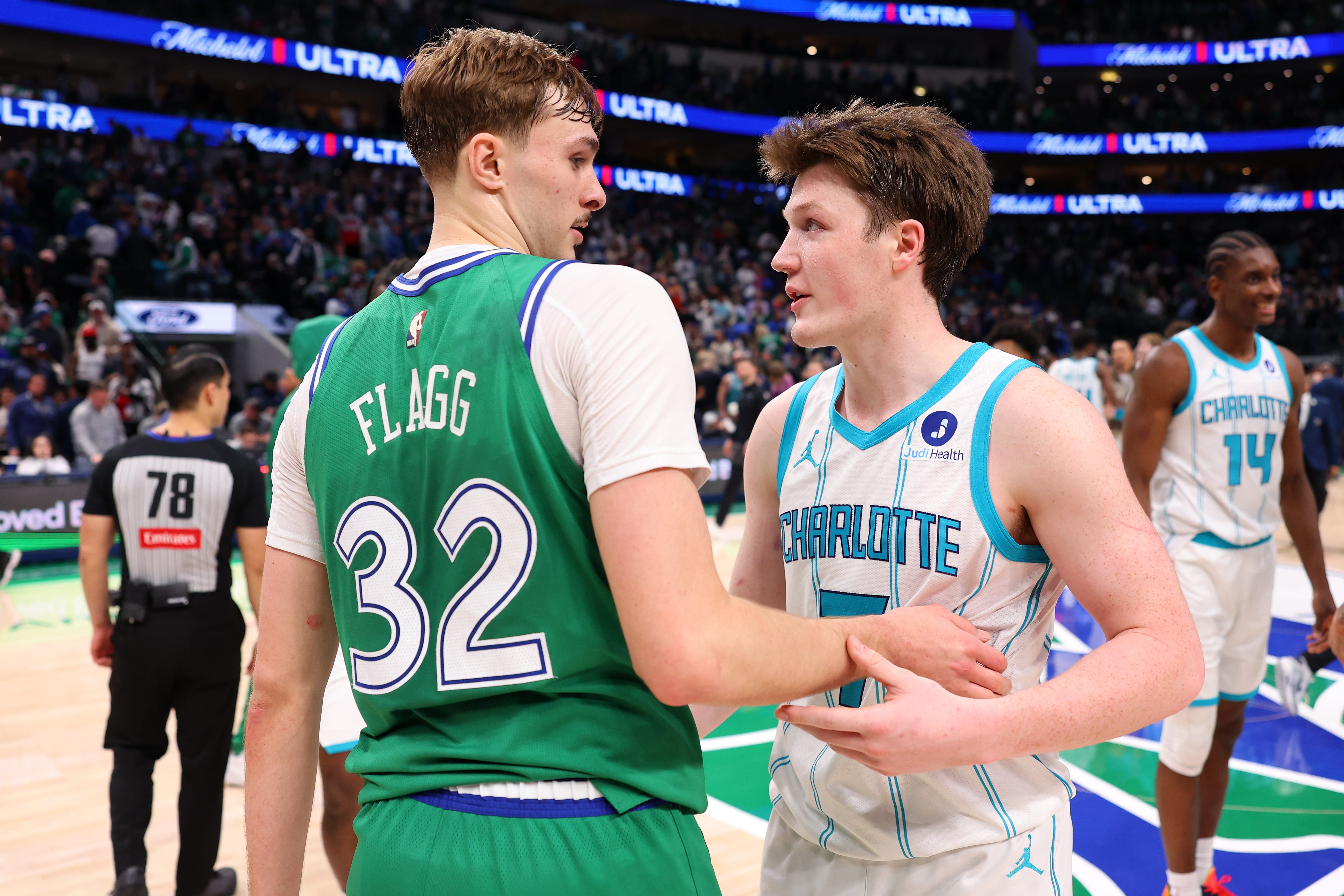
If you’re an avid listener of the Bill Simmons podcast1, you might have heard a recent bit he did with Zach Lowe, where they pondered whether this was the NBA’s weirdest season ever. For what it’s worth, excluding global pandemics, that claim has a lot of merit. The Clippers started the season near the bottom of the league amidst allegations they paid Kawhi Leonard 28 million dollars under the table; a gambling scandal led to the arrest of a coach and a player on the third day of the season; Bam Adebayo scored 83 points in a game; and fully a third of the league was literally trying to lose games.
It’s hard to say whether the weirdness has undermined the NBA’s effort to rebrand the league in a forward direction. With the league moving most of its games to NBC and Amazon Prime, the presentation has focused less on its legacy stars — Steph, Durant, LeBron — and more on its insurgent young core. The guy everyone wants to watch in the playoffs is Victor Wembanyama, not LeBron. But the shift has been backed by an influx of talent. I spent a lot of time analyzing this while building out our NBA draft model, PRISM, and it was hard to miss just how much talent has entered the league over the last few years.
This year’s Rookie of the Year race has been one of the best arguments for that explosion of talent — and, fittingly, one of the weirder ones we’ve seen in a while. Kon Knueppel and Cooper Flagg, former Duke teammates and roommates, traded the #1 spot on NBA.com’s Kia Rookie Ladder all season long. Flagg, the No. 1 overall pick (and the namesake for our college basketball model) has the highlights — 51 points against Orlando, a 42-point game in Utah before he turned 19, the kind of explosive, load-bearing performances that typically lock up the award. Knueppel, taken three picks later, has been the quieter storm: he leads the league in three-pointers made while shooting 43 percent from deep, and played a leading role in Charlotte’s leap from 19 to 43 wins. Flagg is ahead in counting stats per game across the board, but Knueppel has the efficiency and wins.
Is the stats case even close?
There have been attempts to flatten Knueppel's case into some version of "he shoots threes really well," which ignores the off-ball gravity, passing, defensive IQ, and the way he's made Charlotte's entire offense function differently. Flagg’s case is also bigger than “he’s dominating the box score on a bad team” and people should be accounting for poorer context — the chaotic situation in Dallas — which makes it harder for him to produce at the same efficiency as Knueppel.
This framing is not so uncommon in awards discussions — the player with higher counting stats against the player with higher efficiency — and this type of discourse tends to get fans riled up, which is probably why mainstream outlets love to play into it. Analytical types tend to frame basketball around impact, which cuts straight through the noise of trying to calibrate all of these stats. While I don’t think ranking players is as cut-and-dried as just taking some aggregation of their impact metrics, there isn’t really an argument for Flagg from a pure stats point of view. On a per-possession level, he lagged far behind Knueppel.
Voters aren’t answering the same question
Of course, there is an argument against advanced metrics here that isn’t just luddite pessimism — stats like EPM, part of a family of RAPM-type impact stats, don’t always do the best job of distinguishing between a player’s impact and the difficulty of their role. In fact, just the opposite: RAPM and its descendants measure how team-level point differential shifts when a player is on vs. off the court and implicitly tend to reward being on good teams. That’s genuinely useful, but it tends to measure how good a player is at the thing they’re currently being asked to do — as opposed to either how rare the thing they’re being asked to do is, or what they might be able to do in another context.
Knueppel’s role in Charlotte — moving without the ball, spacing the floor, catching and shooting threes within a functional offensive system — is considered an easier adjustment in the NBA. He averages under two dribbles per touch — whereas Flagg’s role in Dallas, which involves a lot of primary creation, high-usage shot generation, and running the offense as an 18-year-old on a team with no other reliable engine, structurally suppresses the efficiency numbers these models care about.
For what it’s worth, Rookie of the Year voters traditionally do care about how much of an advantage creator you are. Knueppel would have the lowest on-ball percentage of any Rookie of the Year since Karl-Anthony Towns won the award in 2016.
So, yeah, EPM can tell you that Knueppel's minutes are technically more productive than Flagg's, but that doesn't settle the vote the way some analytics people want it to. The strongest version of the Flagg case isn't really about counting stats or highlights. Rather, it's a reframing of what the award is measuring — that Rookie of the Year should go to the player who has adjusted to the NBA best, and under that lens, Flagg's case sharpens: he's 19 years old, carrying a bad roster as its primary creator, producing against elite defenders scheming against him every night, and doing it at a level only LeBron, Luka, and a handful of other all-time teenagers have matched.
Still, that framing is building in some implicit credit for potential — Knueppel would be a very valuable player with or without rookie status, while we can’t definitively say that about Flagg this year. And even if we adjust for playtype difficulty, Kon is still ahead of Flagg in efficiency.2
But some Rookie of the Year voters aren’t necessarily even answering the question of which rookie was the best player so much as taking their mandate to mean “who will be the best player?” — and under that criterion, Flagg takes the cake.
Advanced stats like eWINS are admittedly not for everyone. They expose some inconvenient truths: rookies usually stink on defense, and their shiny, high-volume box score production is often paired with middling (at best) efficiency. The arrangement is a win-win — the player gets seasoning and sneaker deals, while their teams remain comfortably within the lottery — so long as you don’t ask too many questions of the data. And most voters don’t. Jae’Sean Tate, for example, had the highest eWINS in 2020 and got zero first-place ROTY votes — most of his value came on the end of the floor voters aren’t paying much attention to.
This year’s race only halfway matches that template. Kon and Cooper have been roughly similar defensively by most advanced metrics — and both are rated as about league average, which is unusual and promising for a rookie. Yet Flagg carries the reputation of an elite defender because without enough signal in the box score, the media is defaulting to their priors about his long-term defensive projection.
There’s also a more subtle issue: when voters treat ROTY as a forward-looking judgment rather than a full-season retrospective, they naturally time-decay the regular season. Victor Wembanyama was clearly better than Chet Holmgren by the end of 2022-23, and voters treated that midseason leap as license to wipe away his early-season struggles.
All of this would be forgivable — maybe even commendable — if voters were actually good at picking the best future player. The problem is they aren’t: take a look at that table above. Tyreke Evans over Steph Curry? Or even Kyrie over Kawhi? ROTY voters have often systematically underrated the lower-drafted guy.
The prediction markets won't sit still
But what makes the race genuinely weird is a string of late reversals in the conventional wisdom — and an unexpected twist involving former ROTY Luka Doncic. When I first planned on writing about Knueppel, I was confident he’d more or less locked the award up, and as of a few weeks ago, the prediction markets agreed, giving him a 94 percent chance at the trophy. Then Flagg put together back-to-back statement games, and Knueppel’s odds cratered to as low as 21 percent.
Silver Bulletin has covered prediction markets extensively in the past.3 They’re often very smart, and they’re certainly not easy to beat. But as Nate wrote about the election of the new pope last year — Leo XIV had been trading at only 1 percent odds — they aren’t necessarily at their best when trying to anticipate the behavior of a cloistered group of insiders. Polymarket’s ROTY contracts have millions of dollars in volume, which don’t exactly approach something like its presidential election markets, but are also not the kind of market you’d expect to flip 50 points in a day.
The first thing worth flagging is that we actually do have information about how voters feel. Only a few days before Flagg’s big weekend earlier this month, ESPN conducted a straw poll of 100 media members, some of whom are in the pool that actually votes on the award. Knueppel received 80 first-place votes to Flagg’s 20. So we have a prior suggesting as of just two weeks ago, Knueppel had a decent lead over Flagg — a lead hard to eclipse even with a full week of regular-season dominance.
Tim Bontemps, the reporter who conducts the straw poll, said something interesting on the Hoop Collective podcast the other day — that an 80-20 split in a room of 100 voters doesn’t mean each individual voter is 80 percent sure. It’s more like a collection of 60-40 decisions that mostly broke the same way. That’s a good point, but let’s analyze it. The lower bound on what 80-20 means is that every single Knueppel voter was close to 51-49 and just barely tipped his way. The upper bound is that all 80 were completely certain. The vote count alone can’t distinguish between those worlds, and Bontemps is right that we shouldn’t confuse margin of victory with depth of conviction.
But we can actually test what happens between the straw poll and the real thing, because Bontemps has been running the MVP version of this poll since 2017. In seven seasons of MVP straw polls, the leader has won the actual award every single time. In 2021-22, Nikola Jokic’s straw poll lead of 62-29 widened slightly to 65-26 in the real vote. In 2020-21, his 89 percent straw poll share held almost exactly at 90 percent. The two most recent seasons did narrow slightly — Jokic went from 85 percent to 80 percent in 2023-24, and SGA went from 77 percent to 71 percent in 2024-25 — but neither came close to flipping.
The bull case for Flagg probably comes from 2022-23. That year, Joel Embiid led the straw poll, but it was essentially a tie: he actually had two fewer first-place votes than Jokic. When the actual ballots came in, Embiid won 73-15 in first-place votes. Despite the close straw poll, voters didn’t scatter — rather, they broke hard in the same direction.
Steve Aschburner, the NBA.com writer who runs the Kia Rookie Ladder and is himself a voter, published his final ballot on April 8th with Knueppel at No. 1, and directly addressed the weekend performances that swung the odds: the 96-point two-game stretch swayed oddsmakers, he wrote, but didn’t eclipse Knueppel’s body of work. Historically Aschburner’s Rookie of the Year ladder has correlated strongly with the actual vote share — his one recent miss being Evan Mobley over Scottie Barnes in 2022, which was decided by 5 first-place votes, the narrowest under the current format. Bill Simmons has also rallied around Knueppel. Two voters, neither of whom are necessarily advanced-stats truthers, have come out with their vote, and they’re sticking with Kon.
That raises another issue: Could there be some form of insider trading? It’s obviously not an out-of-bounds question. Still, the scope for it might be limited on this market — no single voter’s private knowledge of their own ballot moves the needle much in a 100-person electorate, and any conspiracy between media members to collude on voting would be difficult, especially before the ballots come out. Building sharp models in awards markets is also difficult — these are one-off events with small voting bodies, so there’s no clean way to build a model for an event where the criteria can shift with narratives and storylines.
The market has corrected multiple times since the initial flip, with Knueppel briefly reclaiming favorite status before Flagg snatched it back over the last few days. Kon didn’t help his case in the Hornets’ dramatic play-in win on Tuesday — he had one of the worst games of his career, capped by a late-game benching. Despite being the NBA’s leader in threes as a rookie, he was absent from the floor over the last seven minutes, even when the Hornets desperately needed a three to send them into overtime.
And yes, even though the play-in game isn’t technically part of the regular season — statistically, it exists in purgatory, since it isn’t part of the postseason either — it’s going to bleed into voter perception. Because of Luka Doncic’s minimum games appeal, ballots were delayed, and Knueppel’s performance on Tuesday might empower some of those wishy-washy 51-49 Kon voters to go with Flagg, even if that’s technically not within the criteria of the award. The market certainly believes that voters will be swayed — following Kon’s game, Flagg is now inching toward being almost a 3:1 favorite.
The prediction market feedback loop
It would be easier to map out this race if close Rookie of the Year races happened more often. Over the last twenty years there have only been two nail-biters — Scottie Barnes over Evan Mobley in 2022, which came down to a 15-point margin and is still the closest vote since the current format started, and Evans over Curry in 2010.
Everything else has been a blowout, or close enough to one that the discourse around it never really mattered. Wemby was unanimous, KAT was unanimous, Lillard was unanimous, and even the races that felt close at the time, like Ben Simmons and Donovan Mitchell in 2018, turned out not to be. Perhaps the closest precedent is 2007-08, when Kevin Durant took home the trophy despite significantly worse advanced stats than Al Horford, who helped lead the Hawks to the playoffs as an 8th seed. That would seem like bad news for Knueppel, but the voting body is different now, in that they’re more receptive to the use of advanced stats than in 2008.
So, historical analogue or not, when people look at the current market and say it's behaving weirdly, part of what they're picking up on is that we don't really have a reference class for what a close ROTY race is supposed to look like, especially between two players with such different profiles. Some of what looks like noise is just what happens when a binary outcome gets close enough that small inputs start to matter: every new game has more leverage in a way that doesn’t seem rational on the surface.
Of course, that’s really just another way of saying buzz is dominating a race that, on the merits, might not be that close. And maybe this is where the whole thing gets a little recursive. The “buzz” isn’t just a reflection of the race, it’s also an input into it. On one side you have a player who’s had a great rookie year, and on the other, a guy who looks like a future superstar, even if he was an outright negative earlier in the season. Those are different kinds of cases, and voters trying to be rigorous about their ballot are still going to get nudged by which story feels more compelling in a given moment. A 30-point Flagg game in March probably carries different weight than a 30-point Kon game because of what it implies about the next 5, 10 or 20 years.
Prediction markets potentially feed into the same loop. They’re aggregating information, but in a race like this, most of what they’re aggregating is the buzz itself — which podcasts said what, which highlights went viral. You know, the vibes. It’s not that prediction markets are broken per se, it’s that there’s just not much independent information for them to work with — so they end up measuring the zeitgeist and handing it back with the authority of a price.
Now, do I think Kon is still a good bet at 28 percent? I think so, because the vote trackers show a fairly close race, and the priors for him are pretty strong. Still, the ballot delay gives recency bias more room to breathe than it usually gets, and if Kon has another rough night tonight it’s going to get harder to shrug off his doubters. Two weeks ago I would’ve told you this race was over. While the underlying evidence from an 82-game season hasn’t changed very much, if Flagg is holding the trophy in a few weeks, I will no longer be surprised.
Yes, even spreadsheet dorks listen to The Bill Simmons Podcast.
The stat zTS%, created by the innovative databallr.com team, which measures true shooting percentage adjusted for playtype difficulty, loves Knueppel’s historic shooting splits and recognizes that his efficiency is not just a result of some other player’s creation.
Nate is an advisor to Polymarket.
Because role matters a lot in basketball, I think it's perfectly defensible for voters to choose a player with a bigger role when it's abundantly clear that the player is excelling far more than expected in that role. Picking Durant over Horford proved correct because it was clear Durant was being asked to do things beyond his skill set to prepare him for being a Superstar, which is really, really hard in basketball, and dragged down his stats quite a bit (while Horford was excelling at a limited role). The same could be said for Castle over Wells, Wemby over Chet, and Lamelo over Tate. Players shouldn't be penalized for bad stats when they are being asked to get better at really hard things
If you swapped their teams and Flagg was the Hornets' power forward, I wouldn't be shocked if his advanced stats were better than Kon's, because his defense would be much better, and his offensive shot selection would be boosted by easy looks in transition and from LaMelo. Kon, on the other hand, would be taking a bunch of contested 3s off the dribble, because the Mavericks wouldn't have any other creator, and his stats would look much worse.
Picking Kon is totally defensible - he is having an amazing season. But Flagg is doing an OK job at an impossible task as a 19 year old - that is also amazing (just in a different and harder to quantify way).
Maybe fix the FT% in the first table [fixed now]