

Why can’t California count?
The Golden State needs to bring its vote counting into the 21st century.


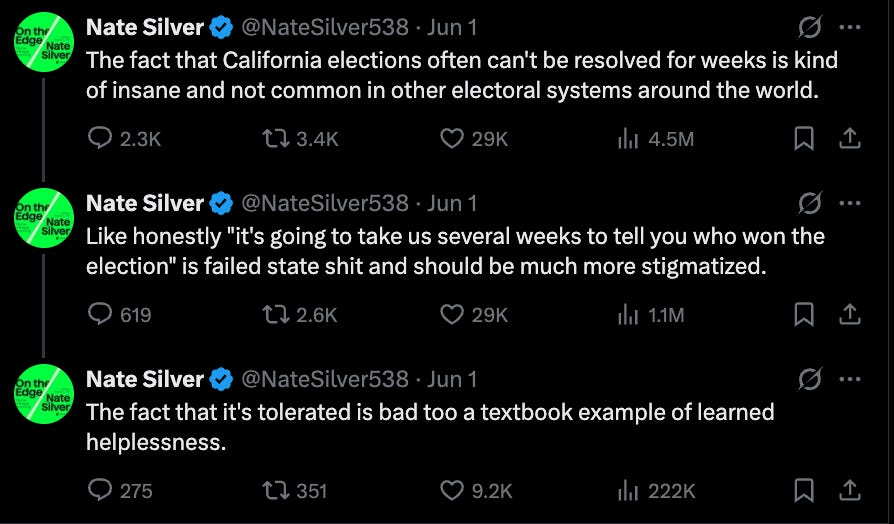
One mode we sometimes use at Silver Bulletin is “Nate’s bad tweets, explained.” (Here’s an example.) But when I expressed my frustration with California’s incredibly slow vote-counting process earlier this week, I was surprised at how little dissent there was from Democrats, Republicans, or pretty much anyone.
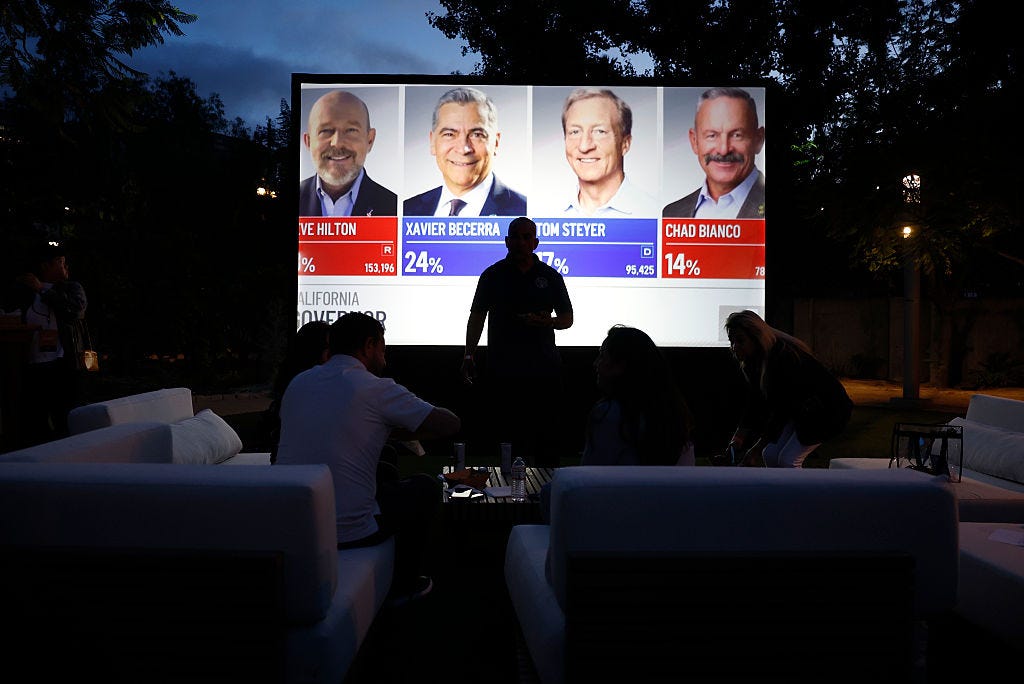
Of course, we might want to analyze the implications of California’s elections on Tuesday under the state’s top-two primary system. But we can’t do that because we’re on the third day since the election and the finish line is not in sight yet for several key races.
Rather than editorialize too much further, though, we assigned Eli to pull some data. Indeed, California is even more of a negative outlier than I’d realized. –Nate Silver
California has few (good) excuses for its slow vote counting
by Eli McKown-Dawson
It’s been three days since the polls closed in California’s primary elections, and we still don’t have race calls for governor, Los Angeles mayor, and for multiple salient US House contests. Did all of those races come down to a few hundred votes and get bogged down in recounts and litigation? Nope. Was there an earthquake or Succession-esque ballot fire that threw vote counting into chaos? Also no.
In fact, this outcome was entirely expected. And that’s the whole problem.
Before Election Day, many newsrooms put out similar articles explaining that tight races “could take days or even weeks” to call. That’s because California is notoriously slow at counting its ballots. In 2024, it took California until November 8 (three days after Election Day) to get just 70 percent of its ballots counted. Across all 50 states, the average share of the vote counted by that date was more than 95 percent, putting California squarely in last place. Rest assured, The Golden State did eventually hit that 95 percent mark… a full 10 days later.
Of course, statewide general elections — like those for president, governor, and US Senator — are called quickly in California, even though the vote count is slow, because the state isn’t particularly competitive. But close races are another story. In 2024, races for California’s 22nd and 27th districts took a week to call1 — and the 13th District took about a month! The country has frequently had to wait on California to see which party won control of the House.
That would seem to indicate there are major issues with California’s election administration, or at least some minor issues that need improvement, right? Not according to California Secretary of State Shirley Weber.2 “I know the value of being fast for some folks,” she told CalMatters. “For me, accuracy is far more important.” She’s not alone. There’s an attitude in some (mainly Californian and mainly Democratic) circles that California’s slow vote counting is indicative of a state that takes its time to carefully count every vote and ensure maximum accessibility. Here’s Democratic gubernatorial candidate Tom Steyer on election night: “It might take some time to figure out where this is going. We’re going to wait until every ballot is counted. We’re going to give democracy time to work.”
To be fair, there are real reasons why you’d expect California’s count to take longer than other states. One explanation you’ll hear often is that the state is massive. With nearly 40 million residents, California would rank as the 4th largest economy in the world if it were treated as a country. Los Angeles County alone has a larger population than 40 states. California also sends a mail ballot to every registered voter and most voters — about 80 percent in 2024 — do choose to vote by mail. Those ballots take more time to tabulate, in part because election workers need to verify that the signature on each mail ballot matches the signature on file for that voter.
And California is quite permissive about when those mail ballots need to arrive. As long as the ballot is postmarked by Election Day, it can arrive up to one week later and still be counted. That means election offices will be getting new primary ballots to count through next Tuesday. Those late ballots don’t just slow down the count; they can also produce strange-looking results with blue or red skews. In this primary, Democrats on average returned their ballots later than Republicans, so the first-counted results from Election Day and early mail ballots were significantly redder than the eventual final result will be.
But none of these factors have anything to do with the accuracy Weber cares about. Vote tabulation is highly accurate across all 50 states, even those that manage to count everything on election night. And none of them are particularly good enough excuses to explain the extent of California’s slowness.
I went to college in another large state: Florida. When you talk to election officials in The Sunshine State, the 2000 election always looms large. Aside from butterfly ballots and recounts, the big story is how Florida’s election administration improved after that trainwreck. Fast forward 25 years, and Florida now manages to count 99 percent of its ballots within a few hours of polls closing, in part because election officials can process ballots before the polls close. And they are able to accomplish this feat of incredible speed with a sizable proportion of mail votes — about 27 percent in 2024.3
California is a massive outlier relative to other states and other countries
California likes to tout that it’s larger than many countries, but most developed countries are able to wrap up nationwide elections more quickly than California can tabulate its votes. Colombia held a presidential election on Sunday, and 99.98 percent of the result was in on Monday morning. Japan also counts most of its votes overnight.4 And in the UK (not exactly a poster child for state capacity), you can generally expect to have calls for all 650 parliamentary seats the morning after the election.
How about India? It’s one of the few places that can claim to have even more complexities than California. In fact, elections there are conducted in multiple stages. But it did manage to count 640 million votes in a day in 2024 once the final phase was over.
Indeed, the more you scrutinize this, the fewer excuses California has. It is not the state with the most mail voting, nor is it the state with the latest mail ballot return deadline. Mail-voting states such as Oregon, Washington, and Colorado count slowly relative to the US average, but they’re all faster than California.
As The New York Times Editorial Board pointed out earlier this year, Colorado is able to mail ballots to all registered voters while maintaining speedy counting in part because it limits late ballots to exceptional circumstances (such as military troops outside the state). That might sound “uninclusive,” but the share of California ballots rejected for lateness moved from just 0.5 percent in 2012 (before the one-week grace period was implemented) to … the exact same 0.5 percent in 2022. You can make voting accessible without bending over backward to accommodate the tiny share of people affected by extending the mail ballot receipt deadline.
What about accuracy and overall quality of election administration? California comes up short there too. There’s no evidence that voter fraud or other election administration issues are any less prevalent in California than in faster counting states. Based on the Elections Performance Index — a project that compares election administration quality across states — California ranked 41st in 2024.5 So the state isn’t slower and better: it’s slower and (often) worse.
Slow counting fuels conspiracy theories
The fallback argument is that speed just doesn’t matter, and the only people who care about California’s weeks of counting are election junkies (guilty as charged) and conspiracy theorists worried about voter fraud. Of course, that’s true to some extent. Many Californians are fine with their timely presidential and statewide decisions, and don’t care that the insurance commissioner primary still hasn’t been called. But these delays do contribute to voter fraud conspiracy theories. Don’t believe me? Here’s the President of the United States early yesterday morning:
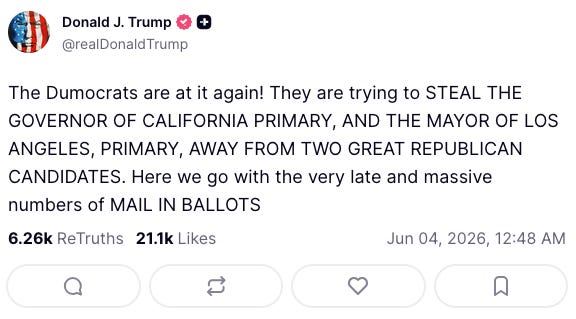
In a rare moment of bipartisanship, Gov. Gavin Newsom agreed, writing in a letter to election officials that “We must acknowledge that the longer the voting count takes, the more mis- and disinformation spreads.” Intuitively, that makes sense, especially when there’s a partisan dimension to when voters return their ballots. It’s unlikely that Democrats will get locked out of California’s 6th district, but right now, the Democratic candidate is in third place because only 53 percent of the vote is in. That’s confusing if you aren’t glued to election Twitter. There’s also evidence that longer-than-expected vote-counting times can reduce trust in elections.
It doesn’t have to be this way. And the solution is not to stick your head in the sand and say that anyone who complains about California’s sluggishness is fueling conspiracy theories. The state has taken some baby steps — counties now have to finish counting most ballots in 13 days instead of 306 — but it’s not nearly enough. Even putting aside inclusivity concerns, California simply counts the ballots it has too slowly, and its elections offices are underfunded. If you want people to be confident in your electoral system, a good first step is to build one that works properly instead of adding yet another example to the “California is a failed state” pile.
CORRECTION: This article originally stated that the 22nd and 27th districts took weeks to call, but they were actually called after one week.
Weber is running for reelection and her primary has been called. Although with only 60 percent of the vote it, that mostly comes down to there only being two viable candidates to begin with.
For those concerned that this sort of speedy counting could lead to inaccuracy, Florida also has a robust post-election auditing procedure.
To get an idea of the speed we’re talking about, some municipalities couldn’t start counting until the day after Election Day in 2017, but the “latest to finish counting in conducted 2017 was the Aichi Prefecture city of Nishio, at 9:55 p.m. on the day following election day.”
The index is based on measures such as turnout, data completeness, registration/absentee ballot problems, audit requirements, mail ballot rejection rates.
Although, the change apparently does not apply to the ballots that take longest to count such as “those filed by voters who registered on election day and those where a signature doesn’t match what’s on file.”
I don't disagree with the premise here, but I wish it included more analysis of what the specific failings of California in particular are and how they could be fixed.
I see a lot of people complain about this, but I don't get a lot of substance. Is this purely a function of the late ballot mailing deadline? Are you suggesting that be changed? If not, what are the counting barriers? Is it technology? Do they not start counting early enough? Is it purely a matter of resources and personnel?
All of that would be more useful than just calling California a failed State.
Setting aside the bluntly, absolute bullshit excuse that California counts slowly "to ensure accuracy", what is the excuse for such a high tax state that doesn't fund it's elections well. They can wax poetic about having a big enough GDP and population to be a country, but that just means you have the tax base to do better.
I genuinely do not get the appeal of living in California unless you are rich. While I personally would not want to live in a high tax blue state, I can concede that states like Massachusetts have fantastic education, healthcare, and infrastructure. But California has stupidly high taxes, yet it counts votes literally weeks after everyone else, it can't finish it's famous high speed rail project, and it's schools are middle of the pack compared to the other states. What the hell are you people paying for?
When the other 49 states all do noticeably better, what's the excuse? It's not a blue or red state problem, a rural or urban state problem, rich or poor state problem, it's JUST California.