

Who should your team take in the NBA draft?
The 2026 NBA draft is the deepest in years. Here's how I'd pick the lottery — if you made me GM of every team.

Joseph’s story today is intended as a companion to our PRISM NBA prospect ratings, and PRISM has also been updated with additional data and player commentary since its initial release. Go check out PRISM! -NS
It's easy to forget, given the incredible games we've been gifted this postseason and the carnage that Knicks have caused to the rest of the Eastern Conference, that the most pivotal moment of the NBA season takes place on a random afternoon in May — when deputy commissioner Mark Tatum strides onto a stage with a stack of envelopes, ready to smile while some fanbases realize a year of struggle was for nothing and others celebrate a potential future of perennial contention. Seated in the audience are the draft prospects, the coveted prizes that the front office executives, also in attendance, throw away entire seasons for.
Despite its funkiness, the lottery is perhaps my favorite event of the year. Even beyond my interest in prospect evaluation, it’s one of the few times the NBA honestly focuses on team-building, acknowledging both the decision-making and, yes, the luck required to take a team from sitting in that audience to hosting a playoff game in May. This year’s lottery felt more special to me than any other — I spent an inordinate amount of time on the draft given my work on PRISM, and I felt like I had a vested interest in the order despite my favorite team, the Spurs, not being in the bottom fourteen for the first time since 2019.
The actual TV presentation of the lottery reveal is pretty unnerving. I’m surprised there hasn’t been a Key and Peele sketch on the prospects’ awkwardness as they realize they may have to spend the next five years in Memphis or Utah instead of Miami or Los Angeles. Last year’s lottery reveal had Cooper Flagg making the biggest “this-had-to-be-rigged” face as the Mavericks won the rights to select him #1.
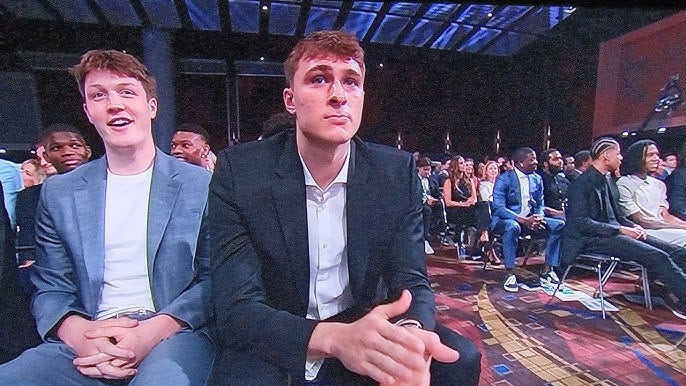
No prospect should feel certain of their destination this year, even if there’s a loose ordering as of right now. My work on PRISM only confirmed this: Cameron Boozer, the projected #3 pick, is ahead in my model by a lot but is unlikely to be selected with the first pick. That makes the 2026 draft unusual — it has so much more top-end talent than a typical class that the team holding the first pick could capitalize and grab additional assets in a trade-down. The lottery results only increased the probability of that happening. The Washington Wizards, who won the lottery, have reportedly been exploring trade options given their comfort level with any of three or four prospects: presumably AJ Dybantsa, Boozer, Darryn Peterson, and Caleb Wilson.
This uncertainty creates diverging scenarios. Depending on your flavor of scouting — I tend to focus more on production, for example — the draft could play out very differently from how I’d run it if I were picking everyone myself.
But that’s what today’s story is intended to highlight. It’s not a “mock draft” or a projection of who teams will pick. It’s who I think they should pick, considering PRISM ratings and team needs.1 Because I’m essentially making myself the GM of all 30 teams, I’ve resisted the temptation to make trades. In real life, I’d trade down if I were the Wizards because I value Boozer more highly than the consensus, but I’m imagining that most of the other 29 Joseph-run teams would also have Boozer #1 on their boards, making deals much harder to find.
The “who they’ll probably take” picks below are based on the consensus mock draft.2 An asterisk by the player’s name indicates the team can’t take their mock-drafted player because they’re already off the board in my draft.
1. 🧙 Washington Wizards
Who they’ll probably take: AJ Dybantsa
Who they should take: Cameron Boozer
The Wizards landed the first overall pick in a somewhat anticlimactic NBA draft lottery, their first win since they nabbed John Wall in 2010. Fun fact: it’s actually Anthony Davis’ THIRD draft lottery win; he was on the Pelicans’ roster in 2019 when they won the Zion Williamson sweepstakes and the Mavericks last season when they picked up Cooper Flagg.
This year’s draft doesn’t have a consensus best prospect the way those ones did, but in the analytics camp, one prospect seems to reign supreme over the others. While there are legitimate gripes with Boozer — he doesn’t project as a rim protector and he gets away with a bunch of travels on his post-ups — it’s hard to ignore this level of dominance from a freshman. He essentially plays as a wingified version of Nikola Jokic, and I expect that to continue as he develops. Yes, I’m aware that’s a lofty comparison, and I’m not saying I expect Boozer to be as good as Joker, but the typecasting of Boozer as a Kevin Love or Al Horford-plus player probably understates his ceiling even if those are reasonable comps.
Boozer will never truly be a poor defender because his strength can help on lighter players trying to drive past him, and because he’ll enter the NBA as the best rebounding wing in the sport. Even if Boozer’s scoring never becomes the main draw of his game, his ancillary skills should be more than enough to make him the best value proposition in the draft. PRISM, I’d note, also focuses on a player’s production over his first seven seasons, when he’s most likely to be on a discounted or otherwise reasonable contract. Sometimes that tilts it a bit toward older players — but Boozer won’t turn 19 until a month after the draft.
The Wizards shouldn’t really be drafting for fit in the first place, but they especially shouldn’t be scared off just because their two best players (Sarr and Davis) are occupying both spots of a double big lineup. Boozer isn’t supposed to be in those spots, projecting more a as an oversized ‘3’, and the Wizards might actually make a playoff push next season if they found a way to incorporate Boozer as a small forward.
Perhaps understanding their optionality, the Wizards have been somewhat secretive thus far on what they plan to do with the pick. They have a budding analytics department and I wouldn’t be surprised if Boozer is on the top of their board and they’re looking for options to trade down, especially since AJ Dybantsa (currently mocked at #1) is coveted by more than a few teams in the lottery this year.
2. 🎷 Utah Jazz
Who they’ll probably take: Darryn Peterson
Who they should take: AJ Dybantsa
It’d be reasonable to assume that the Jazz really want AJ Dybantsa — their owner, Ryan Smith, is a BYU alum, and it’s not everyday that a top draft prospect prefers to live in Utah. In the world where I’m the GM of every team, this works out cleanly — I think Dybantsa is either the second or third best prospect in the class, and the Jazz would look very tantalizing with Dybantsa, Lauri, JJJ, and Walker Kessler in a humongous lineup.
Dybantsa’s combine measurements were super appealing — he measured in at just around 6’9 barefoot, making him a legitimate ‘big wing’, but the concerns about his defense remain. Here’s a disconcerting fact: Reed Sheppard had twice as many blocks as AJ Dybantsa did during their freshman seasons. It’s hard to ignore something like that, even if Dybantsa’s scoring profile is one of the most robust in recent memory. As Jeremias Engelmann wrote, he has some of the signatures of a high-volume, medium-efficiency, middling-defense player who can turn into a quagmire on a bloated contract later. With that said, there are few true can’t-miss prospects on the Flagg tier and PRISM does grade Dybantsa as a “superstar”, a rating that might make him #1 in a weaker draft.